
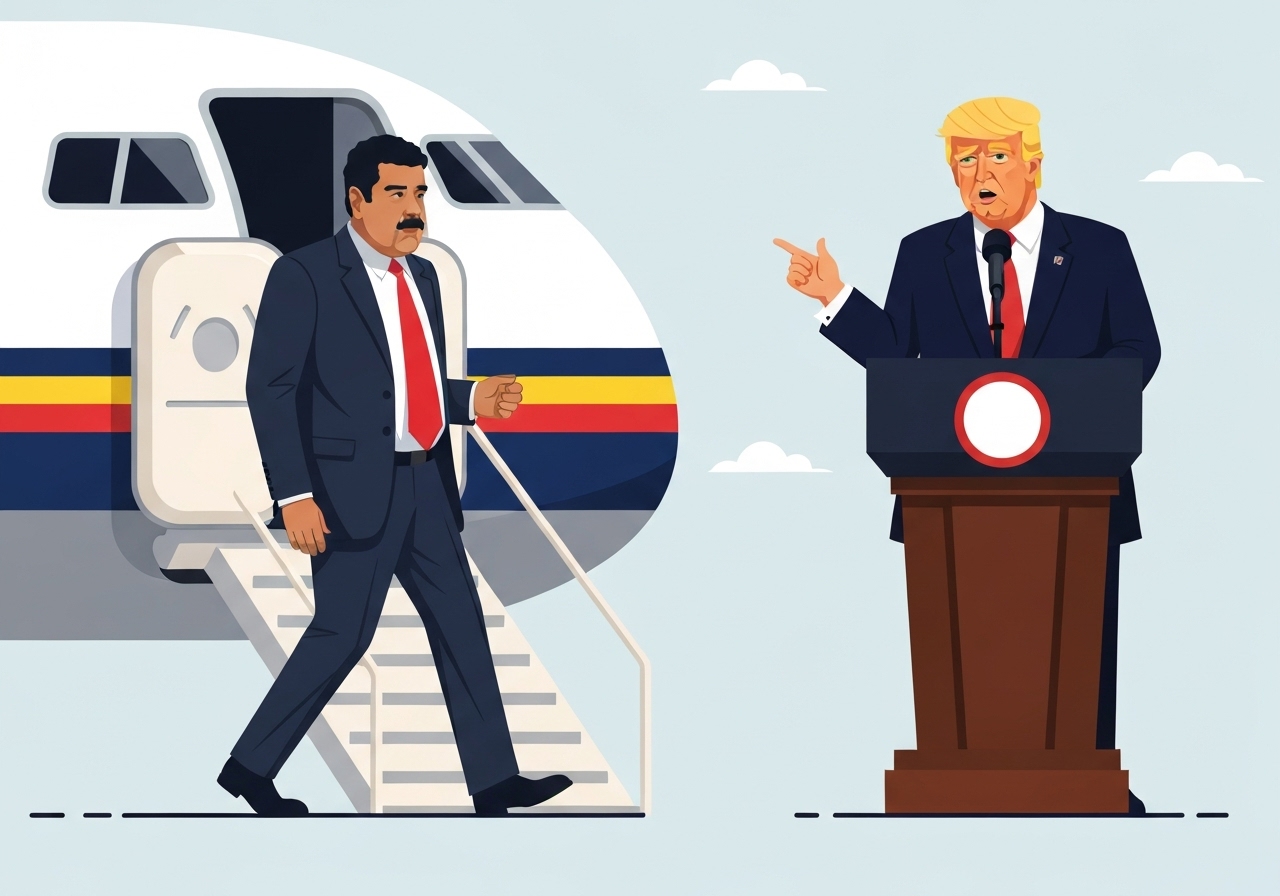
Lead: On Jan. 3–4, 2026, Venezuelan President Nicolás Maduro was captured during a U.S. military operation in Caracas and transported to the United States, where he arrived in New York to face federal narcotics-related charges. The White House said the operation — backed by the Department of Justice and U.S. special operations forces — removed Maduro from power and that the United States will “run” Venezuela temporarily while a transition is arranged. Venezuela’s Supreme Court declared Vice President Delcy Rodriguez acting president; international governments and U.N. officials responded with alarm and calls for restraint. U.S. officials reported no fatalities among American forces, though some service members sustained non‑life‑threatening injuries.
Key Takeaways
- Operation timeline: President Trump approved the mission late on Jan. 2; U.S. forces launched aircraft from about 20 bases and deployed more than 150 aircraft as part of the mission called Operation Absolute Resolve.
- Capture and transfer: Maduro and his wife were taken from a Caracas compound (reported at Fuerte Tiuna) and moved first to the USS Iwo Jima and then to New York; Maduro arrived at the Metropolitan Detention Center (MDC) in Brooklyn at roughly 8:52 p.m. ET on Saturday.
- Legal exposure: A superseding indictment in the Southern District of New York accuses Maduro of narco‑terrorism, conspiracy to import cocaine and weapons offenses; the case echoes charges first brought in 2020.
- Domestic political fallout: Congressional leaders from both parties expressed concern about legal authority and notification, with Democrats planning war‑powers and oversight actions and some Republicans defending the operation as law‑enforcement coupled with military support.
- Regional and global reaction: Russia, China, Iran, Cuba and other states condemned the strikes; the U.N. Secretary‑General warned the action risks setting a dangerous precedent and called for restraint.
- Human and infrastructure impact: Caracas experienced explosions and damage to military facilities; reports noted damaged buildings and families cleaning debris in La Guaira state after blasts associated with the operation.
Background
Nicolás Maduro has led Venezuela since 2013 and was declared winner of a contested 2024 election that drew international criticism and sanctions. The United States has pursued a multi‑front pressure campaign for months: repeated strikes on suspected drug smuggling boats in the Caribbean, seizures of oil tankers alleged to be carrying sanctioned cargo, an oil blockade on Venezuelan exports, and stepped‑up indictments and rewards targeting Maduro and senior associates. In March 2020 federal prosecutors in the Southern District of New York unsealed charges accusing Maduro and others of narco‑terrorism and drug trafficking; U.S. authorities doubled their reward for information on Maduro to $50 million in 2025.
U.S. officials framed recent actions as law‑enforcement efforts supported by military capabilities to ensure mission success and force protection; critics see them as escalations toward regime change. Domestic political debate has centered on whether the executive branch had sufficient legal authority and whether Congress was properly briefed. Regionally, neighbors and international organizations warned that kinetic action on Venezuelan soil could destabilize the hemisphere and provoke wider diplomatic and security crises.
Main Event
According to U.S. briefings, the mission began with air and maritime movements from multiple bases across the Western Hemisphere; helicopters carrying an extraction team flew at low altitude toward the Caracas area under cover of escort aircraft and supporting drones. U.S. officials said air defenses were neutralized ahead of the insertion and that the force — which included law‑enforcement agents and U.S. special operations personnel — reached a compound where Maduro and his wife were present. The extraction reportedly met small arms fire but achieved its objective: Maduro and Cilia Flores were taken into custody and placed aboard U.S. assets.
President Trump publicly described the operation as ‘‘extraordinary’’ and said Maduro was ‘‘taken’’ to U.S. custody to face American courts. Officials said Maduro and his wife were moved to the amphibious assault ship USS Iwo Jima and flown to Stewart Airport near New York, where federal authorities assumed custody. The Maduros face a superseding indictment in the Southern District of New York that mirrors earlier narco‑terrorism allegations and adds weapons counts in the 2026 filing.
On the ground in Venezuela, the government declared a state of emergency and called supporters into the streets. Caracas and several military installations — including Fuerte Tiuna and La Carlota airbase — were reported struck. Venezuela’s Supreme Court issued an order naming Vice President Delcy Rodriguez acting president for 90 days to guarantee administrative continuity. Photographs and witness accounts described charred vehicles and structural damage at military sites; some civilians reported homes with gaping walls after blasts.
Analysis & Implications
Legal and constitutional questions are immediate. U.S. lawmakers and constitutional scholars differ over whether the operation required prior congressional authorization. Supporters argue the mission was a law‑enforcement arrest of indicted fugitives with military assistance and relied on operational secrecy to succeed. Opponents contend that cross‑border kinetic military action to depose or remove a foreign head of state implicates the War Powers Clause and long‑standing norms about use of force without congressional debate or a declaration.
Geopolitically, the action reshapes calculations in Washington and in capitals that have backed Maduro. Moscow and Beijing condemned the operation, and diplomats warned of reciprocal justifications for unilateral seizures or abductions in future crises. That risk is central to critics who say a precedent that permits large states to seize foreign leaders on criminal allegations could erode international order and invite mirror actions by rivals.
Economically and strategically, President Trump’s repeated emphasis on Venezuela’s oil — calling for reconstruction of infrastructure and sales of petroleum — raises questions about control, contracts and revenues. Practical challenges include securing oil fields and pipelines, staffing technical operations, preventing sabotage, and navigating sanctions and international legal limits. Even if the United States aims to facilitate new elections and a transition, the security and governance demands of running a complex, oil‑dependent state are profound and costly.
Comparison & Data
| Item | 2020 Indictment | 2026 Superseding Indictment / Operation |
|---|---|---|
| Primary charges | Narco‑terrorism, drug trafficking | Narco‑terrorism, drug importation, weapons counts |
| Notable defendants | Maduro and senior officials (2020 filing) | Maduro, Cilia Flores, son, ministers, gang leader (superseding names echoed 2020) |
| Reward for information | Previously offered; increased in 2025 | $50 million (U.S. government) |
| Operational scale (U.S. description) | — | Extraction force, Delta Force involvement; >150 aircraft; launches from ~20 bases |
Context: The table highlights continuity between the earlier criminal case and the latest legal action while noting the military scale of the 2026 operation as described by U.S. officials. The numbers for aircraft and bases come from U.S. briefings; some operational details remain classified.
Reactions & Quotes
Many U.S. lawmakers voiced swift reactions reflecting bipartisan unease about legal and strategic consequences. Senate Democratic leader Chuck Schumer warned that using force without Congress invites bleak historical lessons about nation‑building costs; others hailed the tactical success while questioning the long‑term plan.
“You don’t treat lawlessness with other lawlessness,”
Sen. Chuck Schumer (Democrat)
The White House framed the mission as necessary to bring an alleged criminal to justice; Secretary of State Marco Rubio and other administration officials described the action as law‑enforcement supported by military precision and emphasized options remain for the administration.
“This was a law‑enforcement function supported by the Department of War,”
Secretary of State Marco Rubio (statement)
International officials expressed alarm. The U.N. Secretary‑General called the operation a worrying escalation and urged respect for international law; Russia and China condemned the strikes as violations of sovereignty.
“Deeply alarmed by the recent escalation… a dangerous precedent,”
U.N. Secretary‑General spokesperson
Unconfirmed
- Precise congressional notification timeline: several lawmakers say they were informed only after operations began; official explanations differ and some claims about who knew what remain under review.
- Details of alleged “off‑ramps” offered to Maduro prior to the operation, including locations or terms, have not been publicly documented.
- Full casualty counts and the complete list of damaged civilian infrastructure in and around Caracas are still being compiled; independent verification is incomplete.
- The practical mechanics and legal authority for any U.S. management of Venezuelan oil operations remain unannounced and unconfirmed.
Bottom Line
The capture and transfer of Nicolás Maduro to U.S. custody marks an extraordinary escalation with immediate legal, diplomatic and security consequences. On the one hand, the operation delivered a tactical outcome: a long‑sought indictment carried out and a high‑profile defendant inside U.S. courts. On the other hand, it created substantial political fallout at home and abroad — raising constitutional questions about presidential authority, sparking demands for congressional oversight, and prompting international leaders to warn against a precedent that might be exploited elsewhere.
Watch next steps closely: scheduled court proceedings in the Southern District of New York, actions by Venezuela’s interim authorities and military, responses from major international actors (notably Russia, China and neighboring states), and legislative moves in Washington (war‑powers resolutions, oversight hearings). How the U.S. intends to translate short‑term control into a viable, lawful transition in Venezuela will determine whether this episode is judged a narrow enforcement action or the start of a prolonged and costly political involvement.
Sources
- CBS News — News: original live coverage and timeline of events
- Reuters — News: international reaction and diplomatic reporting
- The Associated Press (AP) — News: on‑the‑ground effects and eyewitness accounts
- U.S. Department of State — Official statements and briefings
- United Nations — U.N. spokesperson statement on international law and regional implications