
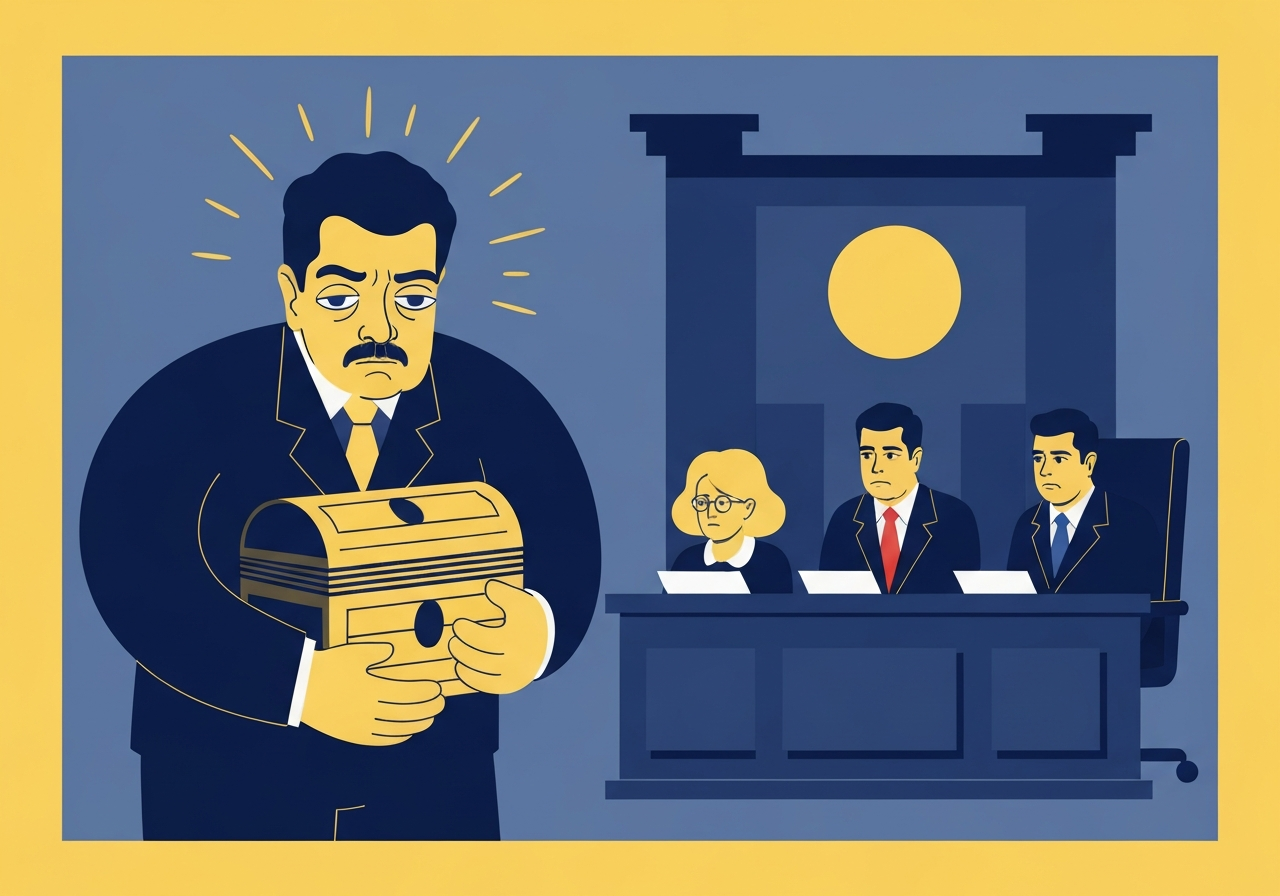
Lead: US prosecutors told a New York federal court that former Venezuelan president Nicolás Maduro and his wife Cilia Flores should not be permitted to use Venezuelan government funds to pay criminal defence lawyers, arguing the couple “plundered” state resources. The dispute arose at a hearing on Thursday before 92-year-old Judge Alvin Hellerstein, who said the right to a defence is paramount but declined to dismiss the case over the funding fight. Maduro and Flores, seized on 3 January and transferred to New York, are facing charges including narco-terrorism and weapons offences; no trial date has been set and both remain in the Metropolitan Detention Center in Brooklyn. The judge said he would issue a later ruling on the funding issue and on the next court date.
Key Takeaways
- Maduro and Cilia Flores were detained in a US operation on 3 January and brought to New York to face charges including narco-terrorism and cocaine-importation conspiracy.
- Prosecutors told the court the couple should not access Venezuelan government funds because they allegedly “plundered” state wealth for personal benefit.
- OFAC initially licensed payments from the Venezuelan government for legal fees then revoked that licence, creating the central legal dispute.
- Judge Alvin Hellerstein, 92, expressed concern for the right to counsel but declined to dismiss the indictment over the funding argument at Thursday’s hearing.
- Maduro and Flores have not applied for bail and are housed at the Metropolitan Detention Center in Brooklyn; no trial date is set.
- Defense counsel argued a public defender could be overwhelmed by this transnational, complex case, pressing the court to allow government-funded private counsel.
- US President Donald Trump said during a cabinet meeting the administration is considering additional cases, while also asserting Maduro will receive a fair trial.
Background
Federal prosecutors in the United States have charged Nicolás Maduro and Cilia Flores with multiple offences, including narco-terrorism conspiracy, cocaine-importation conspiracy, and various weapons-related counts. The pair were reportedly seized during a night-time raid on their Caracas compound on 3 January and transported to New York to face the indictment. The legal fight over who pays their lawyers centers on US sanctions against Venezuela and decisions by the Office of Foreign Assets Control (OFAC), which regulates financial interactions with sanctioned parties.
Under US law, defendants who cannot afford counsel are entitled to court-appointed attorneys. Defense teams argue, however, that the extraordinary scope of these charges — arising from alleged conduct in another country and implicating international evidence and witnesses — would overwhelm federal public defenders. Prosecutors counter that longstanding US sanctions and national-security concerns justify denying Venezuelan government funds, and they assert the Maduros have access to other resources for legal representation.
Main Event
At Thursday’s hearing in Manhattan, Maduro and Flores sat in green khaki jumpsuits and listened to translation via headphones while attorneys debated the funding question. Judge Hellerstein repeatedly pressed both sides on what relief they sought and wrestled with the legal and diplomatic implications of allowing a sanctioned government to pay defence costs in a US criminal case. He declined to dismiss the indictment on the funding dispute and said he would issue a written ruling and set the next court date at a later time.
Prosecutors urged the court to deny access to Venezuelan government funds, arguing the Maduros had diverted state wealth and that permitting such payments would raise national-security and policy concerns. Defense counsel, including Barry Pollack, stressed the practical difficulties a public defender would face in mounting a defence involving transnational narcotics and weapons allegations, and argued the defendants have a constitutional right to retain counsel of choice if funds are legitimately available.
The OFAC issue complicated proceedings: officials first issued a licence allowing Venezuelan government payments for legal fees, then revoked it, leaving the defence without the anticipated source of funds. Judge Hellerstein noted changes in the diplomatic landscape since the defendants’ capture — including a reported resumption of ties and the installation of a new acting leader — and asked how those developments affected the funding analysis.
Analysis & Implications
The court’s tension between preserving a defendant’s right to counsel and enforcing sanctions policy highlights a rare collision between criminal procedure and foreign-policy controls. If a court permits sanctioned foreign-government funds to be used for defence, it could set a precedent affecting other cases where political actors face US charges. Conversely, denying access raises practical concerns about whether appointed counsel can adequately handle a sprawling international prosecution.
Allowing Venezuelan government payments could be viewed as tacitly engaging with a regime the US has sanctioned, which raises policy questions for OFAC and the Department of Justice. The judge’s observation that the diplomatic context shifted after the arrest — and that a Venezuelan authority indicated willingness to fund counsel — complicates a straightforward sanctions-based refusal. Courts will need to weigh evolving foreign relations alongside prosecutorial claims about misuse of state assets.
For Venezuelan politics and US-Venezuela relations, the case may have ripple effects far beyond courtroom procedure. The US government’s posture — including comments from President Donald Trump about additional charges — will be watched in Caracas, where public opinion is divided. If further indictments are pursued, or if the court permits foreign-government funding, the litigation could become another flashpoint in an already fraught bilateral relationship.
Comparison & Data
| Allegation | US Characterization |
|---|---|
| Narco-terrorism conspiracy | Accused of coordinating drug shipments to support illicit activity |
| Cocaine-importation conspiracy | Alleged involvement in transporting cocaine into the United States |
| Possession & conspiracy for machine guns/destructive devices | Charges related to illegal weapons possession and conspiracies |
The table summarizes the principal counts in the US indictment. While statutory penalties vary by count, the broader legal question at this stage is procedural: who may lawfully fund a defence when the defendants and their government are subject to sanctions.
Reactions & Quotes
Courtroom remarks and public responses captured the polarised views. The judge repeatedly emphasized the centrality of counsel while asking practical questions about relief and implementation.
“The right to defence is paramount.”
Judge Alvin Hellerstein
Prosecutors framed the dispute in stark terms about alleged corruption and misappropriation of state wealth.
“The defendants plundered the wealth of Venezuelans and should not be permitted to use those funds to finance their defence.”
US prosecutors (court filing)
Outside the courthouse, Venezuelans expressed a mix of sympathy and condemnation, illustrating split domestic public opinion.
“He is a man who had everything but lost it through greed… I hope he receives a life sentence.”
Ana Patricia, 72, retired lawyer, Caracas resident (interview)
Unconfirmed
- Whether Maduro and Flores have immediate, accessible personal funds sufficient to hire private counsel is disputed and has not been independently verified by the court record.
- Reports that Venezuela has fully normalised diplomatic relations with the US after the arrest are evolving and require official confirmation from both governments.
- Any suggestion that OFAC’s licence decisions were politically motivated has been asserted by parties but is not established in the public record.
Bottom Line
The hearing exposed a rare legal crossroads where criminal defendants’ constitutional rights meet sanctions-driven foreign-policy constraints. Judge Hellerstein signalled concern for ensuring an effective defence but declined to resolve the dispute immediately, leaving the case to unfold through further filings and a forthcoming ruling.
How the court ultimately balances the right to counsel against sanctions policy will carry implications beyond this indictment: it could shape how courts treat funding for defence in cases involving sanctioned actors and influence diplomatic interactions tied to high-profile prosecutions. Observers in Caracas and Washington will watch closely as legal, political, and procedural threads continue to converge.
Sources
- BBC News (international news reporting)
- Reuters (international news reporting)
- US Treasury: OFAC (official agency guidance)