
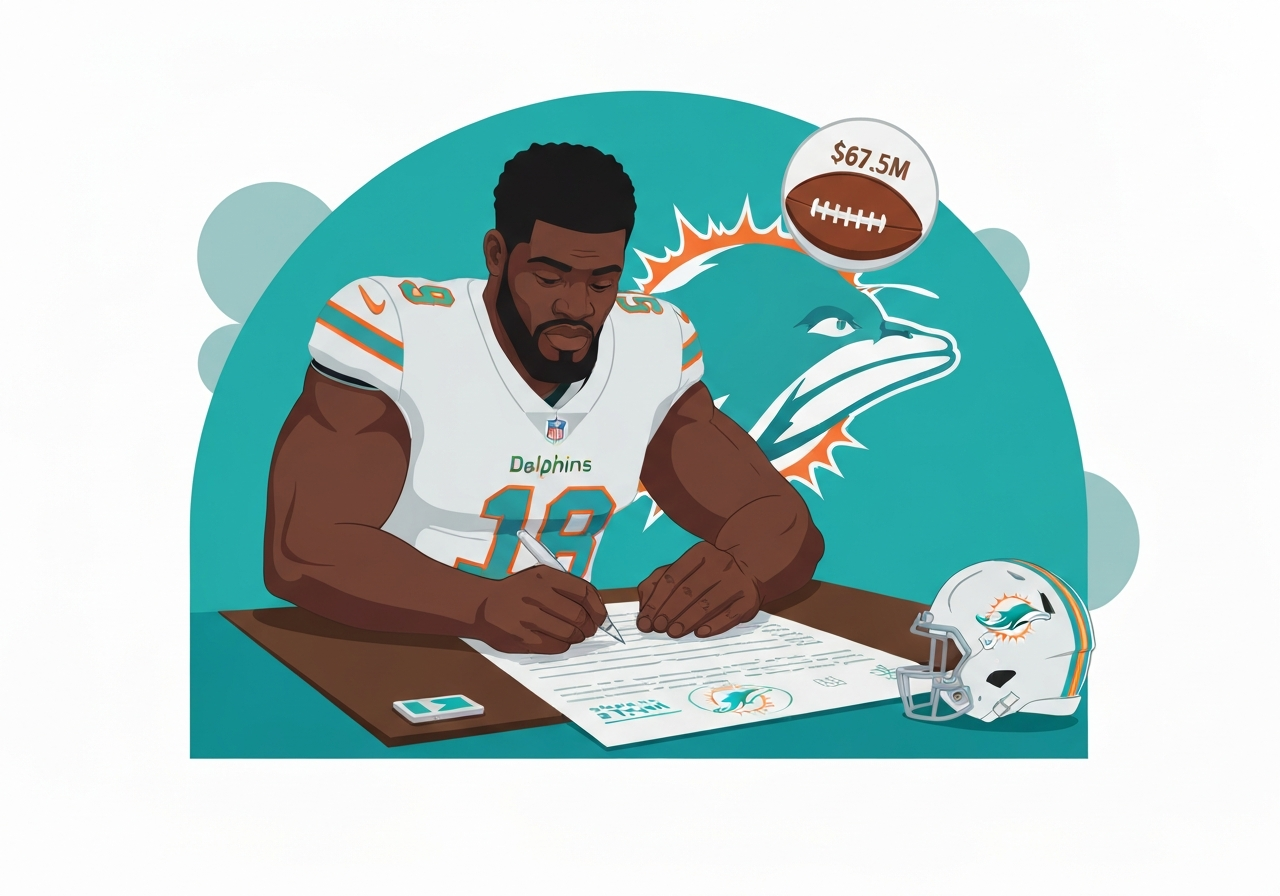
Lead: The Miami Dolphins have reached agreement with quarterback Malik Willis on a three-year, $67.5 million contract, including $45 million fully guaranteed, sources told NFL reporters. The move follows the team’s release of Tua Tagovailoa earlier Monday, a maneuver that will create roughly $99 million in dead-cap spread over two years via the June 1 mechanism. The deal cannot be finalized until the new league year opens on Wednesday. Miami’s new front office and coaching staff, who worked with Willis in Green Bay, are betting their familiarity can unlock his upside.
Key Takeaways
- Contract terms: Three years, $67.5 million total with $45 million fully guaranteed; average value about $22.5 million per season.
- Tua Tagovailoa was released earlier Monday, generating roughly $99 million in dead money spread over two years using the June 1 release mechanism.
- Deal timing: Agreement reported now but cannot become official until the new league year begins on Wednesday.
- Front-office continuity: GM Jon-Eric Sullivan and head coach Jeff Hafley worked with Willis in Green Bay the past two seasons and were key in bringing him to Miami.
- Player background: Willis was a 2022 third-round pick by the Tennessee Titans and struggled in limited action there before a reset in Green Bay.
- Green Bay stint: In 11 appearances (three starts) with the Packers under Matt LaFleur, Willis showed improved accuracy and quick decision-making in a friendly offense.
- Development caveat: He remains a developing passer who saw few standard drop-back reps in Green Bay as LaFleur leaned on RPO concepts.
- Payroll context: The contract is meaningful for a cap-constrained Dolphins roster and is slightly more per year than what the Jets paid Justin Fields last season.
Background
Malik Willis entered the NFL as a third-round selection in 2022 by the Tennessee Titans. His early tenure in Nashville featured limited opportunity and mixed results; across two seasons with the Titans he started three games and many evaluators labeled his processing and reads as inconsistent. Those struggles cost him a clean path to starting work and led to a change of scenery.
Green Bay acquired Willis and placed him in Matt LaFleur’s offense, a system that frequently deploys RPOs and quick reads. In that environment Willis made 11 appearances, including three starts, and displayed more accuracy and faster release on designed quick-game concepts. Observers noted that the scheme masked some traditional drop-back work he had not yet mastered, creating both hope about his upside and caution about how transferable those gains are.
The Dolphins’ decision to move on from Tua Tagovailoa reflects a broader roster reset under new management. Releasing Tua and shouldering substantial dead-cap charges cleared the roster path and cap space necessary to pursue a quarterback perceived as a higher-upside option despite developmental needs. GM Jon-Eric Sullivan and coach Jeff Hafley—figures involved in Willis’s recent Green Bay tenure—are positioned to shape the QB’s next phase.
Main Event
The reported agreement came after Miami formally announced Tua Tagovailoa’s release earlier Monday, a transaction that uses the June 1 mechanism to split the dead money burden. That move signaled the Dolphins were prepared to accept immediate financial pain in exchange for roster and schematic flexibility. Sources told league reporters the club quickly pivoted to Willis as the preferred complement to their new coaching approach.
Willis’s reported three-year, $67.5 million package includes $45 million fully guaranteed, a structure that gives Miami both commitment and future flexibility. The annualized figure—about $22.5 million—positions him in the lower-to-middle tier of starting quarterback averages while reflecting the Dolphins’ willingness to invest substantially in a developmental starter. The contract cannot be filed with the league office until the new league year opens on Wednesday, at which point it becomes official.
Coaching fit is a central part of the rationale. Sullivan and Hafley, who spent the past two seasons around Willis in Green Bay, believe their familiarity with his traits—mobility, quick decision-making in RPOs and timing accuracy—gives them an accelerated roadmap to improve his weaknesses. How offensive coordinator Bobby Slowik and Hafley configure the offense will be determinative: more RPO/quick-game concepts could maximize Willis’s current strengths, while a heavier schematic drop-back workload would test his developing processing skills.
From a roster-management perspective, the deal compels Miami to re-balance its cap and depth chart. The team will likely need to shed veteran salary or restructure contracts elsewhere to accommodate Willis’s deal while maintaining competitive depth across skill positions and the offensive line. The transaction is therefore both a football and financial pivot for the franchise.
Analysis & Implications
Strategically, Miami is accepting a growth-first approach at quarterback. Willis offers a higher ceiling—mobility, playmaking out of structure and improved accuracy within a friendly scheme—than many backup options, but he also carries proven inconsistencies from his time in Tennessee. The Dolphins’ new regime appears to value scheming and coaching continuity over a conservative veteran stopgap.
On-field design will matter. In Green Bay, Willis flourished inside quick-release, RPO-heavy packages that limited complex post-snap progressions. If Miami leans into those strengths early, Willis could produce efficient play and control games with his legs. Conversely, substantial reliance on traditional drop-back reads without a clear developmental plan risks exposing the same errors that curtailed his early career.
Financially, the contract is a middle ground: meaningful guarantee ($45 million) but not the multi-year, fully guaranteed megadeals reserved for entrenched stars. That gives Miami options to reassess after the term should Willis not progress as hoped. The team’s absorption of roughly $99 million in dead money to move off Tua is a costly short-term statement of intent, indicating they prioritized gaining roster control over preserving cap cleanliness.
League-wide, the signing signals a continuing trend of teams willing to invest in younger, higher-upside QBs rather than committing long-term to veteran bridge starters. It also underscores the influence of coaching familiarity in free-agent choices: front offices increasingly prize managers who have direct, recent experience with a player’s traits and work habits.
| Item | Value |
|---|---|
| Contract length | 3 years |
| Total value | $67.5 million |
| Fully guaranteed | $45 million |
| Average per year | ~$22.5 million |
The table above isolates the financial terms to frame roster and cap choices. Contextually, Miami’s figures are a significant but not elite commitment, pairing upside with fiscal flexibility relative to the largest quarterback market contracts.
Reactions & Quotes
Initial reporting and team moves produced swift interpretation from league insiders and public coverage. Below are two concise, attributable comments from the reporting stream, each placed with brief context.
Reporting summary prior to the contract becoming official:
“The Dolphins are signing quarterback Malik Willis to a three-year, $67.5 million contract,”
Ian Rapoport, NFL Network Insider (report)
This line from an NFL Network insider summarized the core financial terms as reported to the league media; the phrasing reflects contemporaneous reporting before official league paperwork is filed.
On timing and league procedural constraints:
“The deal cannot become official until the new league year begins on Wednesday.”
NFL.com report
That procedural note clarifies that while terms can be agreed and announced, the transaction is contingent on the opening of the new league year when contracts are processed and roster limits reset.
Unconfirmed
- Whether Malik Willis will be named the Week 1 starter has not been confirmed; the final depth chart decisions remain with the coaching staff.
- Specific roster moves or contract restructures to offset Willis’s cap impact have not been announced and are subject to further transactions.
- Detailed play-calling plans—how heavily Miami will rely on RPOs versus conventional drop-back schemes—have not been publicly disclosed.
Bottom Line
The Dolphins’ agreement with Malik Willis is a clear directional choice: they opted for a quarterback with high physical upside and familiarity with part of their new coaching staff rather than a veteran, lower-ceiling alternative. The contract binds Miami to a meaningful financial commitment in the short term while preserving flexibility if Willis does not progress as hoped.
How quickly Willis can translate the improvements he showed in Green Bay into consistent, NFL-level drop-back play will determine whether the investment yields a long-term franchise solution or a stopgap that requires further changes. In the near term, the move reshapes Miami’s cap picture and signals that the new front office and coaching staff are willing to accept short-term pain for potential long-term gain.
Sources
- NFL.com — Sports news report summarizing contract terms and roster move (media).
- Ian Rapoport / NFL Network — Insider reporting on the agreement (league insider/beat reporting).
- Miami Dolphins — Team official site for roster and organizational announcements (official team).