
Lead
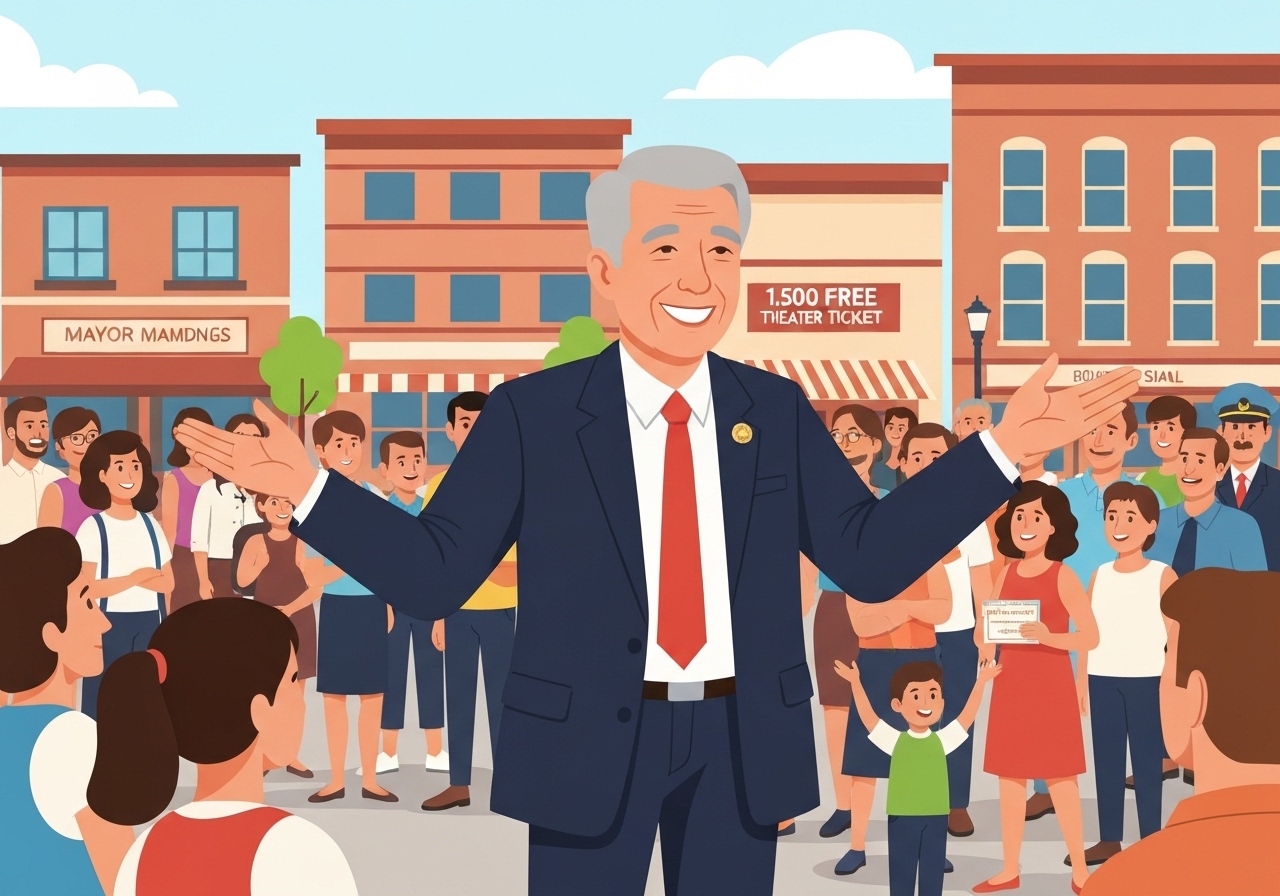
On Jan. 9, 2026, New York City Mayor Zohran Mamdani distributed QR-coded vouchers for 1,500 free tickets to the Under the Radar theater festival, saying access to culture belongs within the city’s affordability agenda. The giveaway took place on Hillel Place in Flatbush, outside the Leonard and Claire Tow Center for the Performing Arts at Brooklyn College, days after he took office. The festival, which runs through Jan. 25, 2026, agreed to set aside the complimentary seats after discussions with the mayor’s team. Officials framed the move as an extension of Mamdani’s campaign focus on lowering everyday costs for New Yorkers.
Key Takeaways
- Mayor Zohran Mamdani handed out QR-coded vouchers for 1,500 free Under the Radar festival tickets on Jan. 9, 2026, in Flatbush, Brooklyn.
- The Under the Radar festival runs through Jan. 25, 2026, and the Leonard and Claire Tow Center at Brooklyn College served as one venue for the program.
- Mamdani made the distribution on his ninth day in office, linking the move to a broader affordability platform that included free buses and child care during the campaign.
- Festival co-creative directors Kaneza Schaal and Meropi Peponides were present; festival founder Mark Russell publicly welcomed mayoral engagement.
- The mayor spent roughly 20 minutes engaging with passers-by, handing out tickets and complimentary beanies as part of the in-person rollout.
- Officials positioned the initiative as proof-of-concept for expanding subsidized or free cultural access to under-served New Yorkers.
Background
Zohran Mamdani won the mayoralty on a platform that foregrounded affordability across multiple daily costs, with campaign promises that included free municipal bus service and expanded child care supports. Those pledges signaled a governing emphasis on reducing the price barriers that affect low- and moderate-income residents. Arts access was not a central theme of most recent mayoral contests, but advocates have long argued that cultural programming is an essential civic good rather than a discretionary luxury.
Under the Radar is a long-running festival known for experimental and emerging theater work; it attracts audiences interested in contemporary, often boundary-pushing performances. The festival uses multiple venues across the city and has a reputation for showcasing small-cast productions and innovative staging that can be costly for ticket buyers. Local arts organizations, venues and funders are frequent stakeholders in discussions about pricing, outreach and community partnerships that expand access.
Main Event
On the day of the giveaway, Mamdani stood at a folding table on Hillel Place in Flatbush, distributing cards with QR codes that recipients could redeem for festival seats. Black, purple and red Under the Radar beanies were available as a complimentary item, and dozens of people queued to meet the new mayor, take selfies and claim tickets. Mamdani spent roughly 20 minutes outside before a scheduled news conference at the Tow Center.
Officials said the festival agreed to make 1,500 free tickets available to align with the mayor’s access initiative. The distribution was informal: passers-by were offered vouchers on a first-come, first-served basis and directed on how to redeem them for performances running through Jan. 25. The mayor’s remarks at the news conference emphasized that live performance creates communal experiences — laughter, reflection and shared silence — that should be widely available.
Some attendees used the chance to speak briefly with the mayor about local concerns; Mamdani redirected several people to aides for follow-up. Festival founder Mark Russell welcomed the attention, asking rhetorically when a mayor last acknowledged downtown performance and describing the partnership as constructive. Organizers and the mayor framed the move as both a symbolic and practical step toward reducing barriers to participation in the arts.
Analysis & Implications
Practically, the giveaway represents a low-cost, high-visibility intervention that signals the mayor’s priorities without requiring immediate, large-scale budgetary commitments. By persuading a festival to set aside 1,500 seats, Mamdani demonstrated how municipal leaders can leverage political capital and relationships with cultural institutions to expand access. The approach relies on voluntary cooperation from arts organizations rather than on new line-item funding, which may limit the model’s scale and sustainability unless paired with longer-term policy measures.
Politically, the gesture advances a narrative that ties culture to everyday affordability, reframing theater attendance as a public good rather than a luxury for the well-off. That framing could reshape municipal conversations about arts subsidies, outreach funding and partnerships with non-profit presenters. However, it also invites scrutiny about equity in distribution: free tickets offered on a first-come basis may advantage those with flexible schedules or better internet access to redeem QR codes, leaving some targeted communities underserved.
Economically, expanding subsidized access through ticket vouchers could boost audience diversity and build new long-term patrons, which benefits venues and creators. But if the approach becomes a recurring expectation, arts organizations will seek predictable public or philanthropic funding to underwrite forgone ticket revenue. Without stable support, institutions may find it difficult to scale up free-ticket programs without cutting programming or reducing artist fees.
Comparison & Data
While municipal leaders occasionally sponsor discounted or free cultural access—through school partnerships, community programs or special events—the explicit alignment of a mayoral affordability agenda with a major experimental festival is relatively uncommon in recent New York practice. The 1,500-ticket allotment is modest relative to citywide audiences but significant for a single festival run focused on smaller, experimental works.
Reactions & Quotes
“These are moments that every New Yorker deserves,” said the mayor, framing the initiative as part of a broader push to make civic life more affordable.
Zohran Mamdani, Mayor of New York City
“When does a mayor actually acknowledge downtown performance?” asked festival founder Mark Russell, welcoming the collaboration as an unusual show of mayoral support for contemporary theater.
Mark Russell, Founder, Under the Radar
“I never thought I could see a show like this without stretching my budget,” said one person who accepted a voucher, describing gratitude that the tickets made the festival accessible.
Attendee, Flatbush distribution
Unconfirmed
- Whether the 1,500-ticket program will be repeated or formalized as an annual partnership remains unconfirmed.
- Details about the fiscal arrangements between the mayor’s office and the festival—such as any compensation, logistical support or in-kind promotion—were not disclosed publicly at the time of reporting.
- Exact redemption and attendance rates from the vouchers, and the demographic breakdown of recipients, had not been released as of publication.
Bottom Line
The ticket distribution was both a symbolic and practical demonstration of Mayor Mamdani’s affordability priorities, extending that rhetoric into cultural policy by securing 1,500 free seats at a noted experimental festival. It highlights how municipal leadership can nudge cultural institutions toward greater public access without immediate budgetary appropriation.
For long-term impact, officials and arts leaders will need to address distribution equity, sustainable funding and the logistics of scaling similar programs. Observers should watch whether this remains a one-off visible gesture or develops into a structured policy that broadens arts access across neighborhoods and audiences.