
Lead
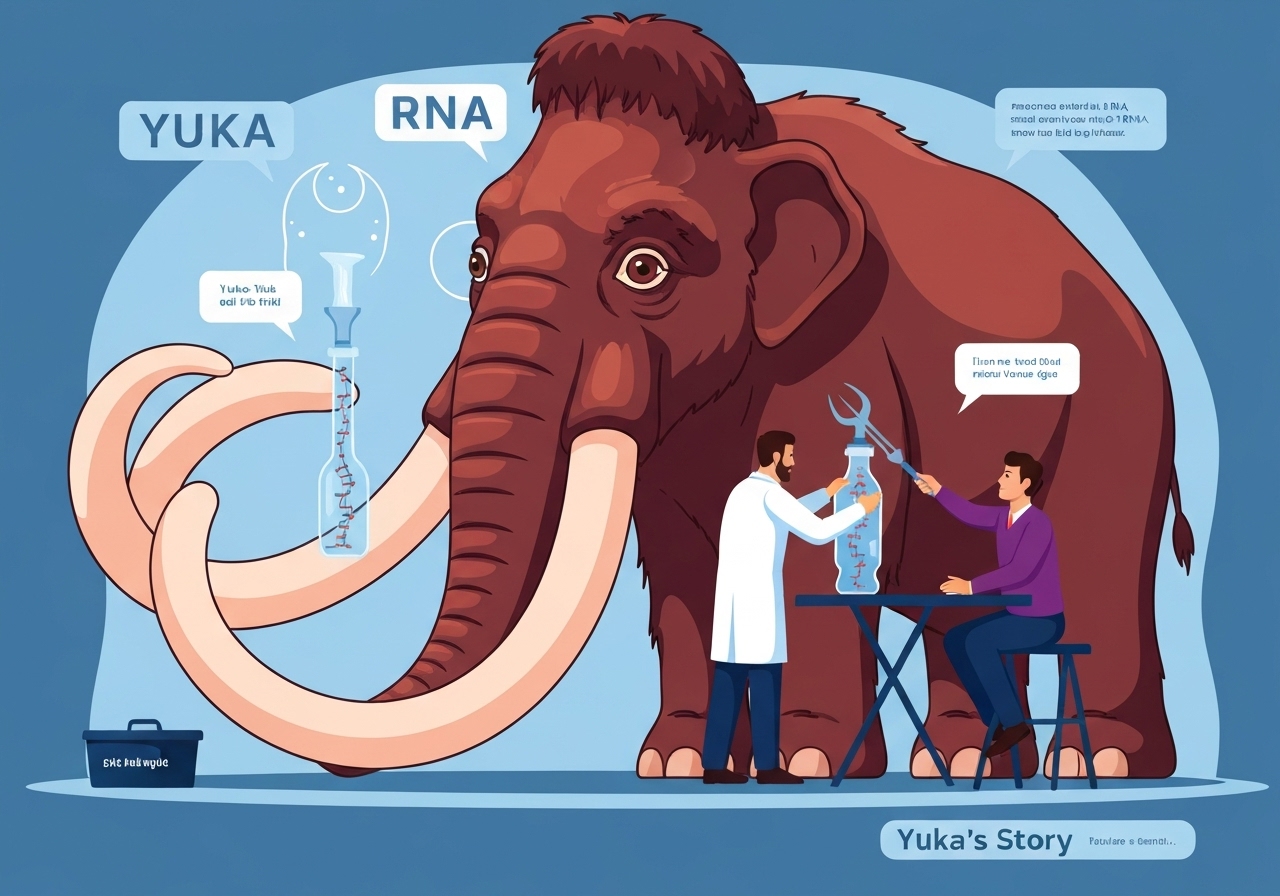
Researchers report they extracted fragmented RNA from Yuka, a juvenile woolly mammoth recovered from a Siberian permafrost cliff, revealing molecular snapshots of tissues around the time of death. The study, published in Cell, used samples collected in 2012 and analyzed RNA from ten mammoth remains, with three specimens—including Yuka—yielding useful data. The RNA fragments point to muscle-specific activity and stress responses and, unexpectedly, to the presence of a Y chromosome in Yuka. The finding demonstrates that, under exceptional preservation, ancient RNA can survive for roughly 39,000 years and offer insights distinct from DNA alone.
Key Takeaways
- Yuka, a juvenile woolly mammoth thawed from a Siberian permafrost cliff, lived and died about 39,000 years ago; samples were first seen by researchers in 2012.
- The team sampled tissues from ten mammoths and recovered analyzable ancient RNA from three specimens, including Yuka.
- Extracted RNA fragments reflect slow-twitch muscle function and molecular stress responses, suggesting active muscle processes near death.
- Genetic analysis found Y-chromosome RNA and DNA signatures indicating Yuka was genetically male (one X and one Y chromosome).
- The results were published in the journal Cell and required extensive computational reconstruction of very short RNA fragments.
- This study is presented as a proof of principle that cellular gene activity at death can be partially recovered from exceptionally preserved Pleistocene specimens.
- Experts note the recovery depended on pristine permafrost preservation; applicability to specimens from temperate or tropical deposits remains uncertain.
Background
Yuka is a juvenile woolly mammoth discovered thawing from a permafrost cliff on the Siberian coastline. The specimen was not a complete carcass but was remarkably well preserved after approximately 39,000 years in frozen ground. Paleogeneticists led by Love Dalén (Stockholm University) and collaborators have previously sequenced DNA from Yuka and other mammoths; DNA supplies the genomic blueprint but not the transient molecular activity within cells.
RNA molecules — such as messenger RNA — link genes to protein production and indicate which genes were active at a given time in particular tissues. Unlike DNA, RNA is chemically less stable and typically degrades within minutes to hours in living systems, which is why recovery from ancient remains has been rare. A handful of prior studies had reported ancient RNA in exceptional contexts, suggesting recovery could be possible if samples and lab workflows minimized contamination and degradation.
Main Event
In the reported study, the researchers collected tissue samples from ten woolly mammoths and carried out delicate RNA extractions under strict laboratory protocols to avoid modern contamination. Most resulting RNA fragments were extremely short, reflecting extensive breakage over millennia; the bulk of the work therefore focused on computational assembly and validation of tiny sequence reads. After reconstruction and validation steps, RNA attributable to mammoth tissues was identified in three specimens, one of which was Yuka.
The RNA profile from Yuka’s sampled muscle tissue showed signals consistent with slow-twitch (endurance) muscle function and molecular markers associated with cellular stress. The stress-related transcripts are compatible with scenarios such as predation or physical entrapment, but the data do not uniquely identify the cause. Parallel DNA analysis confirmed the presence of both X and Y chromosomes in Yuka, overturning an earlier visual assessment that had suggested the animal might be female.
The authors emphasize that this constitutes a proof of principle: under exceptional preservation conditions, it is possible to recover snapshots of gene expression from long-extinct species. The project combined field collection, wet-lab extraction optimized for short fragments, and large-scale computational analyses to sort authentic ancient RNA from background noise. The work was published in Cell and has attracted commentary from independent paleogeneticists who praised the technical advances while urging caution about generalizing the method to less pristine contexts.
Analysis & Implications
Recovering RNA rather than only DNA opens a different window into ancient biology: RNA reports on genes that were actively transcribed in specific tissues and moments, offering tissue- and time-specific information that DNA cannot provide. For the mammoths studied, muscle RNA suggests not only what tissues existed but which pathways were engaged at death, such as metabolic or stress responses. That kind of signal can refine interpretations of how an individual animal died or what physiological state it experienced in the minutes-to-hours before death.
The finding also has broader methodological implications for paleogenetics. It indicates that under the right thermal and depositional conditions — typically cold, anoxic, and stable permafrost — molecules thought too fragile to survive for tens of thousands of years can persist in retrievable form. Laboratories attempting similar work will need ultra-clean protocols and substantial computational effort to reconstruct and validate fragmented reads, increasing costs and technical barriers but expanding potential data streams.
On an ecological and evolutionary level, ancient RNA may help researchers examine gene regulation and tissue-specific responses in extinct species, which could refine models of adaptation to Ice Age environments. For questions such as how mammoths coped with cold, infection, or starvation, transcriptomic data could add nuance to genomic inferences by indicating which pathways were active in particular organs. However, signals are necessarily a snapshot tied to the moment of death and may reflect acute stressors rather than baseline physiology.
Finally, the work raises prospects for ancient RNA virus research because many pathogens (for example, influenza or other RNA viruses) carry RNA genomes. If authentic viral RNA can be distinguished from environmental contamination and validated in ancient samples, it could illuminate long-term pathogen evolution — but methodological and ethical challenges remain before such applications become routine.
Comparison & Data
| Metric | Value (this study) |
|---|---|
| Specimens sampled | 10 woolly mammoths |
| Specimens with analyzable RNA | 3 (including Yuka) |
| Estimated age | ~39,000 years |
| Preservation context | Siberian permafrost cliff |
The table above summarizes the basic comparative data reported: ten samples were screened, three yielded sufficient RNA for analysis, and the most notable specimen (Yuka) was dated to about 39,000 years old. Typical RNA survival in contemporary, non-frozen environments is measured in minutes to hours, which underlines how exceptional permafrost preservation must have been for these molecules to persist. The study combined molecular lab work and extensive bioinformatics to assemble and authenticate very short RNA fragments against mammoth reference sequences.
Reactions & Quotes
Several independent experts praised the technical achievement while underscoring caveats about wider applicability. The quotations below are short excerpts presented with context.
“It felt like a very high‑risk project…you see processes going on inside the cells right around the time it died.”
Love Dalén, paleogeneticist (lead author)
Dalén framed the work as a risky but successful attempt to retrieve transient molecular signals from deep time, stressing the combination of field preservation and laboratory rigor that made the result possible.
“Fabulous in terms of technological barriers being shattered, but preservation was exceptional here.”
Maanasa Raghavan, University of Chicago (paleogeneticist, external)
Raghavan praised the technical breakthrough but cautioned that specimens from warmer, more biologically active environments may not yield similar results.
“This adds a layer of insight about how these creatures lived and adapted, and points toward studying ancient RNA viruses.”
María Ávila Arcos, National Autonomous University of Mexico (evolutionary genomicist, external)
Ávila Arcos highlighted the wider scientific possibilities, including applications to pathogen history, while implying the need for careful validation and ethical consideration.
Unconfirmed
- The precise cause of the stress signatures in Yuka’s muscle RNA is not confirmed; predation by cave lions is plausible but alternatives (e.g., entrapment in mud) cannot be ruled out.
- Whether the same RNA-recovery methods will work on specimens from temperate or tropical deposits remains unproven and likely limited by poorer preservation conditions.
- Recovery of authentic ancient RNA viruses from Pleistocene material is speculative at present and would require strict authentication to exclude modern contamination.
Bottom Line
This study provides a carefully validated demonstration that fragments of RNA can persist in exceptional permafrost-preserved remains for roughly 39,000 years and can report on tissue-specific activity near the time of death. The discovery does not overturn DNA-based paleogenomics but augments it with transient, functional information that can refine interpretations of physiology, stress, and potentially disease in extinct animals.
Practical limits remain: the approach depends on unusually good preservation and intensive laboratory and computational workflows, so broad application across specimens and regions is uncertain. Nonetheless, the result expands the paleogenetic toolkit and invites targeted follow-up studies that could explore transcriptomes in other well-preserved Pleistocene samples and carefully assess the feasibility of recovering ancient RNA pathogens.