
Lead
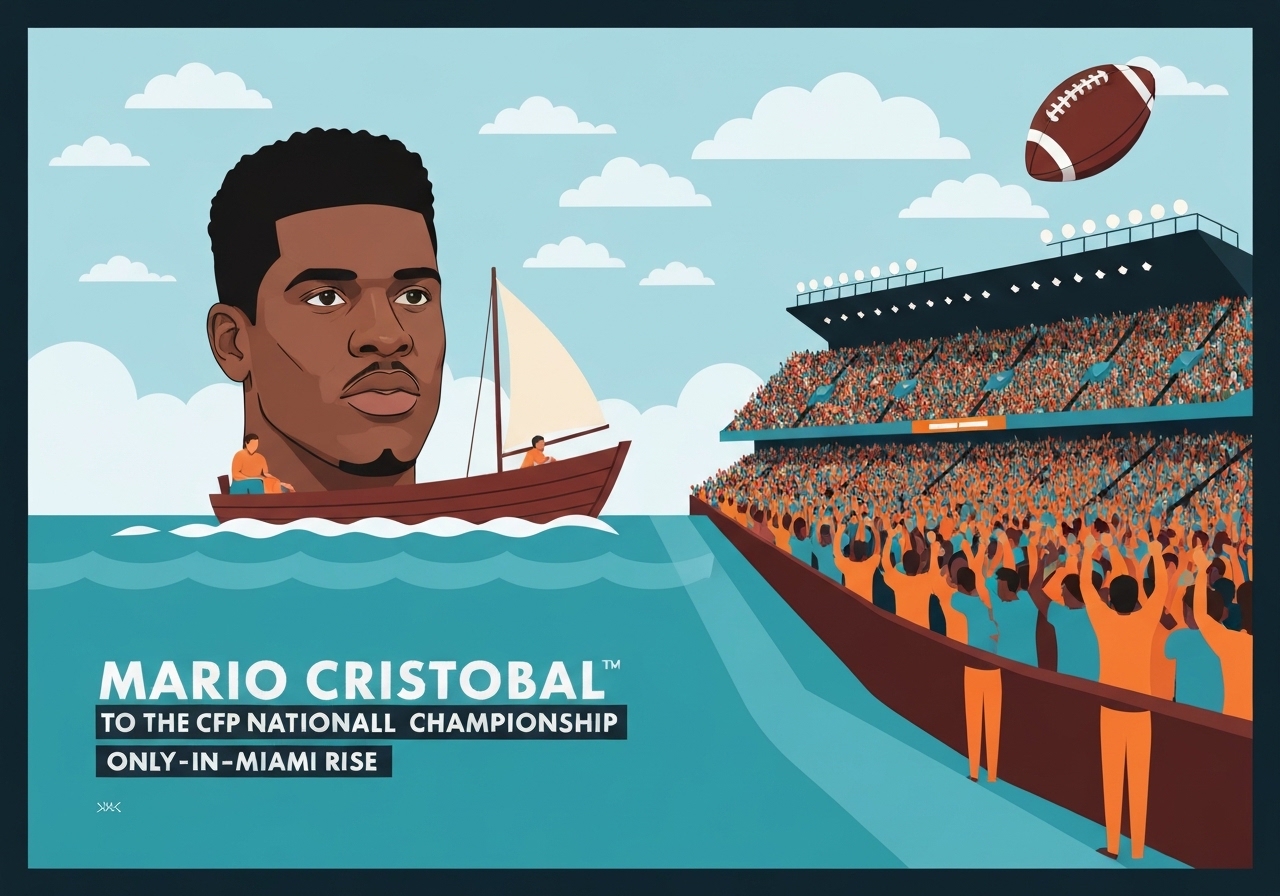
Mario Cristobal, the son and grandson of Cuban exiles, will lead the University of Miami into the College Football Playoff national championship at Hard Rock Stadium, a journey that traces back to his family’s exile from Cuba and a grandfather who rebuilt a life in Miami. His grandfather, Mario Campos, fled Cuba in 1961 after imprisonment following Castro’s rise; Campos later founded a construction company and helped anchor a family that emphasized work, discipline and education. Cristobal’s path from Miami player and NFL Europe lineman to college coach and eventual return to his alma mater has been marked by program rebuilds at FIU and Oregon and a concerted effort to reframe Miami football’s image. The team’s 11-2 season and playoff berth complete a personal and institutional arc that began on SW 25th Street and now culminates at the national title game.
Key Takeaways
- Mario Cristobal will coach the University of Miami in the College Football Playoff national championship at Hard Rock Stadium; the Hurricanes finished the season 11-2.
- Cristobal is a second-generation Cuban American whose grandfather, Mario Campos, spent 26 years with Cuba’s national police, was imprisoned after 1959 and left for Florida in 1961.
- Campos Construction Company Inc. was incorporated in 1970; the family home on SW 25th Street figures centrally in Cristobal’s personal narrative.
- Cristobal played at Miami (redshirted in 1988), then professionally in Amsterdam, and later joined coaching staffs at Miami, Rutgers, FIU, Alabama (under Nick Saban), and Oregon.
- At FIU, Cristobal inherited a program with eight total wins in its first three seasons, no wins the year before he arrived, and severe scholarship and APR constraints from NCAA penalties.
- At Oregon Cristobal won two Pac-12 championships and a Rose Bowl appearance before returning to Miami to rebuild his alma mater’s program.
- The Hurricanes had finished in the AP Top 25 only four times in the 16 seasons before Cristobal’s return and had one major bowl in that span (the 2017 Orange Bowl).
- The program’s recent rise required pairing top freshman recruiting classes with targeted portal transfers and a sustained institutional focus on academics and compliance.
Background
The Cristobal family story begins in Cuba. Mario Campos, a guajiro who later worked for the national police for 26 years, was jailed after Fidel Castro took power; he was released and left for Florida in 1961. Campos arrived unable to read or write English, took low-wage work, saved, learned construction skills informally and incorporated Campos Construction Company Inc. in 1970. That household ethic—work, thrift and self-reliance—became the family’s foundation and framed expectations for Luis and Clara Cristobal’s sons.
Luis Cristobal Sr. and Clara also emigrated to Miami in the early 1960s; Luis had been imprisoned and tortured under Castro and survived two condemned standoffs with firing squads. In the United States Luis opened a car-battery business; Clara worked in automotive title processing and retired at age 79. They emphasized education, discipline and earning one’s way—lessons that informed Mario’s focus on study, judo/jujitsu and ultimately football.
Miami football itself carried a complex legacy. The Hurricanes’ swagger in the 1980s earned them a national reputation—on-field bravado, off-field arrests and memorable games like the 1988 matchup against Notre Dame—while later decades brought academic and booster scandals. The school faced NCAA sanctions after a 1995 Pell Grant controversy and again endured fallout from a 2013, 30-month investigation into booster Nevin Shapiro, which led to reduced scholarships, probation and reputational damage.
Main Event
Cristobal’s personal arc mirrors Miami’s institutional ups and downs. He arrived at the University of Miami as a student-athlete, redshirted in 1988 and maintained a reputation as a straight-arrow lineman who graduated with a business degree. After a professional stint in Amsterdam with NFL Europe and exploratory stops in marketing and federal service testing, he accepted a graduate assistant role under Butch Davis and began a steady climb through the coaching ranks with stops at Miami, Rutgers and other programs.
When Cristobal took the head job at Florida International University, he inherited a program still in its infancy: FIU had existed three years before his arrival, had just eight wins in that stretch and was under NCAA sanctions that cost 24 scholarships and stressed academic progress rates. Cristobal framed the role as an all-encompassing challenge—coaching, budgeting, compliance and program building—and turned FIU into a back-to-back bowl team before being dismissed after a 3-9 season in a controversial move that sent him to Alabama.
Three years on Nick Saban’s staff at Alabama provided a professional reset; Cristobal then accepted the Oregon job, where he guided the Ducks to two Pac-12 titles and a Rose Bowl berth. Despite on-field success in Eugene, Cristobal felt the pull of Miami. With encouragement from Dennis Lavelle, his former high-school coach, he returned to lead his alma mater, charged with restoring both the program’s competitive standing and its institutional reputation.
The rebuild emphasized recruiting—pairing top freshman classes with selective portal transfers—player development and an insistence on compliance and character. Results arrived incrementally: 5-7 in his first year, 7-6 the next, and then a breakthrough 11-2 season that propelled Miami into the playoff conversation and onto the national championship stage at Hard Rock Stadium.
Analysis & Implications
Cristobal’s trajectory is instructive about how immigrant family values can shape leadership styles in sport. The narrative of discipline, manual labor and accountability—embodied by his grandparents and parents—translates into a coaching philosophy that prizes relentless work over flash. That orientation has practical returns in recruiting and player development, particularly when a program must reestablish standards after years of off-field problems.
At an institutional level, Cristobal’s Miami demonstrates the tightrope between image repair and competitive urgency. Administrators sought both cultural reform and restored national relevance; Cristobal’s approach—emphasizing academic structures, roster management and targeted transfers—shows how those dual aims can be pursued simultaneously, though not without trade-offs and skepticism from some observers.
Economically and regionally, the Hurricanes’ return to the playoff stage has clear ripple effects: stronger local recruiting pipelines, renewed donor interest, ticket and merchandising revenue and enhanced visibility in the South Florida market. For college football, Miami’s rise—rooted in both high school recruiting and portal activity—illustrates the modern program-building formula and how it can revive programs with historic prestige but recent decline.
One broader implication concerns evaluation criteria for playoff selection. Miami’s 11-2 season prompted debate about the committee’s priorities—strength of schedule, conference resume and overall body of work. If Miami’s run results in a title or a close national showing, it may validate a pathway that blends traditional recruiting with portal offensive moves; if it falls short, critics may argue the system still rewards nostalgia and brand over season-long résumés.
Comparison & Data
| Period/Program | Notable Stat | Context |
|---|---|---|
| FIU (pre-Cristobal) | 8 wins in first 3 seasons | No wins the year before his hire; limited facilities and scholarship sanctions |
| Miami (16-year stretch before Cristobal) | 4 Top-25 finishes | One major bowl bid (2017 Orange Bowl); reputational and compliance challenges |
| Oregon (Cristobal era) | 2 Pac-12 titles, Rose Bowl | Program with strong facilities and donor base |
| Miami (Cristobal, current) | 11-2 season, CFP berth | Return to national championship game at Hard Rock Stadium |
The table highlights contrasts in institutional resources and outcomes. FIU’s limited start and penalties made Cristobal’s success there more difficult; Oregon offered deep resources that accelerated wins; returning to Miami required reconciling past excesses with a modern competitive model. The statistical threads—Top-25 finishes, conference titles and win totals—help explain why Cristobal’s return has carried both symbolic and practical weight.
Reactions & Quotes
“If anybody can do it, I can do it, too.”
Lou Cristobal, brother
Lou framed the family’s ambition and the ethos passed down from their grandfather as central to Mario’s mindset. That perspective underscores the household discipline and the expectation that success must be earned.
“It’s nostalgia theater in this country. Everyone wants to go back, back, back.”
Mario Cristobal, head coach
Cristobal has publicly pushed back against storytelling that reduces Miami’s resurgence to sentiment alone, stressing program-building and forward-looking strategy over legacy appeals.
“Don’t get twisted with him. The guy is an animal. There is no quit in that guy.”
Lou Cristobal, brother
Family and supporters highlight Cristobal’s relentlessness as the practical engine behind his coaching methods and recruitment focus.
Unconfirmed
- The precise prevalence of “Cubans Don’t Apply” signs on Miami storefronts in the early 1960s is anecdotal in family accounts and not exhaustively documented here.
- Some behind-the-scenes internal discussions about hiring choices and administrative deliberations that shaped Cristobal’s return are reported via interviews but lack independent documentary records.
Bottom Line
Mario Cristobal’s story is both personal and emblematic: it links a family’s exile and work ethic to a coach’s insistence on discipline, development and institutional repair. From his grandfather’s construction business to Cristobal’s recruiting strategy, the narrative emphasizes persistence over spectacle.
For Miami and college football, the immediate stakes are on the field at the national championship; longer term, Cristobal’s tenure will be measured by whether the program sustains academic integrity, recruits effectively in South Florida and adapts to the portal/NIL era without reverting to past excesses. Regardless of the game’s outcome, the arc from SW 25th Street to Hard Rock Stadium encapsulates how community, culture and coaching can intersect to reshape a flagship program.