
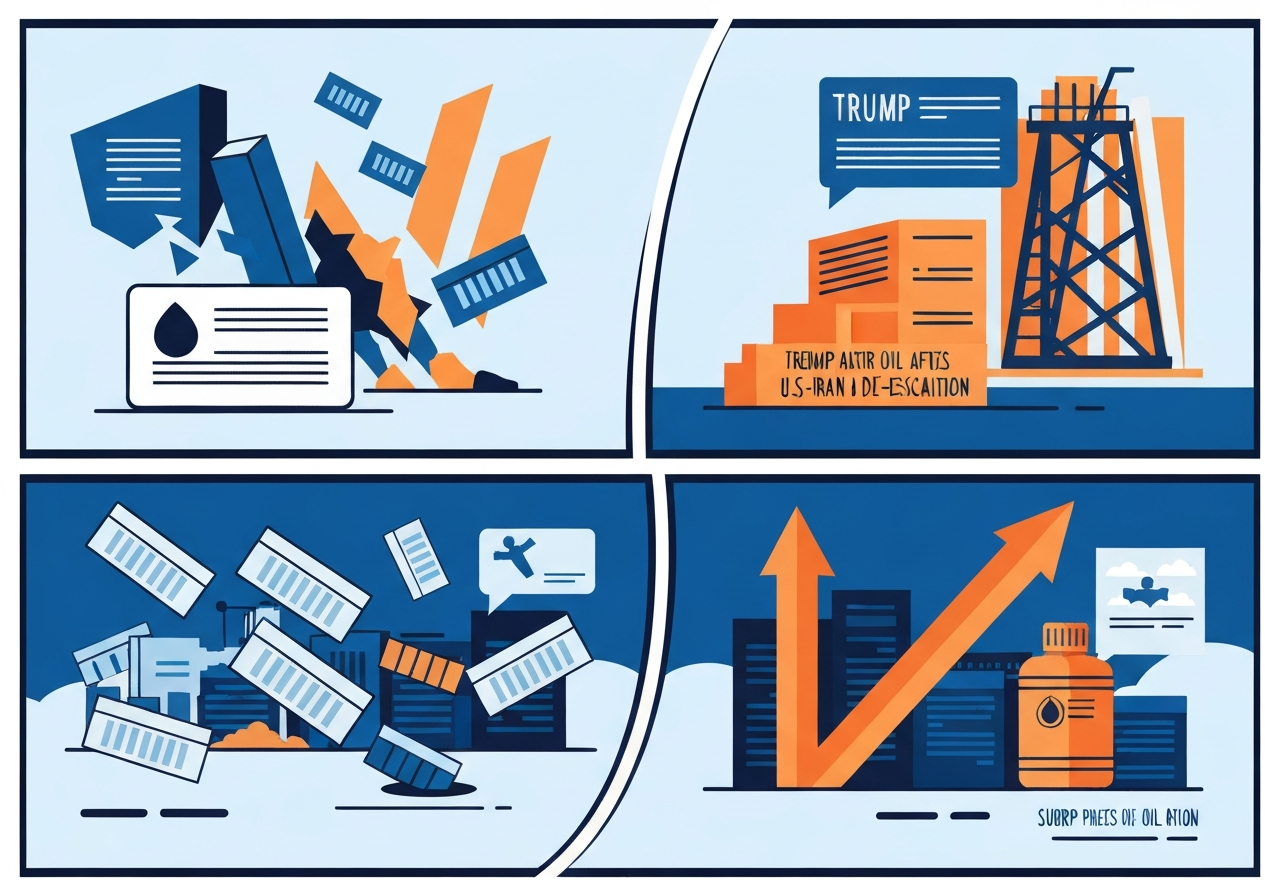
Lead: U.S. and global markets swung on Thursday after President Donald Trump’s Wednesday address signaled continued military action tied to the U.S.-Iran confrontation. Oil jumped roughly 10% with West Texas Intermediate near $110 a barrel, while major equity indexes suffered sharp early losses before later recouping some ground. Traders cited renewed uncertainty over the Strait of Hormuz and fresh headlines about an Iran-Oman transit protocol that briefly eased fears. The net effect: commodities rallied, cyclical and travel-related stocks slumped, and risk assets priced in a longer, more volatile period of geopolitical friction.
Key takeaways
- Oil surged about 10%; WTI traded around $110.21 per barrel and Brent near $109.25 as of early Thursday trading, with intraday highs briefly above $113.
- U.S. stock indexes fell sharply at the open—Dow briefly down about 668.5 points—before recovering to modest gains later in the session.
- Coinbase received conditional approval from the U.S. Office of the Comptroller of the Currency to operate as a trust bank, potentially expanding payments services under federal supervision.
- Tesla reported Q1 deliveries of 358,023 vehicles, up 6% year‑over‑year but down 14% from the prior quarter; shares slid more than 5% after the release.
- Initial jobless claims unexpectedly fell to 202,000 for the week ended March 28, continuing a low‑layoff trend ahead of Friday’s jobs report.
- The U.S. trade deficit was $57.3 billion in February, up 4.9% from January but down nearly 55% from a year earlier.
- Eleven S&P 500 names hit 52‑week lows while five reached 52‑week or all‑time highs during Thursday’s session, underscoring broad market rotation.
Background
The recent U.S.-Iran conflict has been a persistent source of market volatility, amplifying moves in oil and risk assets. Strait of Hormuz shipping concerns are especially salient because around a fifth of global seaborne oil passes through that chokepoint; any disruption raises immediate supply concerns and pushes energy prices higher. Political signaling from Washington and Tehran has become a near‑daily market input, with speeches and military developments rapidly priced into futures.
Investor expectations for a quick de‑escalation had supported equities earlier in the week, but that optimism was fragile. Markets had been balancing hopes for a diplomatic or negotiated wind‑down against the likelihood of episodic flare‑ups. The arrival of potential cooperative measures—such as a reported Iran‑Oman protocol for Strait transit monitoring—provided intermittent relief, but comments suggesting further strikes delayed an outright return to calm.
Main event
President Trump’s remarks on Wednesday night, in which he warned of additional military strikes over the coming two to three weeks, triggered a sharp market response. Oil futures jumped immediately, reflecting a re‑pricing of short‑term supply risk. Energy producers and related stocks gained in premarket and early trading, while travel and discretionary names, sensitive to fuel costs and demand outlooks, fell.
Equity indexes opened substantially lower—Dow down roughly 1.4% intraday and the Nasdaq off more than 2% at its worst—before headlines that Iran and Oman were drafting a protocol to monitor Strait of Hormuz traffic helped lift risk appetite. By midday the three major U.S. indexes had trimmed losses and in some cases ticked into positive territory, illustrating how intraday news flow continues to dominate sentiment.
On the corporate front, several developments intersected with the geopolitical narrative. Coinbase disclosed conditional OCC trust charter approval, which, if finalized, would allow expanded payment products under federal oversight; the stock traded lower amid the broader market pullback. Tesla’s mixed delivery and production figures—358,023 deliveries in Q1, up 6% year‑on‑year but down 14% from Q4—prompted investor re‑rating as the company shifts focus toward AI and other initiatives.
Analysis & implications
Higher oil prices raise near‑term inflation risks and can complicate central bank policy calculations, even as jobless claims and other data point to a resilient labor market. A sustained spike in energy costs would increase input prices for transportation and manufacturing, potentially slowing consumer spending if gasoline costs rise significantly. Policymakers will watch whether the oil move is ephemeral or signals a persistent risk premium tied to prolonged geopolitical friction.
For markets, the current pattern—sharp moves on headline risk followed by partial reversals when diplomatic or monitoring steps appear—suggests elevated volatility will persist. Traders are effectively pricing a range of outcomes: a short, intense period of military action (consistent with the “two‑to‑three week” frame cited by the White House) versus a drawn‑out campaign that would sustain energy premiums and weigh on growth‑sensitive sectors.
Corporate earnings and cash flow assumptions may be tested if fuel costs remain elevated. Sectors with direct exposure—airlines, cruises, and logistics—face margin pressure, while energy producers stand to benefit near term. Investors seeking safety may also rotate toward defensive sectors and high‑quality fixed income if the geopolitical risk intensifies.
Comparison & data
| Measure | Before Trump speech | After speech (session peak) |
|---|---|---|
| WTI crude | Below $100 per barrel | ~$110.21 (intraday peak > $113) |
| Brent crude | Below $100 per barrel | ~$109.25 |
| Dow Jones | Flat to mildly lower | Down as much as 668.5 points intraday, recovered later |
Context: the table highlights how rapid headline shifts have altered price levels within a single session. Oil’s move from sub‑$100 into the low‑$110s reflects the market’s sensitivity to short‑term supply risks tied to the Strait of Hormuz and potential military activity. Equity moves show the typical knee‑jerk risk‑off reaction followed by selective stabilization as more information becomes available.
Reactions & quotes
“What often happens with the stock market is that any certainty is often considered a positive. A two‑to‑three week time frame is much better than two to three months.”
Larry Tentarelli, Chief Technical Strategist, Blue Chip Daily Trend Report
Context: Tentarelli argued that a defined short time horizon for strikes can be treated by markets as better than an open‑ended conflict, and that perception can help equities recover.
“Equity markets are kind of numbing to what crude is doing…while markets are forward‑looking, the moves in crude contradict that optimism.”
Ryan Detrick, Chief Market Strategist, Carson Group
Context: Detrick highlighted the decoupling that sometimes occurs between equity optimism about a diplomatic near‑term solution and energy markets which price immediate supply risk.
“Over the long haul we will be able to explore, with the OCC, offering not just custody products but also other infrastructure products, particularly around payments.”
Paul Grewal, Chief Legal Officer, Coinbase (company statement)
Context: Coinbase emphasized the conditional trust charter would not make it a commercial bank, but could broaden payment and settlement services under federal oversight.
Unconfirmed
- Details on any formal, signed Iran‑Oman protocol remain fluid; early reports described drafting and monitoring plans rather than a finalized agreement.
- The timing and scope of additional U.S. strikes—beyond the administration’s public remarks—are subject to change and have not been fully disclosed.
- Draft measures reported about 100% tariffs on patented drugs were described in a leaked draft; final policy action and exemptions were not confirmed at the time of reporting.
Bottom line
The market reaction underscores how geopolitics can reassert itself abruptly, pushing commodity prices and rotating sector leadership even in an otherwise resilient economic backdrop. Oil’s rapid rise injects a fresh inflation and growth risk into the near‑term outlook, while equities will likely remain sensitive to daily headlines about military activity and diplomatic steps.
Investors should expect higher volatility and short‑term dislocations: energy names may outperform while travel and rate‑sensitive sectors face pressure. Policy and corporate responses—plus the next batch of economic data, including Friday’s jobs report—will be decisive in whether markets see this episode as a brief risk premium uptick or the start of a longer period of elevated energy‑driven uncertainty.