
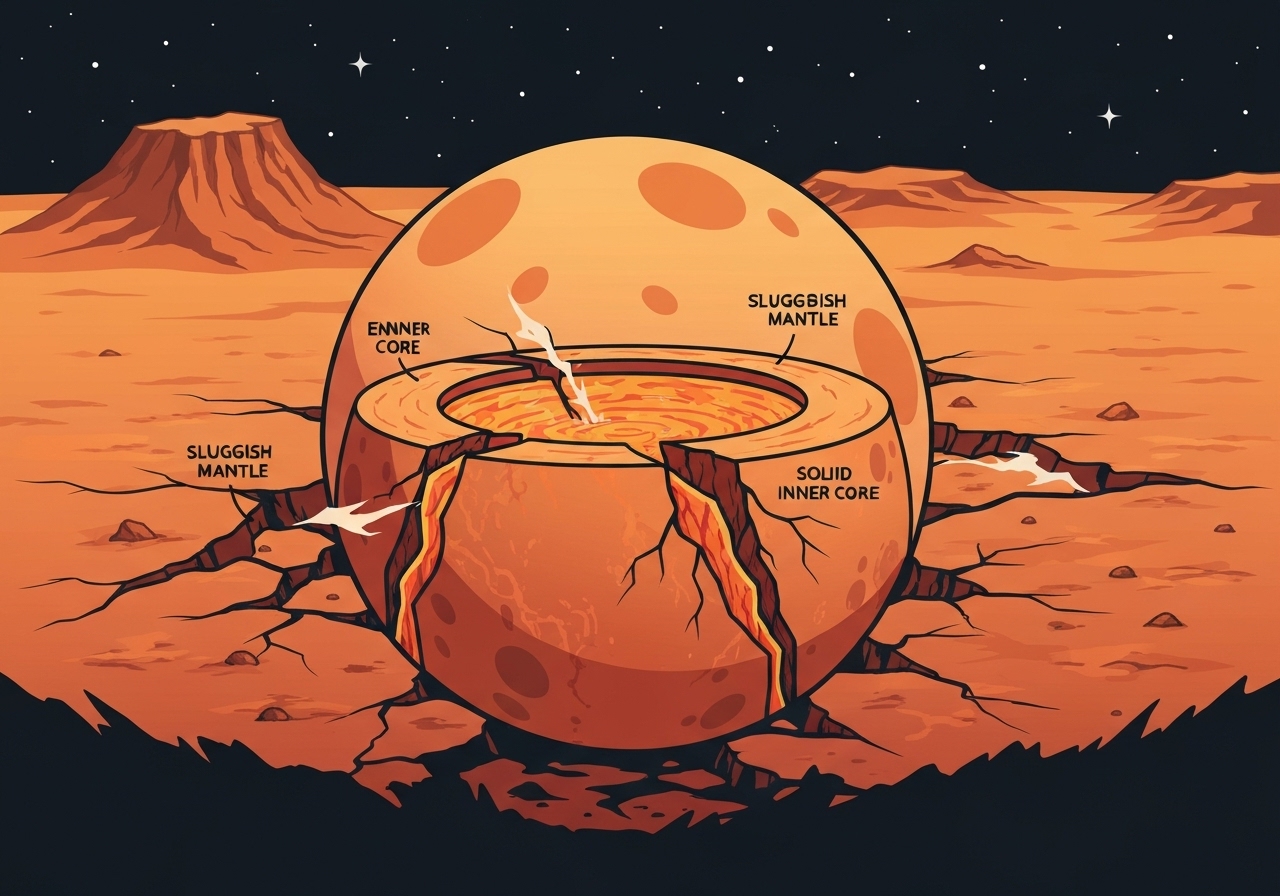
Quakes on Mars Reveal Sluggish Mantle and Solid Inner Core
Lead: Using seismic records from NASA’s retired InSight lander, teams reporting in Nature and Science in early September 2025 found that Mars hosts a solid inner core about 375 miles in radius and a mantle scattered with ancient, meter-to-mile-scale debris down to roughly 870 miles — results that reshape views of the planet’s early impacts and why it lost a global magnetic field.
Key takeaways
- Data come from InSight’s seismometer, which logged more than 1,300 marsquakes during its mission.
- One study finds high-frequency seismic waves were delayed and scattered, indicating a debris-rich, slowly convecting mantle.
- Another analysis shows low-frequency waves traveled faster through the planet’s center, consistent with a solid inner core beneath a liquid outer core.
- The inferred inner core radius is about 375 miles; seismic timing differences reached up to ~200 seconds compared with a fully liquid center.
- Debris in the mantle appears down to ~870 miles depth, with fragments exceeding two miles across in places.
- Researchers suggest one or more catastrophic impacts likely injected the material; the mantle’s sluggishness may have preserved it for billions of years.
- These findings carry implications for Mars’s thermal evolution and the disappearance of its global magnetic field.
Verified facts
InSight, launched by NASA’s Jet Propulsion Laboratory in 2018, recorded seismic activity from the Martian surface until dust accumulated on its solar panels. The mission recorded more than 1,300 quakes and returned a final selfie on (mission sol 1,211), after which operations ceased.
One research team analyzed eight quakes that produced seismic waves across a range of frequencies. They observed that higher-frequency arrivals were delayed by tens of seconds relative to lower-frequency waves. Numerical modeling showed those short-wavelength signals scattered off discrete, higher-density or compositionally distinct blocks embedded within the mantle.
A separate group focused on low-frequency signals from more than 20 marsquakes. Their timing analysis indicated compressional waves crossing the planet’s central region arrived up to about 200 seconds earlier than models with a fully liquid core predict, implying an inner solid region beneath a liquid outer core.
The combination of results points to a two-layer core (liquid outer, solid inner) with the inner core radius near 375 miles, and a mantle that contains kilometer-scale heterogeneities reaching roughly 870 miles beneath the surface. Both findings are reported in papers appearing in Science and Nature in early September 2025.
Context & impact
Mars is often described as a frozen snapshot of early rocky-planet evolution because, unlike Earth, it has a single, stagnant crustal lid rather than active plate tectonics. That stasis can preserve evidence of ancient processes that Earth’s recycling crust erases.
A debris-filled, sluggish mantle would be less effective at removing heat from the core. On Earth, vigorous mantle convection helps drive outer-core motion that sustains a protective geomagnetic field. Mars’s weaker mantle circulation may have contributed to the shutting down of a once-active dynamo and the disappearance of a global magnetic field.
Identifying impact-generated debris deep in the mantle also provides a record of the scale and timing of early bombardment. If one or more massive collisions delivered the material, those events would have altered Mars’s thermal and magnetic evolution and potentially influenced surface conditions relevant to habitability.
- Scientific follow-ups planned or already proposed include more detailed waveform inversions and comparisons with impact modeling.
- Future missions that will expand seismology beyond Mars — such as NASA’s Farside Seismic Suite to the Moon (launch planned 2027) and Dragonfly to Titan (2028) — will test how common these interior patterns are across other worlds.
Official statements
“There are connections to our own planet and to how planets form in general — comparing Mars to Earth helps reveal which processes are universal and which depend on specific histories,”
Ingrid Daubar, Brown University (commenting on the new papers)
Unconfirmed
- Exact origin of the mantle debris: individual massive impacts versus a sequence of strikes remains unsettled.
- Timing of the impacts that produced the debris is not yet pinned down to a precise epoch.
- Whether mantle sluggishness alone explains the loss of Mars’s magnetic field or if chemical evolution and core composition also played decisive roles.
Bottom line
Seismic records from InSight have revealed a more complex Martian interior than previously demonstrated: a solid inner core sits beneath a liquid layer, while the mantle is riddled with long-preserved debris. Together these observations revise models of Mars’s thermal and magnetic history and will inform comparative studies of rocky planets across the solar system and beyond.