
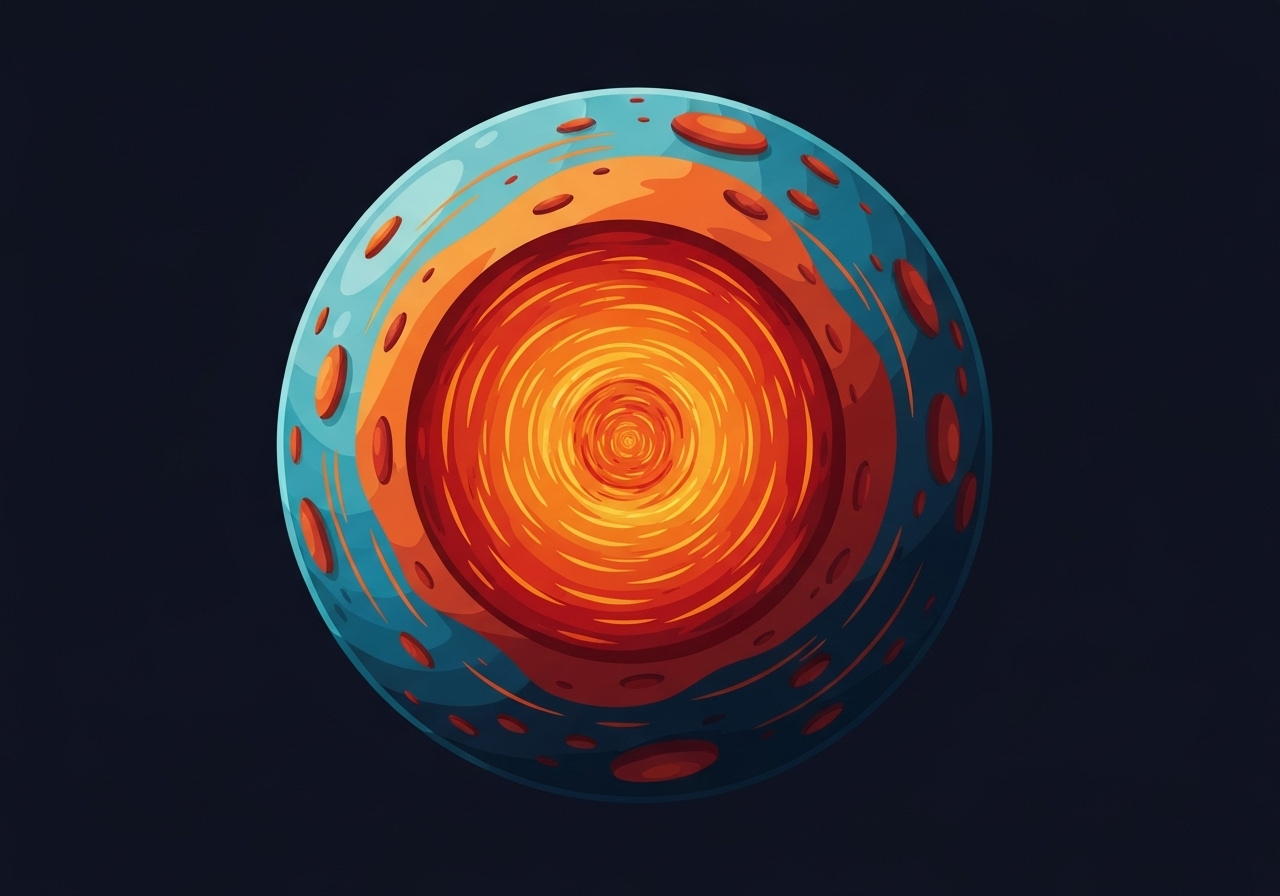
Researchers analyzing seismic data from NASA’s InSight lander report a 610 km solid inner core beneath a liquid outer core on Mars, a discovery published in Nature on 7 September 2025 that strengthens the idea Mars once generated a magnetic field and may have had a thicker, water-friendly atmosphere.
Key Takeaways
- New analysis of InSight seismic signals indicates a solid inner core about 610 km in radius inside Mars.
- The solid layer sits within a larger liquid outer core, a structure more like Earth’s than previously confirmed.
- The finding appears in Nature (Huixing Bi et al., 2025) and used refined event selection and signal-processing to extract a weak inner-core boundary signal.
- Earlier InSight work (Stähler et al., 2021) identified a large, low-density core and did not rule out extra layering; later revisions (Samuel et al., 2023) adjusted core size estimates.
- A solid inner core implies crystallization as Mars cooled and makes a past dynamo—and thus a protective magnetic field—more plausible.
- Confirming this model will require further reanalysis of InSight data and comparison with geochemical and magnetic crustal constraints.
Verified Facts
The result comes from a team led by Huixing Bi (University of Science and Technology of China) and colleagues, reported in Nature on 7 September 2025 (DOI: 10.1038/s41586-025-09361-9). They isolated specific seismic event types at suitable distances from InSight and applied advanced processing to identify signals consistent with an inner-core boundary.
The reported solid inner core radius is ~610 km. That layer lies inside a liquid outer core, consistent with prior detections of a core by InSight seismic studies. Earlier analyses (Stähler et al., 2021) characterized a very large, low-density liquid core—quoted around 1,800 km in earlier summaries—and noted the data then available did not have a strong enough signal to detect an inner-core boundary.
InSight landed on Mars in November 2018 and its last contact with Earth was in December 2022. The mission collected marsquake records and other geophysical observations that have enabled these interior studies. Subsequent re-analyses, such as revisions by Henri Samuel and colleagues in 2023, helped narrow core size and density estimates and left room for layered-core models.
The presence of a solid inner core indicates that crystallization is occurring as Mars cools. On Earth, interactions among a solid inner core, liquid outer core, and mantle drive convection in the liquid layer and sustain a geodynamo that produces a global magnetic field. A similar internal structure on Mars therefore increases the plausibility that a core-driven dynamo operated there in the past.
Context & Impact
Why this matters: a long-lived magnetic field can shield a planet’s atmosphere from solar wind stripping. Mars shows abundant surface evidence—dry lake beds, hydrated minerals, and valley networks—that water once flowed more freely. A past dynamo could have helped preserve a thicker atmosphere and milder climate billions of years ago.
Immediate scientific implications include:
- Re-evaluating thermal evolution models of Mars to account for inner-core crystallization.
- Revisiting the timing and duration of any Martian dynamo and its role in atmospheric loss.
- Comparing seismic models with geochemical constraints on core composition (elements like sulfur, carbon, hydrogen affect melt temperatures and density).
Community response will focus on testing the new model against independent constraints and on whether alternate signal interpretations remain viable. The authors themselves used careful event selection and noise suppression; independent re-analyses of InSight records will be important for confirmation.
“We detect seismic phases consistent with a 600‑plus km solid inner core beneath Mars’ liquid outer layer.”
Huixing Bi et al., Nature (2025)
Unconfirmed
- Whether Mars’ solid inner core actually powered a sustained global dynamo and, if so, the timing and duration of that dynamo.
- Precise core composition and the proportion of light elements inferred from seismic density estimates remain model-dependent.
- How well this inner-core model reconciles with all magnetic, geological, and geochemical constraints across Mars—further study is required.
Bottom Line
The reported 610 km solid inner core inside a liquid outer core brings Mars closer to having an Earth-like internal architecture and strengthens hypotheses that a core-driven magnetic field once existed. Confirmation will depend on further analyses of InSight data and cross-disciplinary checks with magnetic and geochemical evidence; if upheld, the result refines our picture of Mars’ thermal history and its transition from a wetter past to the cold, dry world we see today.