
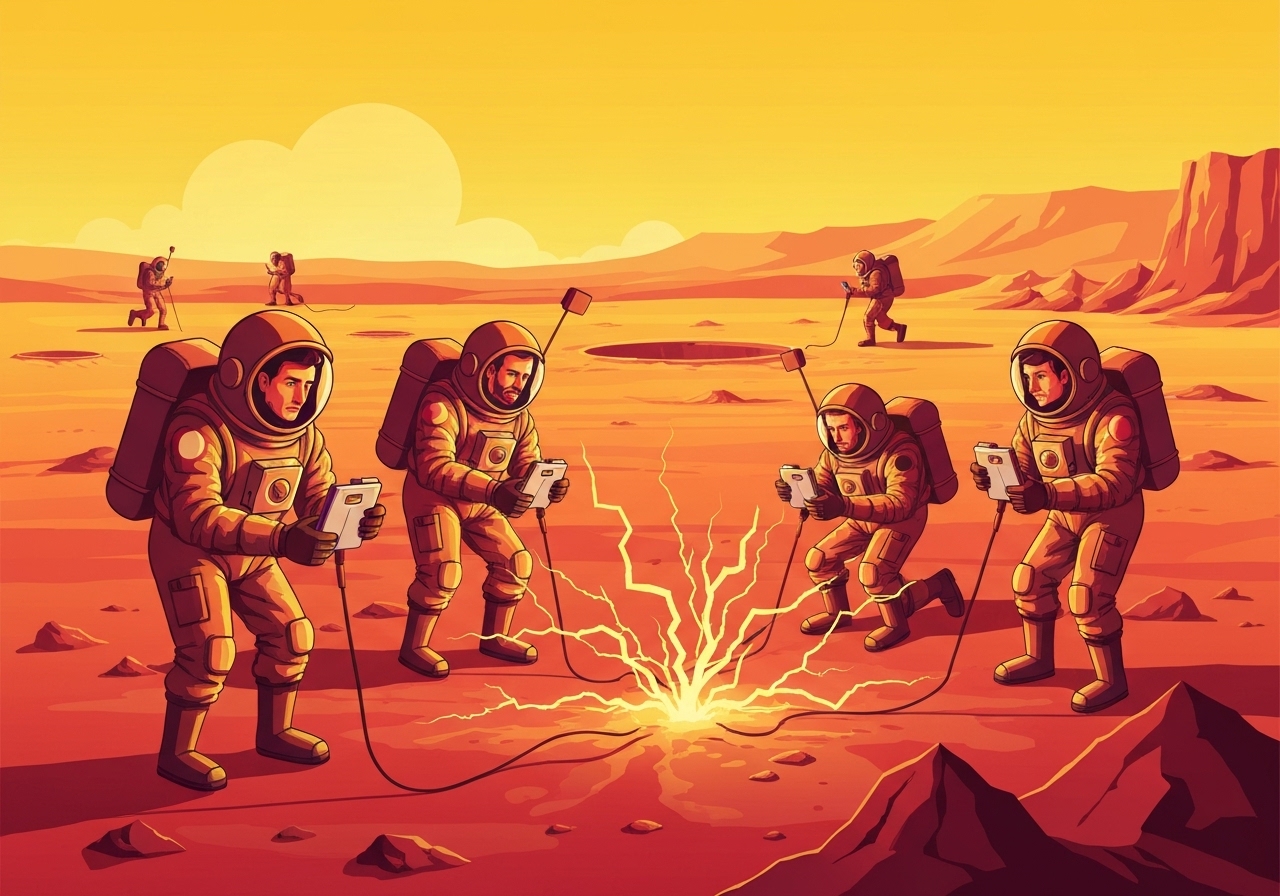
Lead: Scientists say NASA’s Perseverance rover recorded crackling, static-like electrical discharges on Mars—what researchers describe as “mini lightning”—captured by the rover’s microphone over two Martian years. The sounds, 55 discrete events in the analysis, clustered with dust storms and dust devils and were detected at close range by a microphone mounted on the rover’s mast. The discovery, reported by a French-led team and discussed alongside expert commentary in Nature, suggests previously unseen electrical activity on the Red Planet and raises questions about local chemistry and equipment vulnerability.
Key Takeaways
- Perseverance’s microphone recorded 55 electrical-discharge events over two Martian years, primarily during dust storms and dust devils.
- The discharges were detected within about 6 feet (2 meters) of the rover’s mast microphone and were identified in ~28 hours of recorded audio.
- Short discharges associated with dust devils lasted a few seconds; dust-storm-related activity persisted up to about 30 minutes.
- The lead author is Baptiste Chide (Institute for Research in Astrophysics and Planetology, Toulouse); independent commentary appeared from Cardiff University’s Daniel Mitchard.
- Researchers stress the signals were acoustic and electrical but visually unobserved; confirmation will require purpose-built instruments on future missions.
- While Jupiter and Saturn have confirmed lightning, this evidence marks a potential first for Mars and could affect surface chemistry and sensitive electronics.
Background
For roughly 50 years scientists have hypothesized that Mars could host electrical activity produced by friction among dust grains in its thin, CO2-rich atmosphere. Unlike Earth’s dense atmosphere, Mars’ lower pressure and different composition change how sound propagates and how electrical discharges form. Perseverance arrived at Jezero Crater in and carries a suite of instruments—including a microphone primarily intended to record laser-induced rock vapors—that unexpectedly captured atmospheric audio.
Past planetary missions confirmed lightning on gas giants such as Jupiter and Saturn; Mars remained an open question because direct detection is difficult and transient events can be subtle. Dust storms and dust devils are frequent on Mars and are implicated in charging processes: moving grains pick up charge and can create local electric fields strong enough to spark. The possibility of even small, localized discharges has implications for atmospheric chemistry and for the design and operation of future surface hardware.
Main Event
The French-led research team examined about 28 hours of Perseverance audio and correlated acoustic signatures with electric-sensor data to identify 55 instances of crackling sounds they interpret as tiny electrical arcs. Most events coincided with the windiest Martian sols and with visible dust activity recorded by the rover’s cameras. The arcs were described as being only inches (centimeters) in scale but occurring as close as 6 feet (2 meters) from the microphone atop the rover’s mast.
Researchers categorized the events by context: those linked to fast-moving dust devils produced brief, second-scale discharges, while those during broader dust storms could persist for as long as 30 minutes. The audio contained characteristic static-like pops and crackles clearly audible above ambient wind noises and dust impacts. The team published their description alongside a commentary in the journal Nature, framing the observation as a chance discovery made with an instrument that was not originally intended to detect planetary lightning.
Lead author Baptiste Chide emphasized the potential chemical consequences, noting that electrical discharges can drive reactions in local atmospheric gases and on particle surfaces. Independent experts cautioned that the evidence, while persuasive, rests on a single instrument and on acoustic detection rather than direct optical confirmation; they called for additional missions or dedicated sensors to corroborate the finding.
Analysis & Implications
If confirmed, localized electrical discharges on Mars would expand our understanding of Martian atmospheric processes and surface chemistry. Electric arcs can dissociate molecules, generate reactive species, and alter the oxidation state of dust and rocks; over geological timescales this could affect interpretations of past habitability signals in collected samples. For missions focused on biosignatures, the possible alteration of organic molecules by discharge-driven chemistry is a consideration for sample selection and laboratory analysis.
The operational risk is primarily to sensitive electronics and instrumentation. Experts note the discharges are small and unlikely to produce human-level lightning strikes, but frequent micro-discharges could induce electrostatic discharges that degrade instruments, cause transient glitches, or accelerate wear on components. Spacecraft designers may need to reassess grounding, shielding, and testing protocols for future crewed and robotic surface assets.
Scientifically, the finding opens targeted research avenues: quantifying discharge frequency across seasons, mapping correlations with dust loading and wind speed, and establishing whether discharges contribute measurably to atmospheric chemistry such as transient oxidants. International mission planners may prioritize dedicated electric-field and high-speed optical sensors to move from acoustic inference to direct detection and characterization.
Comparison & Data
| Event context | Recorded count | Typical duration |
|---|---|---|
| Dust devils | Majority of short events | Seconds |
| Dust storms | Fewer but longer episodes | Up to ~30 minutes |
The team analyzed roughly 28 hours of audio and electrical-sensor data, finding 55 events over two Martian years. Because Mars’ atmosphere is thinner, acoustic signals are attenuated and travel differently than on Earth, which means detection likely reflected very local discharges near the rover rather than long-range lightning.
Reactions & Quotes
“It opens a completely new field of investigation for Mars science,” said Baptiste Chide, describing how electrical discharges could influence Martian chemistry and our interpretation of surface samples.
Baptiste Chide, Institute for Research in Astrophysics and Planetology (lead author)
“The evidence is strong and persuasive, but it’s based on a single instrument and the discharges were heard rather than seen,” noted Daniel Mitchard, who urged further measurements before a definitive conclusion.
Daniel Mitchard, Cardiff University (independent commentator)
NASA mission scientists highlighted that Perseverance’s microphone and other environmental sensors are providing unexpected science opportunities beyond their original design.
NASA Mars 2020 mission team (official commentary)
Unconfirmed
- No direct optical detection of the discharges has been reported; identification rests on acoustic signatures and correlated electric signals.
- The spatial extent of the phenomenon across Mars is unknown; observations so far are local to Perseverance’s location in Jezero Crater.
- The exact chemical consequences for collected rock and soil samples remain modelled rather than empirically measured.
Bottom Line
Perseverance’s microphone has yielded evidence of small-scale electrical discharges on Mars, most commonly tied to dust activity. While the signals are compelling, they derive from a serendipitous use of an instrument not expressly designed for lightning detection, so independent confirmation is needed.
Confirmed or not, the finding reframes questions about Martian atmospheric chemistry and engineering robustness for future surface missions. Planners and scientists will likely prioritize dedicated electromagnetic, optical, and in situ chemical measurements in follow-up missions to assess frequency, distribution, and practical impacts.