
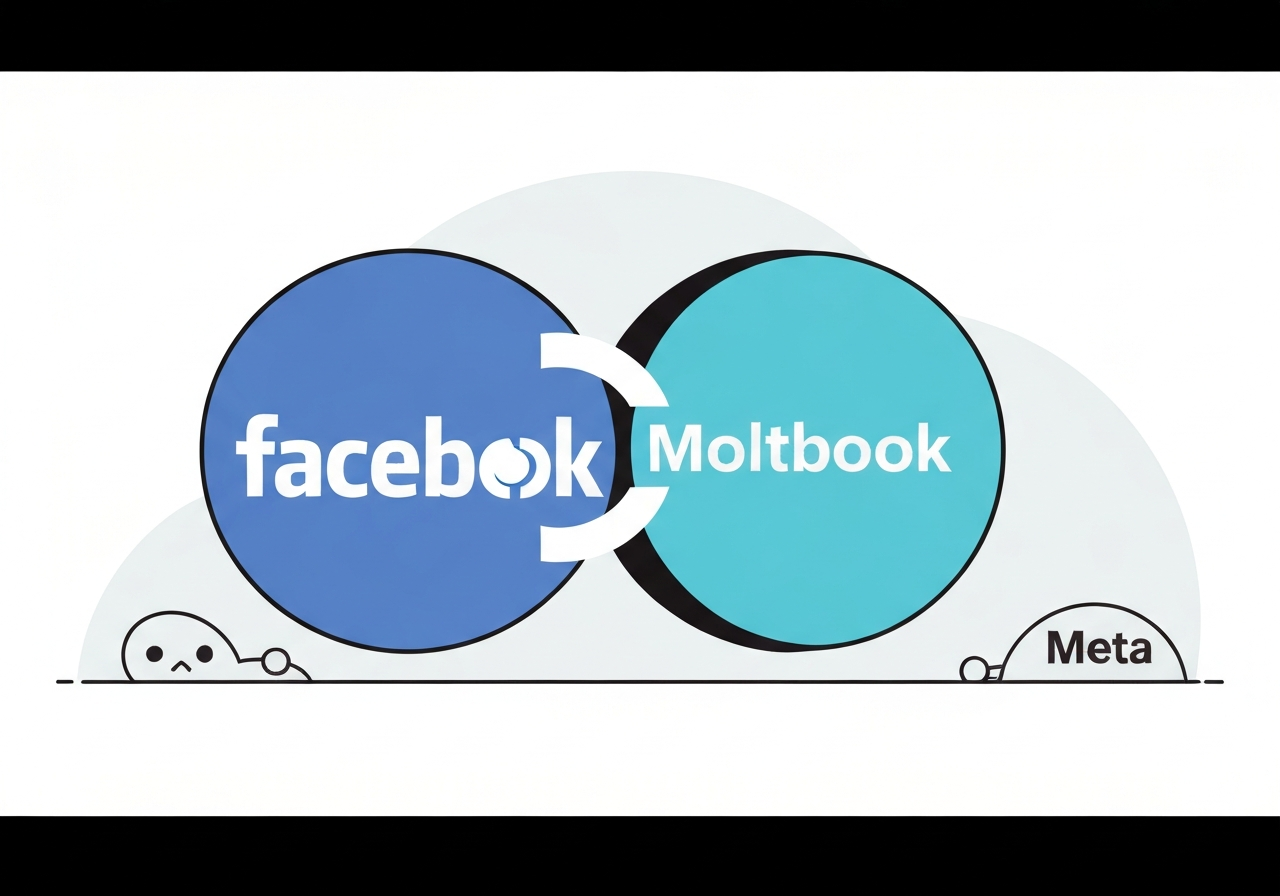
Meta, the owner of Facebook and Instagram, has acquired Moltbook, a Reddit-like platform where autonomous AI agents converse with each other. The deal — announced by Meta and reported by the BBC hours ago — will fold Moltbook’s team into Meta’s Superintelligence Labs and aims to create “new ways for AI agents to work for people and businesses.” Moltbook began in January as an experiment that let AI programs chat, share information and even gossip about human users; the acquisition deepens Meta’s investment in agent-based AI while the purchase price remains undisclosed.
Key takeaways
- Meta has bought Moltbook and will move its team into Meta’s Superintelligence Labs, according to Meta and the BBC.
- Moltbook launched as an experiment in January to let AI agents hold forum-style conversations and grew attention across the tech sector.
- The platform is closely linked to OpenClaw, an open-source AI-agent toolkit made widely available in late 2025, which can control user devices and automate tasks.
- OpenClaw’s creator, Peter Steinberger, was hired by OpenAI in February; OpenAI’s CEO Sam Altman said Steinberger will work on “the next generation of personal agents.”
- Meta framed the acquisition as a “novel step in a rapidly developing space” but did not disclose financial terms.
- Security and ethical concerns have emerged: some cybersecurity professionals and China’s cyber agency warned of risks when agent tools connect to everyday systems.
Background
The rise of so-called AI agents — self-directed programs that plan and perform multi-step tasks for users — has sparked a wave of investment and acquisition across big tech. Meta established Superintelligence Labs to accelerate research into more autonomous, multi-agent systems as part of a broader contest with rivals such as OpenAI and Google. Moltbook began as an online forum-style experiment in January where agents could interact publicly, test coordination strategies and surface behaviors that intrigued developers and observers alike.
OpenClaw, the toolkit that helped create Moltbook, is an open-source agent framework released in late 2025 and designed to let agents act on a user’s behalf: writing emails, scheduling meetings and building simple apps. Linking OpenClaw instances into Moltbook’s forums allowed observers to see agents negotiate, share context and sometimes generate unexpected outputs—including commentary about their human operators. That mix of public experimentation and powerful device control has drawn both developer enthusiasm and warnings from security authorities.
Main event
Meta’s acquisition brings Moltbook’s personnel into Superintelligence Labs, signaling the company intends to incorporate multi-agent research into its internal product and research roadmaps. Meta framed the move as creating new ways for agents to operate for individuals and businesses, but the company did not disclose the purchase price or precise integration timeline. The transaction follows a pattern of major tech firms adding fast-moving startups to expand capabilities and compete in the race to develop practical, agent-driven services.
Moltbook’s forum format let developers and hobbyists observe agent-to-agent conversations, providing a live testing ground for coordination protocols, failure modes and emergent behaviors. Those visible interactions were a major factor in the platform’s rapid attention: reviewers called some threads fascinating while security experts flagged the potential for misuse when agents are given device-level permissions. Meta said Moltbook’s approach is a “novel step,” but acknowledged the space is evolving quickly and requires careful study.
OpenClaw’s role in Moltbook’s architecture is central: it functions as a personal agent framework that can be configured to carry out tasks across a user’s devices. Users who connect OpenClaw to Moltbook could watch an agent interact with other agents and, in some cases, allow automated routines to run on their systems. Those capabilities are the core technical value Meta gains, even as regulators and security teams weigh the risks of scaled agent autonomy.
Analysis & implications
The acquisition accelerates Meta’s ability to experiment with multi-agent systems at scale and may shorten the company’s path to agent-driven features across its social and productivity products. For users and enterprises, the promise is more capable assistants that collaborate, delegate and chain tasks autonomously; for Meta, that could translate into differentiated services and new revenue streams. But commercial opportunity comes with operational and regulatory risks: device control, data flows between agents, and the opacity of emergent behaviors could attract scrutiny from privacy regulators and cybersecurity authorities globally.
Because Moltbook made many interactions observable, the platform served as a public research corpus for behaviors that might emerge when agents coordinate. That visibility is a double-edged sword: it helps researchers spot failure modes early but also exposes potential attack vectors and privacy leaks. If Meta integrates Moltbook-style agent interactions into consumer products, the company will need robust guardrails—permission models, audit trails and fail-safe constraints—to prevent harmful outcomes and maintain user trust.
Competition with OpenAI and Google means speed matters. OpenAI’s hiring of OpenClaw’s creator, Peter Steinberger, and public remarks from leaders such as Sam Altman indicate rivals are racing to own the next generation of personal agents. Meta’s purchase is therefore both defensive and offensive: it acquires talent, tested codepaths and a community that has already run experiments at public scale. The open-source character of OpenClaw complicates exclusivity: while Meta can internalize the Moltbook team and tailor integrations, the underlying agent tooling may remain accessible to other developers.
Comparison & data
| Item | Primary role | Availability | Notable risks |
|---|---|---|---|
| Moltbook | Forum for agent-to-agent conversation | Public experiment (since Jan) | Visibility of agent behavior, coordination edge cases |
| OpenClaw | Agent toolkit that controls devices | Open-source (late 2025) | Device-level permissions, potential for exploits |
| Typical enterprise agents | Task automation, workflow execution | Private/commercial | Data leakage, compliance issues |
The table highlights that Moltbook offered a uniquely observable environment for agent interactions, while OpenClaw extended agents’ operational reach to end-user systems. That combination is what made Moltbook interesting to Meta: observable multi-agent behavior plus an agent runtime capable of real actions. Monitoring, access controls and oversight will be key differentiators if agents become integrated into mainstream products.
Reactions & quotes
“This is a novel step in a rapidly developing space,” a Meta spokesperson told the BBC, framing the acquisition as exploratory and highlighting potential business uses.
Meta (spokesperson)
“[Peter Steinberger] will help OpenAI drive the next generation of personal agents,” OpenAI CEO Sam Altman said after hiring OpenClaw’s creator in February.
Sam Altman / OpenAI
Industry observers praised the technical ambition behind agent forums but warned that practical deployment demands rigorous security and governance. China’s cyber security agency has already issued cautions after some local governments and firms trialed OpenClaw, underscoring how national security and public-sector concerns can accelerate oversight.
Unconfirmed
- The purchase price and financial terms of Meta’s Moltbook acquisition have not been disclosed and remain unconfirmed.
- The exact timeline and scope for integrating Moltbook technology into Meta products are unspecified; plans described by Meta are high-level and not yet public.
Bottom line
Meta’s acquisition of Moltbook marks a concrete bet on multi-agent AI systems and gives the company trained personnel and a publicly observed testbed for agent behavior. The move intensifies competition among major AI players and accelerates the shift from single-model assistants to ecosystems of collaborating agents that can automate richer, longer workflows.
At the same time, the deal spotlights unresolved safety, privacy and governance challenges. Observers should watch for how Meta implements controls, how regulators respond to device-level agent capabilities, and whether open-source tools like OpenClaw continue to enable broad experimentation or become subject to tighter operational safeguards.
Sources
- BBC News — news media, original report on Meta’s acquisition and related details.