
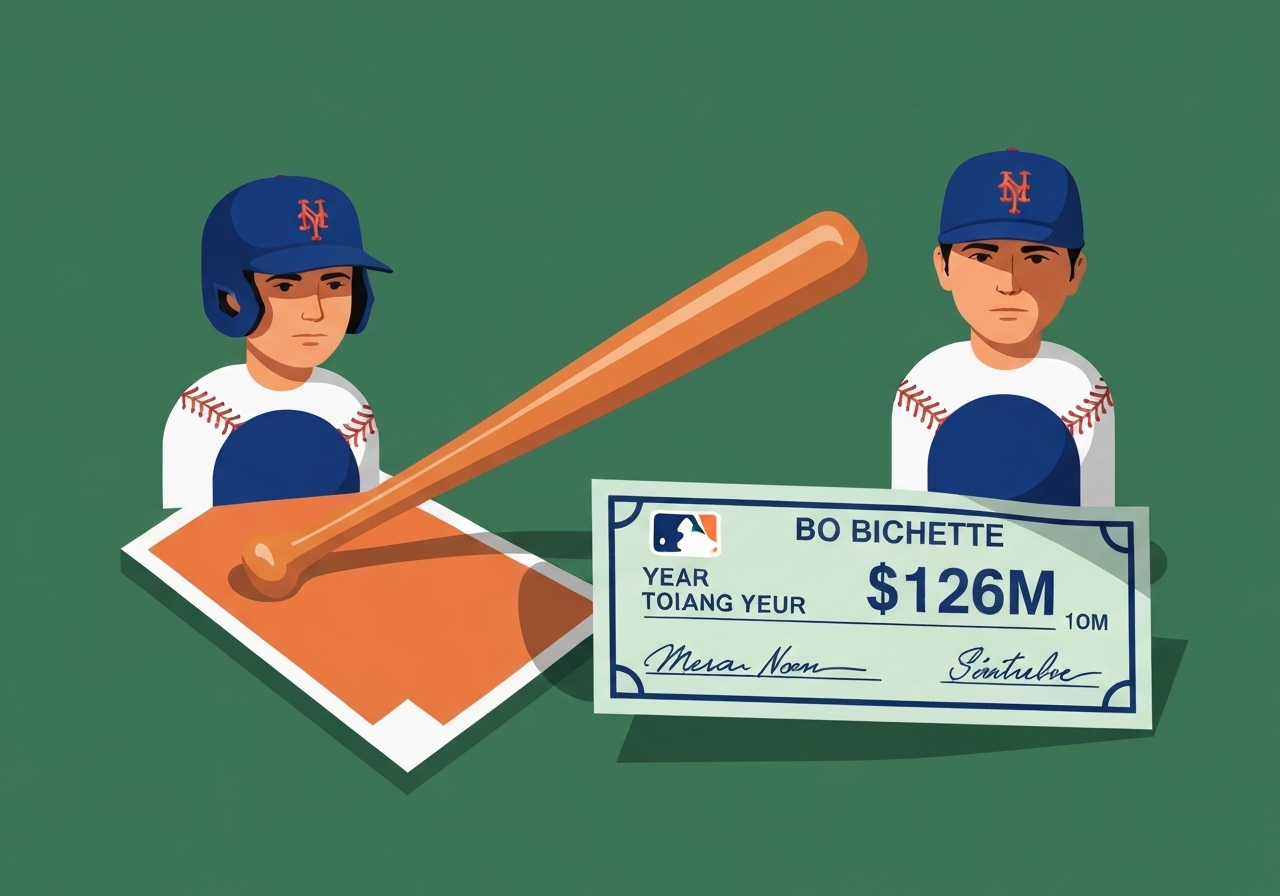
Lead: The New York Mets agreed Friday morning with free agent infielder Bo Bichette on a three-year contract worth $126 million, sources reported. The deal carries a $42 million annual value, includes full no-trade protection and gives Bichette opt-outs after both the first and second seasons with $5 million paid if he exercises either one. Bichette is expected to shift to third base for the Mets, and the contract remains subject to a physical; his agency is Vayner Sports.
Key Takeaways
- The Mets and Bichette reached a three-year, $126 million agreement with a $42 million AAV; the contract reportedly has no deferred money and awaits a physical.
- Bichette has full no-trade protection and two single-season opt-outs (after 2026 and 2027), each carrying a $5 million opt-out bonus if exercised.
- Sources reported Bichette is expected to play third base for New York, a move that would alter the club’s infield alignment and increase the likelihood of trades involving Brett Baty and other infielders.
- In 2025 Bichette posted a .311/.357/.483 line with 18 home runs in 628 plate appearances and a 134 wRC+, his best since 2019; he finished the year especially hot over his final 238 plate appearances (.381/.437/.591, 187 wRC+).
- Bichette suffered a sprained PCL in early September 2025, missed the remainder of the regular season and early postseason, and returned to play in the World Series while visibly limited.
- The $42 million AAV ties for the sixth-largest average annual value in MLB history and pushes the Mets an estimated $33 million past the luxury-tax threshold, greatly increasing their 2026 payroll charge.
Background
New York’s move for Bichette comes immediately after a high-profile free-agent pursuit that ended with Kyle Tucker signing a short-term, record-breaking deal with the Los Angeles Dodgers. The Mets had pursued Tucker aggressively and reportedly offered a four-year, $220 million proposal before Tucker agreed to a four-year, $240 million contract with Los Angeles. Missing on Tucker prompted the Mets to pivot quickly to the next top bat on the market.
Bo Bichette, a second-generation major leaguer, has been a consistent above-average hitter across his career, carrying a lifetime line near .294/.337/.469 into the signing. His 2024 season was curtailed by calf injuries and a broken finger, producing a poor .225/.277/.322 line in 80 games. He rebounded sharply in 2025, which on a rate basis was one of his strongest campaigns to date.
Main Event
Sources report the contract guarantees $126 million over three years with no deferred payments; it also grants Bichette full no-trade protection. The agreement contains single-season opt-outs after Year 1 and Year 2; if Bichette exercises either opt-out he receives a $5 million bonus, according to reporting. The deal remains contingent on Bichette passing a physical and is facilitated by Vayner Sports.
Mets insiders expect Bichette to move across the diamond to third base, a change driven by his defensive profile and the club’s current roster construction. New York’s existing infield has pieces such as Francisco Lindor and Marcus Semien up the middle, leaving the corner infield slots open to reconfiguration. Brett Baty, who had been penciled as the team’s primary third baseman, is now a likely trade candidate or a player whose role will be reworked.
On the field, the Mets get a high-contact, moderate-power bat. In 2025 Bichette produced a 14.5% strikeout rate (a career low), a 91 mph average exit velocity (72nd percentile) and a 48.8% hard-hit rate (83rd percentile). Those metrics underpin his strong 2025 rate numbers, even as durability and late-season injury remain concerns after the PCL sprain in September.
Analysis & Implications
Offensively, Bichette provides an immediate upgrade. His contact profile, low strikeout rate and above-average power make him a top-lineup threat; even if his season was helped by a prolonged hot streak, the peripheral data supports sustainable production. Installed at third base, Bichette’s bat could produce All-Star-type offensive output so long as he remains healthy.
Defensive fit is the principal uncertainty. Bichette’s limitations at shortstop were primarily range-related, and his arm velocity (about 82.3 mph average on throws last season) is roughly average for an infielder and slightly better than the 81.2 mph average previously recorded for Brett Baty. While Bichette is not projected as an elite third baseman, average defense at the position combined with his bat would be a net win for the Mets.
The financial ramifications are significant. The $42 million AAV is among the largest in baseball history and, per payroll estimates, pushes New York well above the luxury-tax threshold. That produces steep surtaxes and effectively magnifies the club’s 2026 hit for Bichette to figures far above his nominal AAV, constraining roster flexibility and future spending choices.
Roster construction will likely shift: the Mets may convert Baty into trade capital and create room for Jorge Polanco’s planned first base/DH usage and other mix-and-match roles. Clubs in need of third base help could pursue Baty, Mark Vientos, Luisangel Acuña or Ronny Mauricio, increasing the likelihood of multiple moves before Opening Day.
Comparison & Data
| Player/Deal | Term | Total | AAV |
|---|---|---|---|
| Bo Bichette (Mets) | 3 years | $126,000,000 | $42,000,000 |
| Kyle Tucker (Dodgers) | 4 years | $240,000,000 | $60,000,000 |
| Mets’ offer to Tucker (reported) | 4 years | $220,000,000 | $55,000,000 |
Context: the Bichette AAV ranks among the top MLB contracts by average annual value and ties the mark of a prior high-end pact. From a payroll perspective, estimates suggest the Mets move roughly $33 million above the luxury-tax threshold because of this signing; the club would face incremental surtaxes (a partial 95% surtax on a lower slice and a 110% surtax on the bulk) that greatly increase the team’s near-term cash cost.
Reactions & Quotes
Team and league insiders framed the move as a fast pivot after Tucker signed elsewhere, and beat writers highlighted the positional plan and contract specifics.
“expected to play third base for the Mets”
Jon Morosi / MLB Network (report)
Morosi’s reporting focused on the defensive plan; that positioning is central to how New York intends to integrate Bichette with Lindor and Semien. The shift to third will have ripple effects for internal depth and trade decisions.
“full no-trade protection”
Jon Heyman / New York Post (report)
That protection makes Bichette’s deal player-friendly and limits the Mets’ ability to move him, reinforcing that any roster churn will come mainly from the club’s other infield assets rather than Bichette himself.
“opt outs after the first and second season”
Ken Rosenthal / The Athletic (report)
Rosenthal’s detail on opt-outs — and the $5 million opt-out bonus tied to exercising them — highlights Bichette’s retained leverage; he can re-enter the market twice during his late-20s window if he chooses.
Unconfirmed
- The final outcome of Bichette’s pending physical has not been publicly announced and may affect guarantee language or roster timing.
- Long-term impact of the September 2025 PCL sprain on Bichette’s defensive range and durability remains uncertain and will require monitoring through spring training.
- Specific trade targets, asking prices and timelines for Brett Baty or other infielders have not been confirmed by the Mets organization.
Bottom Line
The Mets’ signing of Bo Bichette is an aggressive, short-term investment that upgrades their lineup immediately while introducing defensive and payroll questions. Offensively, Bichette offers premium contact and hard-hit metrics that should bolster an already potent middle of the order; defensively, his move to third base is workable but not without risk given past range issues and a recent knee injury.
Financially, the contract’s AAV and player-friendly protections increase New York’s luxury-tax exposure and reduce flexibility for additional big-ticket moves. Expect the Mets to explore trades involving infield surplus, and monitor Bichette’s spring health and early defensive reps closely — the signing changes New York’s offseason calculus and sets a new baseline for the club’s win-now posture.