
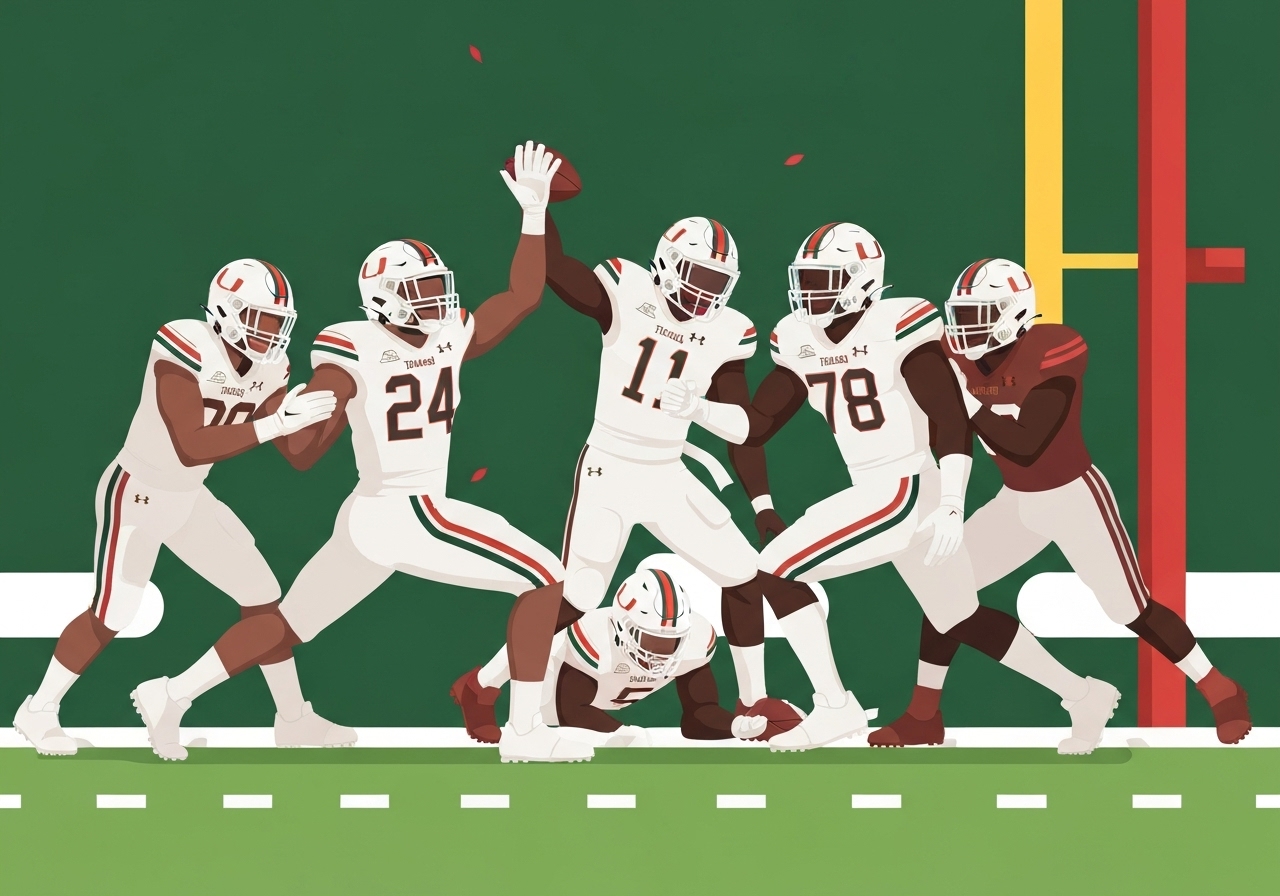
Lead: On Saturday, Dec. 20, 2025, No. 10 Miami stunned No. 7 Texas A&M 10-3 in a College Football Playoff first-round game at Kyle Field in College Station, Texas. The Hurricanes, the final at-large selection by the CFP committee, prevailed after a late goal-line stand and a game-sealing interception. The contest produced the first scoreless halftime in a CFP game since the format began in 2014, and Miami will now meet No. 2 Ohio State in the Cotton Bowl quarterfinal on Dec. 31 in Arlington.
- Score: Miami won 10-3 over Texas A&M on Dec. 20, 2025 in College Station, Texas.
- Historic halftime: The game was scoreless at halftime — the first scoreless halftime in CFP play since 2014.
- Key plays: Miami opened second-half scoring with a field goal; Malachi Toney scored an 11-yard touchdown on an end-around.
- Critical defensive sequence: A&M reached the Miami 5-yard line late but failed on a contested catch and then threw an interception by Bryce Fitzgerald, his second of the game.
- Special teams struggles: Kicks were affected by strong winds; Miami’s Carter Davis and A&M’s Jared Zirkel combined for four missed field goals before Davis converted in the second half.
- Injury scare: Miami defender Mohamed Toure was initially motionless after a goal-line collision but ultimately walked off under his own power.
- Next rounds: Miami advances to play No. 2 Ohio State in the Cotton Bowl on Dec. 31; other first-round games Saturday included Ole Miss–Tulane and Oregon–James Madison.
Background
The College Football Playoff’s opening weekend featured three first-round matchups on Saturday, with Miami entering as the final at-large pick and Texas A&M hosting as the No. 7 seed. Miami’s inclusion drew attention because a disappointed Notre Dame team chose not to pursue a bowl after being left out of the field, heightening scrutiny of the committee’s at-large decisions. The CFP, which expanded its bracket and seeding processes in recent years, places heavy emphasis on résumé, strength of schedule and late-season form when choosing the final slots.
Kyle Field’s gusty conditions have a known effect on both kicking and passing, and that forecast shaped coaching decisions on Saturday. Both teams arrived with different strategic incentives: A&M aimed to assert home-field advantage and ball-control drives, while Miami sought to leverage quick plays and special-teams opportunities to offset being the lower seed. The stage — a CFP first-round game with a berth to face Ohio State awaiting the winner — raised the stakes for conservative play early on, contributing to the rare, scoreless first half.
Main Event
The opening 30 minutes were dominated by defense and wind, as both kickers struggled and neither side found the end zone. Miami’s Carter Davis and Texas A&M’s Jared Zirkel combined to miss multiple field-goal attempts as Kyle Field’s gusts repeatedly pushed attempts wide. The drought ended on Miami’s first drive after halftime when Davis converted a field goal, finally breaking the deadlock.
Shortly after, Miami manufactured the game’s only touchdown when quarterback Carson Beck executed a designed pitch to wide receiver Malachi Toney on an end-around; Toney turned it into an 11-yard score by sprinting down the sideline. A&M responded with urgency, moving into Miami territory and eventually reaching the five-yard-line with a chance to flip the game late.
At the goal line, a contested throw intended for Rueben Owens II was broken up by Miami defender Mohamed Toure in a heavy collision that initially left Toure motionless before he eventually walked off with medical attention nearby. On the following snap, A&M quarterback Marcel Reed’s pass was intercepted by Bryce Fitzgerald — his second pick of the night — sealing the Hurricanes’ 10-3 victory and sending Miami to the quarterfinals.
Analysis & Implications
Miami’s win underscores how short playoff runs can hinge on a few pivotal plays: special-teams execution in adverse weather, a timely gadget play for a score, and an ability to make one more turnover than the opponent. As the final at-large team, Miami enters the next round with momentum and a confidence boost, but the Hurricanes’ kicking uncertainty in windy conditions will be a question mark against stronger opponents like No. 2 Ohio State.
For Texas A&M, the loss will prompt scrutiny of red-zone decision-making and passing execution under pressure. The Aggies advanced to the five-yard-line and had an opportunity to tie; the inability to finish on that drive — compounded by Fitzgerald’s interception — highlights both Miami’s situational defense and A&M’s missed chances in critical moments. Coaches often emphasize finishing drives in the postseason, and this game will be reviewed closely by staff and analysts.
Special teams emerged as a decisive factor: four early missed field goals altered field-position dynamics and forced both offenses to prioritize drives over settling for long attempts. Going forward, both programs will weigh personnel and approach on kicking in windy environments, and NFL scouts or draft evaluators will note how players performed in high-pressure, low-scoring playoff conditions.
Comparison & Data
| Team | Seed | Score | Notable |
|---|---|---|---|
| Miami | No. 10 | 10 | Final at-large; advances to Cotton Bowl vs. Ohio State |
| Texas A&M | No. 7 | 3 | Reached Miami 5-yard line late; intercepted sealing loss |
The table highlights the seeds and outcome; statistically, the unusual scoreless halftime is the standout fact and the first such occurrence in CFP history since the format began in 2014. That rarity underlines how environmental conditions and conservative game plans combined to suppress scoring through two quarters.
Reactions & Quotes
Coach remarks and expert commentary framed the result and key moments.
“Our guys executed when it mattered; that goal-line sequence showed the character of this team.”
Miami head coach (postgame statement)
Miami’s coach praised the defense and situational execution after the game, attributing the win to discipline and timely plays.
“We had chances and didn’t finish; turnovers and the wind made it hard to find a rhythm.”
Texas A&M head coach (postgame press conference)
The Aggies’ coach acknowledged missed opportunities and cited environmental factors, while teammates and analysts noted that A&M’s offensive line and decision-making on short-yardage plays will be focal points in offseason review.
“Big-time games come down to one play — the interception was the turning point.”
College football analyst (broadcast)
Broadcasters and analysts singled out Bryce Fitzgerald’s second interception and Miami’s goal-line defense as the match-deciding elements.
Unconfirmed
- The precise medical diagnosis and full extent of Mohamed Toure’s on-field injury have not been publicly released and remain unconfirmed.
- The detailed reasons behind Notre Dame’s decision to opt out after being left out of the CFP have not been fully documented in official statements.
- Specific wind speed measurements cited by some observers as the direct cause of multiple missed field goals were not provided by either team’s official reports.
Bottom Line
Miami’s 10-3 victory over Texas A&M is a reminder that playoff football often turns on a handful of plays and environmental conditions. The Hurricanes, selected as the bracket’s final at-large entry, now carry momentum into a high-profile quarterfinal matchup with Ohio State on Dec. 31 in Arlington’s Cotton Bowl.
For Texas A&M, the loss will trigger scrutiny over red-zone execution and the ability to adapt under adverse weather; for Miami, special-teams consistency and how the defense performs against top-tier offenses will determine whether this upset is a springboard or an isolated postseason triumph. The CFP’s opening weekend also reinforced that seeding and reputations matter less than situational execution when the playoff clock is ticking.