
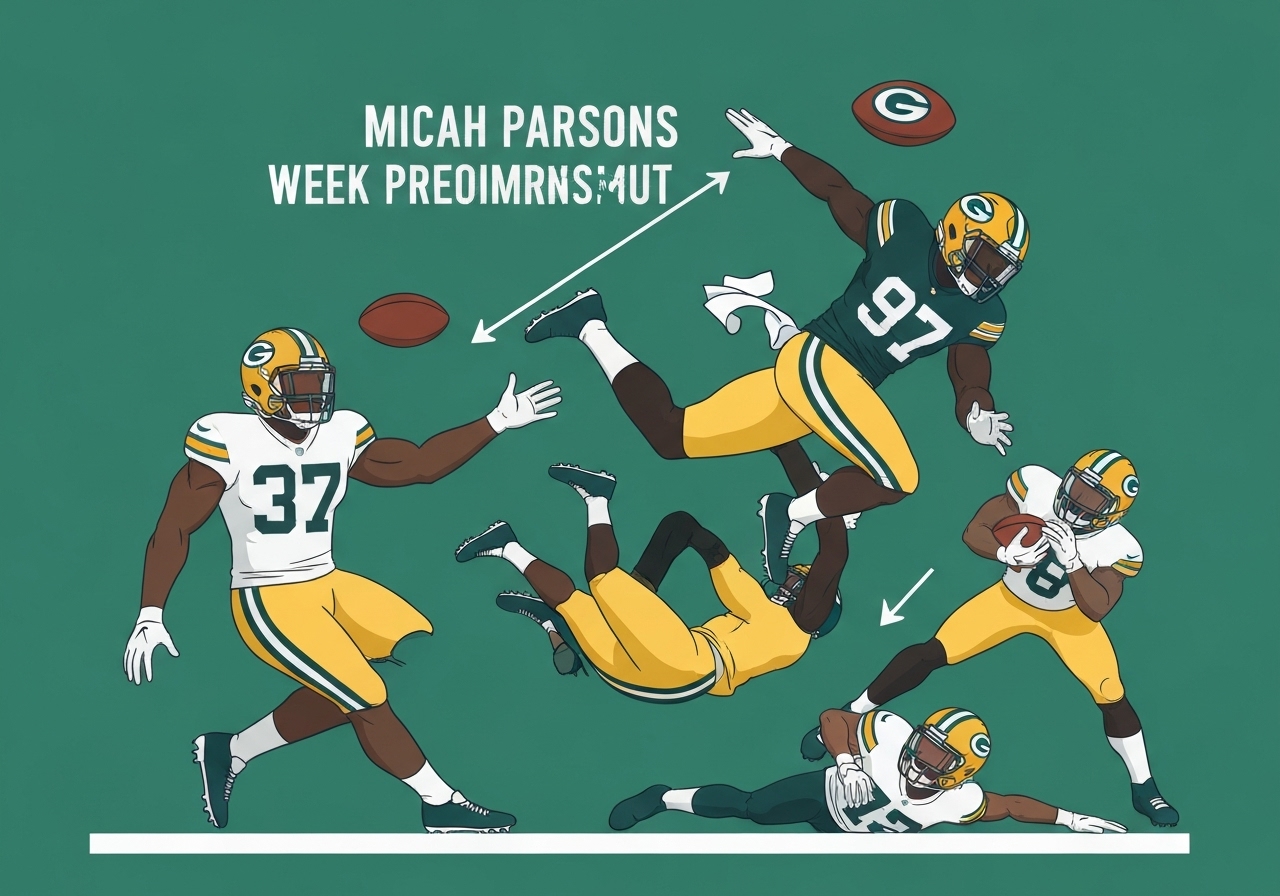
Lead: Week 1 of the 2025 NFL season delivered stark early signals: Micah Parsons made a disruptive debut for the Green Bay Packers, Buffalo edged Baltimore 41-40 in a playoff-caliber matchup, and several teams landed on opposite ends of the momentum spectrum. Notable single-game numbers included Jared Goff facing pressure on 37.2% of dropbacks and the Lions gaining just 46 rushing yards on 22 attempts. The opening weekend produced clear candidates for immediate roster or schematic shifts while leaving several storylines unresolved heading into Week 2.
Key Takeaways
- Micah Parsons’ debut in Green Bay was consequential: the Packers recorded four sacks (tied for third-most in Week 1) even though Parsons played fewer than half of the snaps.
- Detroit’s run game was neutralized — 46 rushing yards on 22 attempts — and Jared Goff was pressured on 37.2% of his dropbacks.
- Justin Herbert threw on 69.5% of plays in the Chargers’ win over Kansas City, the highest pass rate for the Chargers in a Harbaugh victory to date.
- Hyped rookies made immediate impacts: Emeka Egbuka had two TDs (including a 25-yard game-winner) and Jacory Croskey-Merritt rushed 10 times for 82 yards and a score.
- Bills-Ravens ended 41-40 after Matt Prater’s game-winning field goal; Josh Allen totaled 424 yards and four TDs, Lamar Jackson had 279 yards and three TDs.
- Ravens collapsed late despite NextGen Stats assigning them a 98% win probability with 3:50 remaining, a historically rare blown lead.
- Miami’s Week 1 was chaotic: Colts scored on every possession and Miami’s offense opened with interception, fumble, punt, interception.
- Several expected rebuilders underwhelmed (Patriots, Panthers), while a few veteran QBs (Aaron Rodgers, Justin Fields, Daniel Jones) produced unexpectedly high outputs.
Background
The NFL’s opening weekend often sets narratives that can define early perceptions: defensive resurgence, rookie readiness, and veteran bouncebacks. After an offseason of high-profile moves and coaching adjustments, Week 1 offered a first full-game stress test for schemes and personnel. Teams that invested heavily in defense — or in pass-rush talent like Parsons — hoped for immediate returns; other clubs leaned on rookie skill players to provide fast returns on their draft capital. Historically, single-game sample sizes can mislead, but positional and play-type splits from Week 1 supply concrete signals coaches and front offices will weigh when making short-term changes.
Analytic measures such as pressure rate, blitz frequency and targets per route run were front-and-center this weekend. The Packers’ low blitz rate (11.6%) combined with high pressure on Jared Goff (37.2%) illustrated structural defensive effectiveness rather than solely schematic gambling. Meanwhile, next-gen metrics showing near-certain win probabilities (e.g., 98% for Baltimore with under four minutes remaining) highlighted several dramatic collapses that will be dissected by analytics teams. For coaches and executives, Week 1 gives actionable intelligence: safety of starting lineups, in-season development priorities and early trade/roster signals.
Main Event
Green Bay’s emphatic defensive showing was the weekend’s standout. The Packers held Detroit’s run game to 46 yards on 22 attempts and accumulated four sacks, with Micah Parsons emerging as a consistent disruptor despite limited snaps. Parsons’ first sack as a Packer was one of several plays where he turned traffic into immediate pressure; the pass-rush performance was an important validation for Green Bay’s offseason plan. The Lions managed just six points until a late Isaac TeSlaa touchdown made the final score 27-13, but the game largely underlined Green Bay’s defensive control.
In Baltimore, the Bills staged an improbable comeback to beat the Ravens 41-40. Josh Allen delivered a 424-yard, four-touchdown performance and Matt Prater — newly in Buffalo’s kicking mix — supplied the walk-off field goal. Lamar Jackson still produced an efficient 279-yard, three-touchdown game, but his team could not close. The late-game decisions and defensive breakdowns for Baltimore have already attracted scrutiny after a loss that analytics models had almost certainly counted as won with under four minutes left.
Other headline events: Justin Herbert’s heavy pass usage (69.5% pass rate) shifted the Chargers’ identity in the opener, while rookies such as Emeka Egbuka (two TDs, including a 25-yard game-winner) and Jacory Croskey-Merritt (10 carries, 82 yards, TD) delivered. Seattle leaned heavily on Jaxon Smith-Njigba (59.1% targets per route run), but a fourth-quarter fumble contributed to a 17-13 loss to San Francisco. In L.A. and Houston, defenses set the tone — the Rams eked out a 14-9 win where Puka Nacua absorbed a heavy hit but still finished with 10 catches for 130 yards.
Analysis & Implications
Micah Parsons’ arrival in Green Bay changes the early evaluation of the NFC North. Parsons’ ability to disrupt without needing a high blitz rate suggests the Packers can generate heat through design and individual talent, potentially allowing secondary coverages to be more aggressive. If Parsons’ snap count ramps up, expectations for Green Bay’s pass rush and third-down defense will increase, altering game plans for divisional opponents.
Baltimore’s collapse will prompt internal reviews: situational play-calling, late-game defensive calls and special-teams readiness are all on the table. The statistical rarity of their loss — the first since 2000 to blow a lead of 15+ points with possession and under 10 minutes remaining — indicates this is not a product of ordinary variance alone. Ravens coaching decisions (for example, a punt on fourth-and-3 with 1:33 left) will be scrutinized for potential schematic or execution failures.
The Chargers’ shift to a pass-heavy approach in a Harbaugh win raises strategic questions leaguewide. Deploying Justin Herbert on 69.5% of plays could be a tactical pivot that accelerates their offensive ceiling if the protection holds. Conversely, Miami’s offensive implosion and defensive breakdown against the Colts signal deeper schematic or personnel mismatches; Miami’s first four drives (INT, fumble, punt, INT) are unsustainable and increase pressure on coaching staff stability.
Comparison & Data
| Metric | Packers | Lions | Chargers |
|---|---|---|---|
| Rush Yds (Team) | — | 46 (22 att) | — |
| QB Pressure Rate | — | Goff 37.2% | — |
| Blitz Rate | 11.6% | — | — |
| Pass Rate (offense) | — | — | 69.5% |
The table highlights three telling Week 1 splits: Detroit’s inability to run, the unusually low blitz rate the Packers employed while still creating pressure, and the Chargers’ heavy passing script. While single-game numbers are noisy, the alignment of schematic indicators (blitz rate vs. pressure generated) provides cross-checks for what worked and why. Coaches will treat these metrics as inputs to early-week game planning and personnel adjustments.
Reactions & Quotes
“I don’t think I’ve taken too many shots like that one,”
Puka Nacua
Nacua’s comment after sustaining a hard hit in the Rams-Texans game underscored both the physicality of the matchup and his resilience; he still finished with 10 catches for 130 yards. His postgame remark framed how the Rams survived a defensive slugfest to walk away with a 14-9 victory.
“He can handle the moment,”
Team source on Jaxson Dart
A source close to the Giants described rookie Jaxson Dart as composed amid early roster tests. That assessment feeds conversations about whether Brian Daboll will pivot toward the rookie sooner than expected given Russell Wilson’s struggles (46% completion, 4.5 yards per attempt in Week 1).
“We still have a lot to clean up,”
Baltimore coaching staff (paraphrased)
Coaches in Baltimore signaled a thorough internal review after the loss, with staff acknowledging situational decisions and late-game execution will be addressed before Week 2.
Unconfirmed
- Whether the Giants will start Jaxson Dart in Week 2 is undecided; internal evaluations are ongoing and no official starter has been named.
- The long-term snap plan for Micah Parsons in Green Bay has not been disclosed; how quickly his workload increases is subject to coaching decisions and in-game availability.
- Speculation about the longevity of Mike McDaniel’s tenure in Miami is premature; no public organizational statement has confirmed a change in coaching status.
Bottom Line
Week 1 supplied sharp signals and a handful of alarm bells. Green Bay’s defensive investment looks validated in the short term — Parsons’ disruptive presence materially improved pass-rush outcomes even on limited snaps. Buffalo and Baltimore produced an instant classic whose handling of late-game situations will influence play-calling and preparation across the league.
Several teams that underperformed (Miami, New England, Carolina) face a short leash early in the season; Week 2 adjustments will tell whether these are fluky starts or structural problems. For front offices and coaches, the priority is triage: identify fixable execution errors, adjust game plans around emergent strengths (rookie producers, pass-rush gains) and monitor health and workload to convert Week 1 signals into sustained advantage.
Sources
- NextGen Stats (analytics platform)
- The Athletic (sports journalism — original reporting and analysis)
- NFL.com (official league game summaries and box scores)