
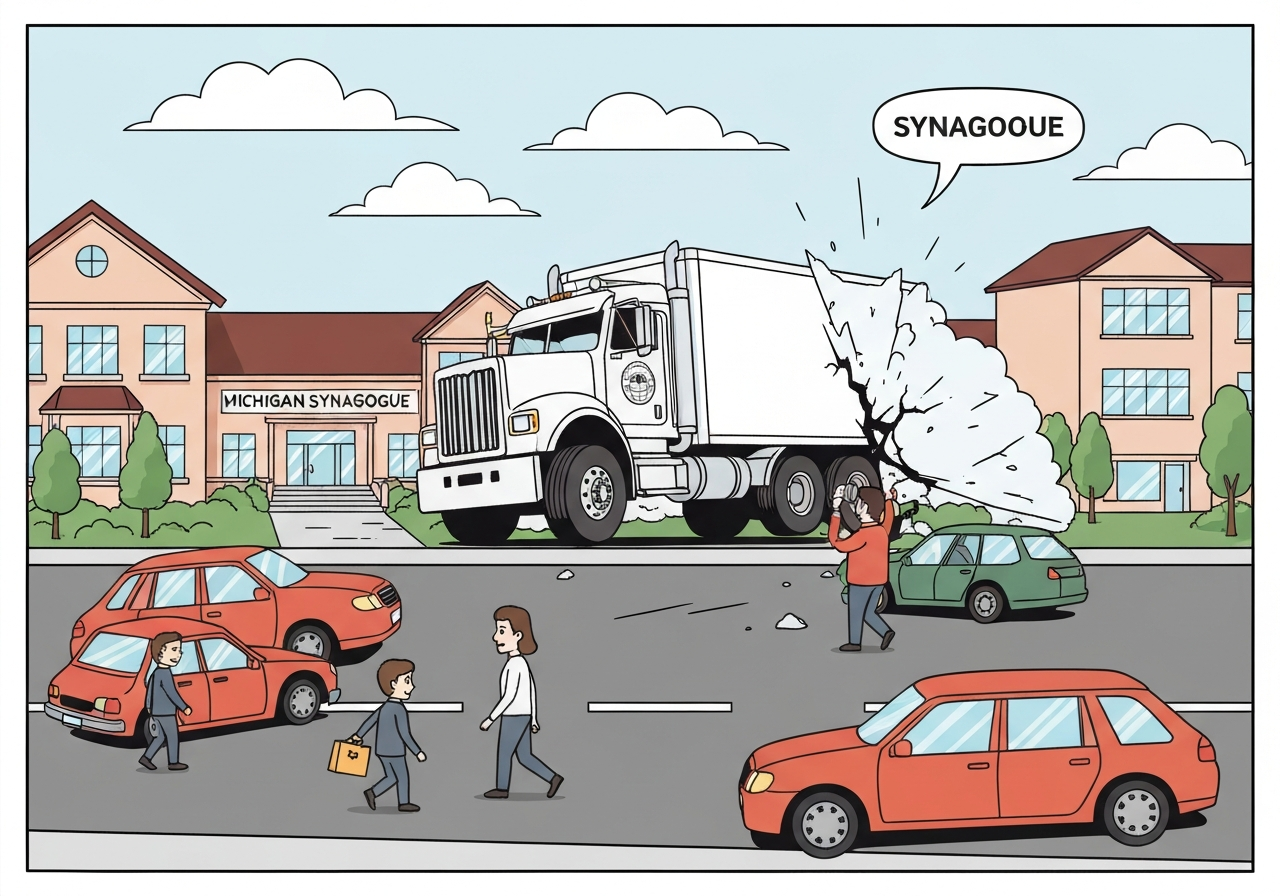
, a pickup truck drove into the parking lot of Temple Israel in West Bloomfield Township, Michigan, and after sitting there for hours the driver plowed the vehicle through the synagogue’s front doors while more than a hundred preschoolers and staff were inside. Security officers exchanged gunfire with the driver; authorities say the attacker, identified as 41-year-old Ayman Mohamad Ghazali, died of a self-inflicted gunshot wound. The building’s engine compartment caught fire and dozens of first responders were treated for smoke inhalation, but officials reported that all children — aged 5 and younger — were evacuated without physical injury. Federal and local investigators are treating the incident as a targeted act against the Jewish community while continuing to probe motive and planning.
- Attack timeline: Ghazali arrived at Temple Israel around 10:00 a.m., remained in the lot for over two hours, then forced entry at about 12:15 p.m.
- Casualties and injuries: The attacker died of an apparently self‑inflicted gunshot after exchanging fire; one security guard was struck by the vehicle but sustained non‑life‑threatening injuries.
- Children: More than 100 preschoolers (ages 5 and under) in the early childhood center were evacuated unharmed.
- Responders: A total of 63 first responders were treated at hospitals for smoke inhalation after entering the building.
- Weapons and materials found: Investigators recovered commercial‑grade fireworks and multiple jugs of flammable liquid in the truck; the attacker had purchased $2,250 in fireworks two days earlier.
- Identity and background: The driver was identified as Ayman Mohamad Ghazali, 41, a naturalized U.S. citizen born in Lebanon who arrived in 2011 and naturalized in 2016.
- Investigative posture: The FBI labeled the incident a targeted attack on the Jewish community; motive remains under active investigation.
Background
Temple Israel is a synagogue with an attached early childhood education center in West Bloomfield Township, a Detroit suburb. Jewish institutions nationwide have operated with heightened security for years amid a documented rise in antisemitic incidents; in 2026, concerns intensified as the U.S.-Israel conflict with Iran and related regional strikes continued. Local and federal law enforcement had been involved in security planning at many Jewish sites in the area, and Temple Israel’s staff had prior training for lockdowns and evacuations. Community leaders say that houses of worship and schools have increasingly adopted measures that resemble small fortifications to protect congregants and children.
Authorities say the attacker lived in Dearborn Heights and worked at a Middle Eastern restaurant there; court records show his divorce was finalized in March 2025. Officials report he had no prior criminal record, no registered firearms, and had not been the subject of an FBI investigation before the incident. Law enforcement sources briefed on the probe say Ghazali appears in some federal databases as linked to individuals described as “known or suspected” Hezbollah associates, though he is not listed as a Hezbollah member; officials emphasize that such database entries do not itself establish motive for this attack. In Lebanon, local officials reported that two of Ghazali’s brothers were killed in an Israeli airstrike on March 5, a development investigators say they are factoring into the inquiry.
Main event
According to investigators, the driver pulled into the synagogue parking lot about 10:00 a.m. and remained there until roughly 12:15 p.m., when he accelerated through the front doors and into an interior hallway. The pickup became jammed between hallway walls, trapping the driver and disabling the vehicle’s movement. Authorities say the driver fired through the windshield; a temple security officer returned fire through the truck’s rear window and another officer engaged from the front, after which the attacker apparently fatally shot himself.
During the exchange, the truck’s engine compartment ignited and smoke spread through the building. Security staff and teachers initiated sheltering and evacuation procedures: staff barricaded in offices until cleared by tactical units, while teachers escorted children out to neighbors and staged safe assembly points. One lead security officer was struck by the vehicle and transported to a hospital with non‑life‑threatening injuries. First responders entered the structure to confirm there were no additional threats; 63 of them later received hospital treatment for smoke inhalation.
Investigators recovered large quantities of commercial‑grade fireworks and several containers of flammable liquid inside the truck; company records show the attacker bought $2,250 worth of fireworks two days prior. Two sources briefed by investigators said the attacker’s body was badly burned, consistent with the post‑impact fire. The FBI’s Detroit field office and local agencies continue to process physical evidence from the vehicle and the building while interviewing witnesses and reviewing digital records.
Analysis & Implications
The attack highlights a layered security challenge: places of worship and education centers must balance daily access with protective measures against rare but high‑impact assaults. The fact that the building houses an early childhood center magnifies the psychological and political consequences, even though physical injuries among children were avoided. Training that staff and security underwent appears to have been decisive in preventing casualties among the youngest occupants; officials and community leaders credited drills and rapid, coordinated response.
At a broader level, investigators are weighing whether the incident was primarily driven by personal grievance, international events, or extremist intent. Officials note the attacker’s recent family losses in Lebanon and the presence of international conflict as contextual factors, but they caution against drawing conclusions before forensic and intelligence analysis is complete. Any confirmed link to foreign actors or organizations would have legal and diplomatic ramifications; conversely, a finding of individual, non‑ideological motives would alter prevention and policy responses.
The discovery of commercial fireworks and flammable liquids introduces questions about intent to cause larger fires or secondary explosions. Procurement records — including the $2,250 purchase at a Phantom Fireworks store — are part of the immediate evidentiary chain investigators are following. If planning is established, it would underscore a need for strengthened perimeter measures, vehicle barriers at congregational entrances, and interagency intelligence‑sharing about material purchases that could enable mass‑casualty attacks.
| Item | Reported detail |
|---|---|
| Children in building | More than 100 (ages 5 and under), all reported uninjured |
| First responders treated | 63 treated for smoke inhalation |
| Fireworks purchase | $2,250 bought two days before attack |
| Attacker age | 41 years old |
The table above aggregates the key numerical details investigators and officials have released. These figures will be refined as forensic accounting, medical reports and official case documents are produced. Analysts are also comparing this attack to prior vehicle‑ramming incidents at public sites to assess prevention measures that proved effective or failed.
Reactions & quotes
Authorities and community leaders reacted swiftly; their statements provide a sense of official posture and community sentiment as the investigation continues.
“Because we are only 30 hours into this active investigation, it would be irresponsible for me to speculate about his motive at this time.”
Jennifer Runyan, Special Agent in Charge, FBI Detroit (official)
Runyan’s comments frame the federal investigative caution: officials are prioritizing evidence collection and analysis over public conjecture.
“We did hear the sound of shooting. We smelled smoke.”
Rabbi Arianna Gordon, Temple Israel (community leader)
Rabbi Gordon described the immediate scene and confirmed that training and rapid sheltering were central to the safe evacuation of children and staff.
“There is a clear nexus between the Iran war and the attack.”
Dana Nessel, Michigan Attorney General (official)
Attorney General Nessel linked the incident to regional conflict in public remarks; investigators say that possible nexus is one of several lines of inquiry being pursued but is not yet conclusively established.
Unconfirmed
- Whether the attacker acted on direct orders or was formerly affiliated with an organized foreign group remains unverified; authorities report database links but have not established operational ties.
- The precise motive for targeting Temple Israel is not confirmed; statements about family losses in Lebanon and regional conflict are contextual but do not prove intent.
- The role, if any, of the recovered fireworks and flammable liquids in a planned secondary attack has not been conclusively determined.
Bottom line
The March 14 attack at Temple Israel exposed vulnerabilities even in heavily guarded community sites but also underscored the value of preparedness: trained staff and security officers helped ensure that over 100 preschool children evacuated without physical harm. The investigation remains active, with federal and local authorities examining physical evidence, purchase records and digital communications to determine motive and any wider connections.
For communities and policymakers, the episode will likely accelerate conversations about visible perimeter protections, the limits of current threat‑reporting systems, and how to balance open access to houses of worship with necessary security. Officials caution against premature conclusions: key questions about motive, planning and external links remain unresolved and will determine both criminal outcomes and policy responses.
Sources
- CNN — national news outlet reporting on the attack and official statements (news)
- FBI Detroit Field Office — federal law enforcement statements and case coordination (official)
- Phantom Fireworks — company statement regarding the reported fireworks purchase (private company)
- U.S. Department of Homeland Security — background on citizen status and security guidance (federal agency)
- The Associated Press — eyewitness and staff accounts from Temple Israel (news)