
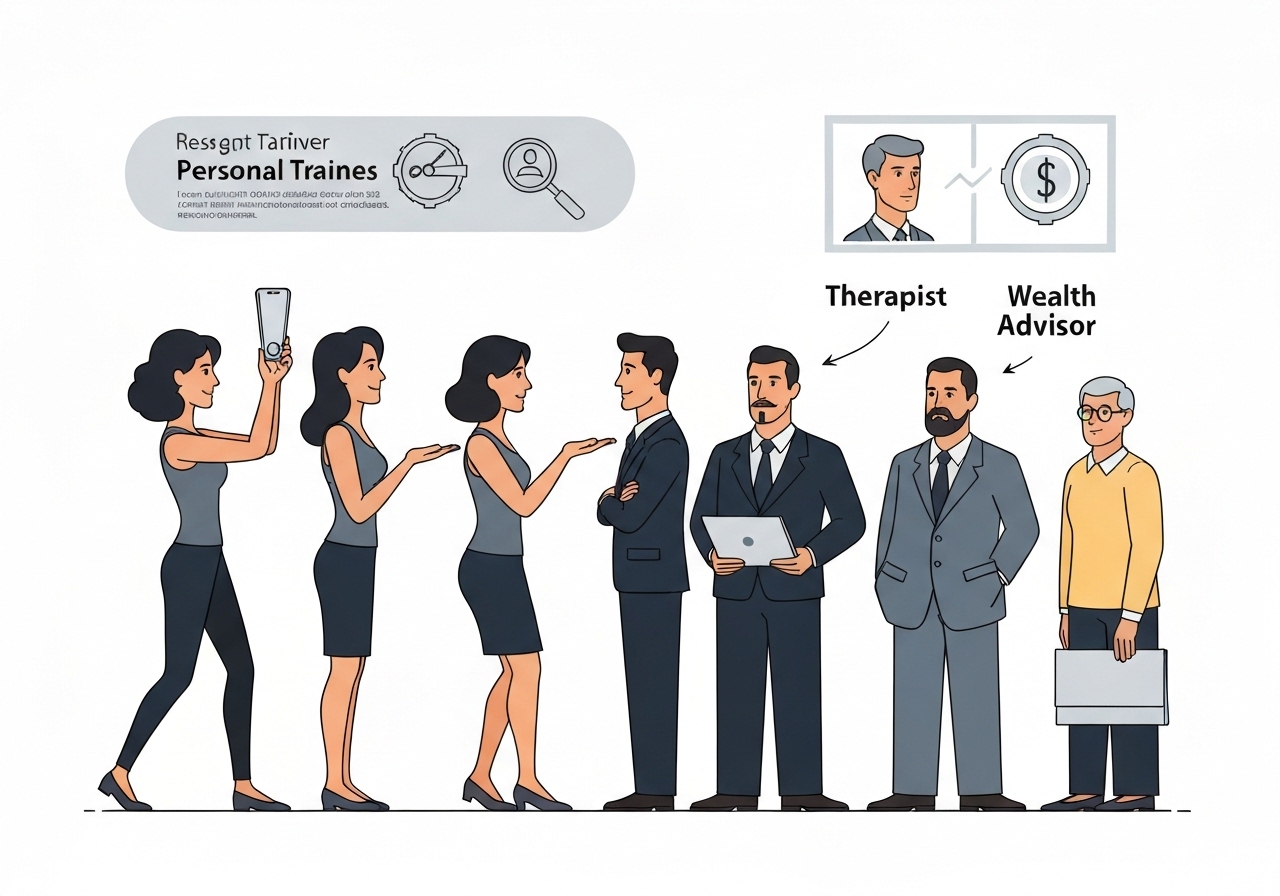
Lead: A new Long Angle survey of 114 people with at least $2 million in net worth, conducted in 2025, found that many wealthy individuals express greater satisfaction with personal trainers, therapists and child-related services than with wealth advisors and tax professionals. Only about one third of respondents use a dedicated wealth advisor for financial planning, and roughly one in five say they plan to fire their advisor largely because of high costs and poor service. Median spending patterns and satisfaction scores point to a clear preference for personalized, outcome-driven ‘soft services’ that address health, family and day-to-day wellbeing. Those trends are strongest among younger millionaires and among households with less than $5 million in investible assets.
Key Takeaways
- Only roughly 33% of millionaires surveyed use a wealth advisor; among those with $5 million or less, just 22% use an advisor while 44% of those with $25 million or more do.
- One in five respondents plan to fire their wealth advisor; among current advisory clients, 26% are considering switching and 18% may stop using an advisor entirely.
- Personal trainers received the highest satisfaction score (9.3 out of 10); therapists, personal sports coaches, and child-related services also scored highly (therapists and private school around 8.3).
- Wealth managers scored 7.2 for satisfaction and were often criticized for high cost: the median annual spend on financial advisors is $10,000, commonly billed as asset-based fees.
- Professional services for children command substantial spending: median nanny spend $53,558, private school $30,000, day care $20,000 annually, with private education and day care scoring above 8 in satisfaction.
- Therapy use and satisfaction skew younger: 43% of millionaires under 40 use a therapist versus 13% of those over 50; median therapy spend is $5,000 annually.
- Tax professionals remain widely used (82% use a CPA/tax pro), but 42% are considering switching due to perceived slowness and lack of strategic advice.
Background
The Long Angle survey polled 114 individuals with net worths of at least $2 million, the majority falling between $5 million and $25 million. The study asked respondents to rate satisfaction across 14 typical professional services used by wealthy households, from investment and estate advice to personal coaching and housekeeping. Historically, wealth management and tax planning have been considered the core services for high-net-worth clients because of their impact on asset preservation and tax efficiency. Yet the rise of lifestyle-focused offerings — health, family support, education and travel — reflects shifting client priorities toward quality-of-life outcomes as wealth managers seek new differentiators.
Providers of so-called ‘soft services’ often deliver highly individualized, goal-oriented interactions: trainers set precise performance targets, therapists cultivate long-term therapeutic relationships, and educators develop tailored learning plans for children. By contrast, respondents reported that many financial and legal providers feel transactional and standardized. That perception has financial consequences: many clients question asset-based fee models that increase advisors’ compensation as portfolios grow, independent of service depth or investment performance.
Main Event
Long Angle’s market-intelligence lead Chris Bendtsen summarized the core finding: services that improve health and family life deliver outsized emotional value compared with incremental balance-sheet improvements. The survey found personal trainers topped satisfaction with an average score of 9.3 out of 10, followed by investment-visa advisors at 8.8 and therapists and sports coaches in the high eights. Private school and day care also scored above eight despite high costs, suggesting that payers perceive strong value when services produce consistent, measurable benefits for children.
Use of wealth advisors varies markedly by wealth bracket. Among respondents with $5 million or less, only 22% reported using an advisor; that share rises to 44% for those with $25 million or more. Overall satisfaction for wealth advisors averaged 7.2, and many respondents who do not use advisors cited cost and poor service as reasons to avoid conventional advisory relationships. The median advisory spend was $10,000 per year, with most clients paying asset-based fees and roughly one third on a flat annual fee.
Accountants and estate lawyers also received lukewarm marks. While 82% use a CPA or tax professional for taxes, 42% are considering switching tax advisors because they perceive CPAs as slow to respond and not sufficiently proactive. Half of respondents do not use an estate lawyer overall, although usage climbs with wealth: 69% of those with $25 million or more reported using an estate attorney. In satisfaction rankings, estate lawyers scored lower than even pool services in the survey.
Analysis & Implications
The data indicate a reordering of priorities among many high-net-worth individuals: emotional and practical wellbeing often trump technical financial services when clients evaluate perceived value. That shift challenges traditional wealth firms, which have long competed on investment performance, tax optimization and trust services. To remain competitive, wealth managers and private banks may need to integrate or partner with high-touch nonfinancial providers to offer family, health and lifestyle support as part of a cohesive client relationship.
Fee structure is central to the dissatisfaction with advisers. Asset-based fees can create perceived conflicts of interest because advisor compensation grows with portfolio size rather than outcomes. The survey highlights a migration toward flat fees as an increasingly popular alternative that clients view as more transparent and better aligned with service delivery. Firms adopting flat or outcome-tied pricing may reduce churn and rebuild trust among price-sensitive clients.
The generational divide around therapy and mental-health spending suggests long-term cultural change in wealthy cohorts. Younger millionaires report higher therapy usage and place more explicit value on emotional support and connection with providers. That cultural evolution may drive demand for more bespoke, relationship-driven professional services across generations, influencing how wealth is managed, preserved and transmitted.
Comparison & Data
| Service | Average Satisfaction (1-10) |
|---|---|
| Personal trainer | 9.3 |
| Investment-visa advisor | 8.8 |
| Therapist | 8.3 |
| Private school | 8.3 |
| Day care | 8.2 |
| Wealth advisor | 7.2 |
| Estate attorney | Below wealth advisor (below 7.2) |
The table summarizes headline satisfaction scores from the Long Angle survey. These numbers show a clear clustering: personal and family services occupy the top of the satisfaction distribution while financial, legal and many property services sit lower. Context matters: spending patterns such as median nanny spend of $53,558 and median advisory spend of $10,000 demonstrate where households are allocating resources in pursuit of perceived value.
Reactions & Quotes
“Improving your balance sheet or bank account doesn’t deliver the same emotional value as improving your health and family life,”
Chris Bendtsen, Long Angle (market intelligence lead)
Long Angle officials used that observation to explain why lifestyle and family services outperform traditional professional providers on subjective satisfaction metrics. The phrasing underscores the emotional dimension that many respondents prioritized in their ratings.
“Flat fee structures reflect a growing client preference for transparent pricing and reduced conflicts of interest,”
Long Angle report
The report explicitly links pricing model dissatisfaction to a willingness to switch advisors, a dynamic that is already prompting some firms to experiment with flat or performance-linked fees.
Unconfirmed
- The survey does not disclose the full sampling methodology or geographic distribution of respondents, so representativeness beyond the sample is unconfirmed.
- Reported intentions to fire or switch advisors are self-reported plans and may not translate into actual behavior.
- Detailed performance data linking advisor fees to investment outcomes were not provided in the summary, so causation between fee model and satisfaction is not proven.
Bottom Line
The Long Angle survey of 114 millionaires shows a notable preference for personalized, outcomes-focused services that improve daily life and family outcomes over traditional financial and legal advisory relationships. Cost and perceived lack of personalization are the principal drivers of dissatisfaction with wealth managers and CPAs; younger clients in particular are reordering spending to prioritize wellbeing and therapy.
For wealth managers and private banks, the implication is clear: firms that embed or credibly partner with high-quality soft-service providers and that revisit fee architecture may better retain clients. Meanwhile, the wealthy themselves appear willing to allocate substantial budgets toward services that deliver consistent, measurable benefits for their health and families — a shift that may reshape how advisory services are packaged and sold.
Sources
- CNBC — news coverage summarizing Long Angle survey results (journalism)
- Long Angle — Long Angle report and company statements (official/industry research)