
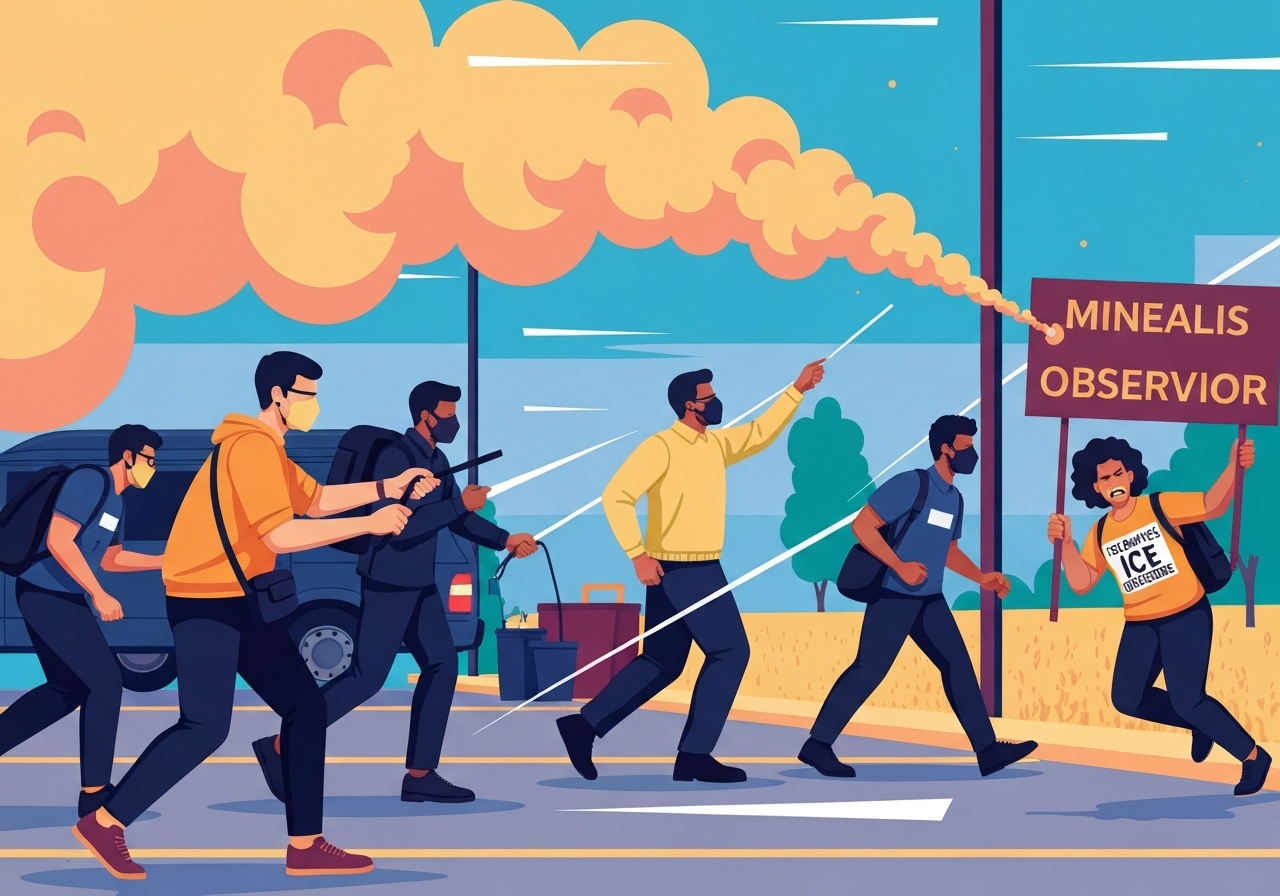
Volunteer observers in Minneapolis say they have been repeatedly targeted, injured and detained while documenting federal immigration enforcement since Operation Metro Surge began in early December. Witnesses report agents used chemical irritants, smashed car windows and made arrests at scenes where bystanders were filming; several observers were held at the BH Whipple federal facility south of the Twin Cities for hours before release. The killings of Alex Pretti and, less than three weeks earlier, Renee Good have intensified scrutiny of tactics used by federal officers and the treatment of people who watch and record enforcement actions. Despite arrests and what observers describe as escalating force, many volunteers say they will continue to monitor raids to preserve evidence and press for accountability.
Key takeaways
- Observers say federal agents deployed so-called “less lethal” measures — chemical sprays and projectiles — at bystanders during immigration raids; multiple volunteers reported being sprayed inside vehicles.
- Several volunteers, including Brandon Sigüenza and Patty O’Keefe, were arrested and taken to the BH Whipple federal building; most were held for hours and later released without charges.
- Two bystanders — Alex Pretti and Renee Good — were killed in separate encounters involving federal officers; community-captured video has become central to contesting official accounts.
- Volunteer witnesses report denial of timely medical care and restricted phone or legal access while detained at Whipple, prompting a class-action suit filed by Advocates for Human Rights.
- Observers allege agents photographed IDs and social media on the same devices used to document detainees, and describe incidents of verbal abuse, including transphobic harassment in one account.
- The Department of Homeland Security has defended its officers, saying they faced assaults and used the minimum force necessary; it did not answer detailed questions about specific detentions raised by observers.
- Despite intimidation tactics described by volunteers, community monitors say public documentation was crucial in countering initial federal explanations of the two fatal shootings.
Background
Operation Metro Surge, which began in early December, mobilized a large federal enforcement presence across the Twin Cities. The BH Whipple federal building has become a central processing point for detainees; observers report it also functions as a holding site for bystanders arrested during enforcement activity. Community volunteer programs that track and record immigration enforcement have operated for years in Minneapolis, driven by concerns about civil liberties, racial profiling and deportation outcomes. Those programs rely on civilian observers to provide independent records of interactions between agents and residents, a role volunteers and advocates say is increasingly necessary as enforcement grows more visible and assertive.
Historically, civilian monitoring of policing and immigration actions has influenced public debate and legal challenges when independent recordings contradict official narratives. Nationally, similar volunteer observer programs emerged after high-profile incidents where video altered public understanding and prompted investigations. In Minneapolis, the recent surge of federal officers followed a spike in enforcement activity and has coincided with several contested uses of force. Stakeholders include local legal aid groups, civil-rights advocates, volunteer observers and the Department of Homeland Security, each framing the events through different legal and security lenses.
Main event
On a recent patrol, Brandon Sigüenza and Patty O’Keefe say they followed a vehicle of Immigration and Customs Enforcement agents after receiving an alert that officers were nearby. Minutes after arriving, Sigüenza says an agent sprayed chemical irritant into the car’s vents, shouted at the occupants and ordered Sigüenza’s arrest; he describes windows being smashed, being pulled from the vehicle and slammed against the car. Both Sigüenza and O’Keefe were transported to the BH Whipple building and held for several hours before release, with no charges ultimately filed.
Another volunteer, who identifies only as RM, recounted being cuffed, dragged from a car with a pain-inducing restraint that they say crushed their wrist, and sprayed with an irritant while inside the vehicle. RM says they were not given water for an extended period and only later washed at a low-pressure sink in a cell; they described the experience as painful and humiliating and said the irritant burned skin even after rinsing in a shower following release. RM and others say agents used aggressive language and, in RM’s case, made transphobic remarks while holding them face-down on the ground.
Multiple observers report similar escalations: Jac Kovarik was detained in December and later again forced out of a residence with agents drawing firearms; Wes Powers was arrested on 8 January and later described seeing agents using personal phones to photograph detainees and access social media. Tippy Amundson and Heather Zemien, pulled from a car on 22 January while warning neighbors by honking, say they assisted an officer having seizures during transport, then were detained at Whipple and later released after intervention by a state representative; they received water and a heater while detained and were cited for impeding federal officers.
Observers who were detained consistently describe limited access to confidential legal counsel and restricted communication while at Whipple. Attorneys and advocates say DHS personnel have at times denied lawyers confidential visits or prevented private conversations with clients, claims the department denies. The cumulative effect, observers and lawyers say, is a chilling environment for civilian documentation of enforcement actions and a potential barrier to legal representation for those detained.
Analysis & implications
The accounts from Minneapolis raise immediate civil liberties and oversight questions. If volunteers documenting public law enforcement activities face repeated use of chemical agents, forced removal from vehicles, or prolonged detention without charge, that creates a legal and ethical tension between federal authority and the public’s right to observe state action. Such tensions commonly prompt litigation, policy reviews and calls for independent investigation, particularly when civilian recordings contradict official narratives about use of force.
Operationally, the treatment of observers can shape community response to enforcement. Intimidation through force or detention risks suppressing bystander documentation that prosecutors, defense attorneys and watchdogs rely on to reconstruct events. Conversely, when videos from witnesses reach the public quickly, they can accelerate oversight and legal scrutiny, as community-captured footage of the killings of Alex Pretti and Renee Good has already illustrated.
There are broader political and administrative implications for DHS and local partners. Allegations of denied counsel access, medical delays and potential misuse of detainee data can spur state and federal inquiries, civil suits and policy changes. The class-action challenge by Advocates for Human Rights signals an escalation from individual complaints to systemic legal claims, which could force greater transparency at facilities like Whipple and prompt clearer protocols for handling observers and bystanders during operations.
Comparison & data
| Incident | Timing | Reported outcome |
|---|---|---|
| Killing of Alex Pretti | Saturday (recent; per reports) | Shot and killed by a federal officer; video circulated publicly |
| Killing of Renee Good | Less than three weeks before Pretti | Shot and killed by federal officer; videotaped by bystanders |
| Observer detentions at Whipple | From early December through January | Multiple volunteers detained for hours; most released without charges |
The table compares recent high-profile uses of lethal force and the pattern of detentions involving observers. While exact counts of detained volunteers are described variably as “dozens” in witness accounts, the pattern across incidents shows repeated claims of limited counsel access, delayed medical attention and aggressive tactics. These comparisons underscore why community documentation has been central to public understanding: independent recordings have become the principal means to corroborate or challenge official accounts.
Reactions & quotes
If we don’t document and film federal agents, then they can shoot you 10 times and then say that you’re brandishing a firearm and it ends there.
Brandon Sigüenza, volunteer observer
Rioters and terrorists have assaulted law enforcement. Despite these grave threats and dangerous situations our law enforcement has followed their training and used the minimum amount of force necessary to protect themselves, the public, and federal property.
Department of Homeland Security (statement)
The whole incident was painful and humiliating. The irritant spread and burned my skin even as I tried to wash it off.
RM, observer (requested anonymity)
Unconfirmed
- Reports that agents systematically accessed detainees’ social media accounts on the same phones used to photograph IDs are based on witness statements and have not been independently verified by public records or agency confirmation.
- Claims that agents offered immigration-related favors in exchange for names of organizers derive from detainee accounts and have not been corroborated by audio, video or agency documentation publicly released so far.
- The DHS assertion that officers were assaulted in multiple incidents is part of the department’s public statement; there is not yet publicly available, independently verified evidence for each alleged assault referenced in that statement.
Bottom line
The recent pattern of detentions and confrontations between federal agents and civilian observers in Minneapolis highlights a fraught intersection of enforcement strategy and community oversight. Volunteer documentation has become a crucial check on official accounts in cases of serious harm, including the two deaths that have drawn national attention, but observers report that intensified tactics risk undermining that oversight capacity. The disputes over access to counsel, medical care and the handling of detainee information raise legal questions likely to play out in courts and oversight reviews.
For policymakers and advocates, the central challenge will be balancing operational security for officers with constitutional protections for bystanders and the public’s right to record public officials. Pending litigation and possible independent reviews of facility practices at Whipple could produce new guidelines on detainee treatment, visitor access and the handling of civilian observers; until then, community monitors say they will keep documenting — a practice they argue is essential to accountability.
Sources
- The Guardian — media report with interviews of observers, advocates and DHS statement