
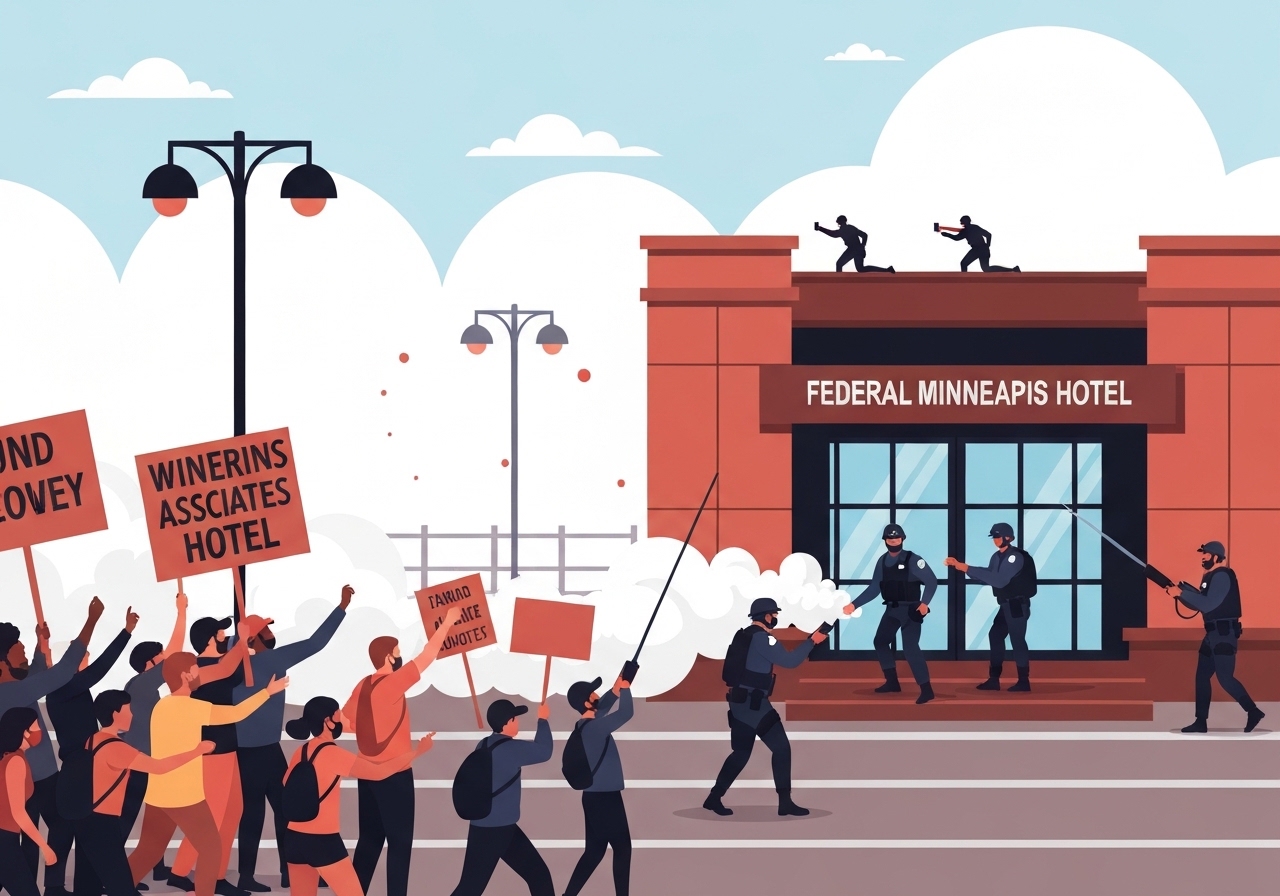
Lead: On Sunday evening, protesters gathered outside the Home2 Suites by Hilton near the University of Minnesota after reports that federal immigration agents were staying there, and clashes escalated when some demonstrators damaged hotel property. Law enforcement moved to clear the crowd using a chemical irritant widely described as teargas, after video and eyewitness accounts showed windows defaced and items thrown toward the lobby. The Minnesota Department of Public Safety (DPS) said state troopers and Department of Natural Resources (DNR) personnel had been called to assist Minneapolis police but were no longer on scene after federal agents deployed the irritant. The demonstration followed public outrage over two recent killings involving federal immigration officers in Minneapolis.
Key Takeaways
- Protest location: Home2 Suites by Hilton near the University of Minnesota; demonstrators believed federal immigration agents were staying at the hotel.
- Use of force: Federal agents deployed a chemical irritant described as teargas to disperse the crowd on Sunday evening; state officials said state patrol and DNR personnel were called to assist.
- Property damage: Video and on-scene reports show graffiti on windows reading messages like “ICE out” and accounts of thrown objects and broken glass.
- Visible security: Footage shows at least two federal officers armed with long guns positioned outside the hotel lobby as the crowd gathered.
- Context of protests: The demonstration occurred days after US Border Patrol officers killed Alex Pretti, 37, and less than three weeks after an ICE agent, Jonathan Ross, killed Renee Nicole Good on 7 January.
- Official response: The Minnesota DPS said federal agents arrived without communication as state personnel worked to encircle the group for arrests.
- Political pressure: Governor Tim Walz publicly urged the White House to withdraw federal immigration enforcement agents from Minneapolis amid the unrest.
Background
Minneapolis has seen heightened tensions after a series of confrontations between residents and federal immigration enforcement personnel. Federal agents have been present in the city in larger numbers since December, according to local officials and residents, which has contributed to protests and public unease. Community groups and some elected officials argue the increased federal presence has escalated friction rather than calmed it, pointing to past incidents in which force was used and civilians were killed.
Two recent deaths have been focal points for anger: Border Patrol officers killed Alex Pretti, a 37-year-old nurse at a local VA hospital, and an ICE agent, Jonathan Ross, killed 37-year-old Renee Nicole Good on 7 January. Video circulating from these incidents has intensified scrutiny of federal tactics and accountability. Minneapolis officials, state authorities and federal agencies operate under different legal authorities, creating repeated questions about who is responsible for crowd management and use-of-force decisions during demonstrations.
Main Event
Protesters began assembling outside the Home2 Suites by Hilton near the University of Minnesota on Sunday evening after reports circulated that federal immigration agents were staying at the hotel following the killing of Alex Pretti. Participants chanted and made loud noises outside the building, and some demonstrators spray-painted windows with anti-ICE messages. Video from the scene shows broken or damaged glass and graffiti on the hotel facade.
As the crowd swelled, footage captured two officers in federal gear standing outside the lobby with long rifles. At one point an officer is audible in video asking, “Where’s the local PD?” while the group remained active on the sidewalk and entry area. Local reports, including from the Minnesota Daily, documented attempts by some demonstrators to throw objects toward the lobby and to smash windows.
The Minnesota Department of Public Safety said state patrol and Department of Natural Resources personnel had been deployed to assist Minneapolis Police with property damage. DPS said that while state units were working to encircle the demonstrators for arrests because the protest was not peaceful, federal agents arrived “without communication and deployed chemical irritants, clearing the group.” The DPS post said the state patrol and DNR were no longer on scene after that action.
Analysis & Implications
The incident highlights recurring tensions over the role of federal agents in local public-order situations. When federal officers operate in a municipal environment without coordinated communication with state or local counterparts, it can produce conflicting tactics and unclear chains of command, raising legal and operational concerns. Deployments like this can undermine trust between community members and multiple layers of government, especially when lethal force has recently been used by federal personnel.
Politically, the episode puts pressure on both the local and federal levels. Governor Tim Walz has publicly called for the withdrawal of federal immigration enforcers, framing their presence as exacerbating rather than reducing violence. The White House and federal agencies face a choice between defending aggressive enforcement tactics and responding to mounting criticism that those tactics are inflaming community unrest.
Legally, questions will arise about authority over crowd control, the permissibility of chemical irritants in specific contexts, and whether proper protocols for interagency communication were followed. If state or local officers had been preparing arrests, a sudden federal intervention without coordination could affect evidence collection, accountability for property damage, and potential civil-rights reviews. The incident may prompt reviews at the state level and possible litigation if protesters or hotel staff seek redress for injuries or property loss.
Comparison & Data
| Incident | Date | Victim age | Agency |
|---|---|---|---|
| Shooting of Renee Nicole Good | 7 January 2026 | 37 | ICE (agent Jonathan Ross) |
| Shooting of Alex Pretti | Two days before the hotel protest | 37 | U.S. Border Patrol |
| Hotel protest and teargas deployment | Sunday evening (reported in 26 January 2026 coverage) | — | Federal agents (with state/DNR involvement disputed) |
The table situates the hotel confrontation in a short timeline of incidents that have driven local anger. Both killings cited here involved 37-year-old victims and federal enforcement personnel, a coincidence that has sharpened community reaction. The broader trend—federal agents surging into Minneapolis since December—has led to recurring public demonstrations and repeated calls for clearer rules of engagement and oversight.
Reactions & Quotes
Local and state officials responded quickly, framing the event as an avoidable escalation driven by poor coordination. Governor Tim Walz used direct language to urge the federal government to pull agents back and to adopt a different approach to immigration enforcement.
“President Trump, you can end this today. Pull these folks back. Do humane, focused, effective immigration control — you’ve got the support of all of us to do that.”
Gov. Tim Walz (public statement)
This remark came amid appeals from other officials seeking de-escalation and clearer lines of authority. The Minnesota DPS described the operational sequence from the state perspective, saying state units had been called to assist Minneapolis police and were attempting to encircle the group for arrests when federal agents deployed irritants.
“While they collaboratively worked to encircle the group for arrests because the demonstration was not peaceful, federal agents arrived without communication and deployed chemical irritants, clearing the group.”
Minnesota Department of Public Safety (DPS)
Eyewitness video adds another, more immediate voice from the scene: an officer asking, “Where’s the local PD?” as demonstrators pressed the perimeter. That clip underscores public confusion about which agencies were responsible for crowd control at the moment federal agents used the irritant.
“Where’s the local PD?”
Federal officer on scene (recorded video)
Unconfirmed
- Whether federal immigration agents were definitively staying inside the Home2 Suites hotel at the time of the protest remains unverified by independent records.
- Precise chain-of-command details about who authorized the chemical irritant deployment have not been publicly confirmed by a federal agency at time of reporting.
- Reports that objects thrown by protesters struck people inside the lobby have not been independently corroborated with physical-evidence or formal injury reports.
- Full forensic and investigative findings in the killings of Alex Pretti and Renee Nicole Good remain pending public-release of official inquiries and body-camera or related evidence.
Bottom Line
The episode at the Home2 Suites underscores a volatile convergence of community anger, federal enforcement tactics, and uncertain interagency coordination in Minneapolis. Recent fatal encounters involving federal immigration officers have amplified public distrust, and the hotel’s standoff shows how quickly property damage and confrontation can prompt forceful responses that complicate local policing efforts.
Absent clearer protocols and better real-time communication among federal, state and local agencies, similar flashpoints are likely to recur. The coming days may produce additional official statements, internal reviews and possible legal actions that could shape policy and operational rules for federal agents operating in municipal settings.
Sources
- The Guardian (international news coverage summarizing the protest and timeline)
- Minnesota Department of Public Safety (DPS) (official state agency statements and posts)
- Minnesota Daily (local reporting on the protest; student/independent news outlet)
- New York Post (news reports referenced regarding lobby incidents and video)
- Office of Governor Tim Walz (official statements and policy positions)