
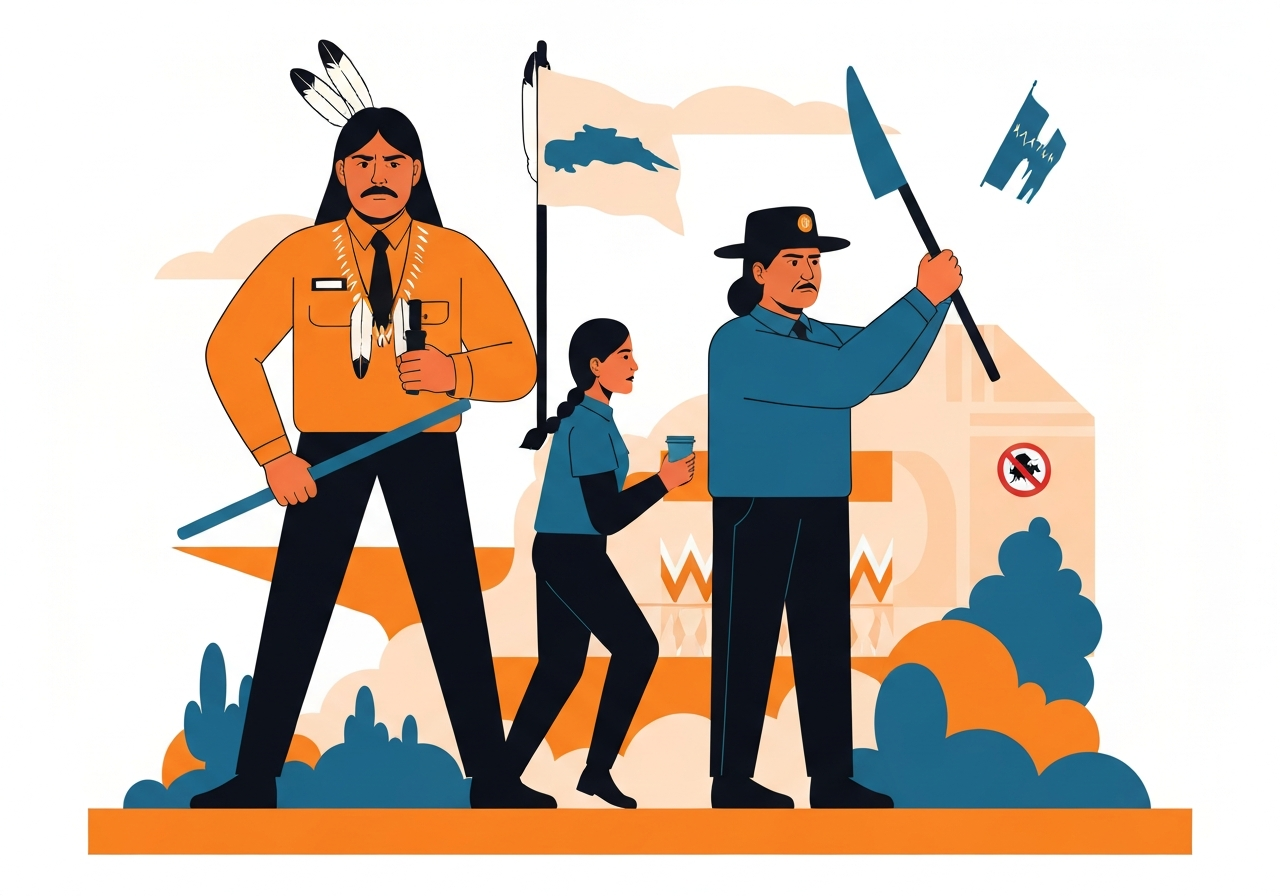
This winter, volunteers in south Minneapolis took up community patrols after federal immigration teams repeatedly operated in the city, stopping people across neighborhoods that include a concentrated Native American corridor. Residents and organized groups such as the Many Shields Society scanned streets, bus stops and online alerts for Immigration and Customs Enforcement (ICE) activity, deploying foot patrollers, watchers in cars and outreach at a neighborhood hub. Tribal leaders say at least four members of the Oglala Sioux Tribe were detained during these operations, a claim the Department of Homeland Security has disputed; organizers responded by helping issue tribal identification at a temporary booth to ease interactions with federal officers. The presence of armed, masked agents near the Pow Wow Grounds cultural corridor reignited memories of past state violence for many elders and youth, prompting a community response that mirrors patrols formed in 1968.
Key takeaways
- Volunteers in south Minneapolis began regular community patrols this winter after multiple sightings of federal immigration teams near Pow Wow Grounds, Little Earth and surrounding blocks.
- Tribal authorities report at least four Oglala Sioux members detained during the operations; the Department of Homeland Security has publicly disputed those tribal allegations.
- Organizers deployed foot patrols with handwarmers, orange whistles and paired drivers; volunteers also monitored local chatrooms for ICE reports and distributed legal-aid contacts.
- Leaders arranged a one-time tribal ID processing station in Minneapolis to help members show paperwork when questioned; many residents lack passports or state Real IDs.
- Community hubs such as Pow Wow Grounds and All My Relations shifted operations toward mutual aid, offering supplies, hot meals and protective gear for patrollers.
- Many elders described renewed generational trauma because detainees are being processed at a Fort Snelling facility, a site with a documented history of mid-19th century detentions of Dakota and Ho-Chunk people.
Background
South Minneapolis hosts one of the largest urban American Indian populations in the United States and includes a dense cultural corridor of community centers, shops and housing projects such as Little Earth. The American Indian Movement (AIM) was founded in this same neighborhood in 1968 in part as a response to police brutality and systemic mistreatment, and it organized early citizen patrols to protect residents. In recent decades tribal governments and urban Indian organizations have developed layered strategies—legal clinics, rapid response networks and mutual aid—to respond to federal enforcement actions that affect both immigrant and Native neighbors.
Federal immigration operations increased in the Twin Cities this winter as the administration announced a forceful enforcement posture. Community leaders say those sweeps did not discriminate by legal status: residents report stops of undocumented immigrants, lawful residents and tribal citizens who do not carry state-issued Real IDs. Tribal officials identified obstacles that make tribal IDs vital in urban settings, since many members live far from reservation ID offices or lack other recognized documents.
Main event
Volunteers gathered outside the Pow Wow Grounds coffee shop this winter, huddled around a small firepit and watching intersections for ICE vehicles. Observers describe agents in SUVs making repeated passes through the neighborhood, with stops near bus stops, apartment buildings and the Little Earth housing community. In response, the Many Shields Society and allied volunteers set up a watch routine: foot patrols with whistles and handwarmers, paired drivers in cars and a small operations hub at the coffee shop and adjacent gallery.
On several occasions organizers say federal officers questioned and briefly detained people who identify as Native American; tribal leadership reported that at least four Oglala Sioux members were taken into custody. The Department of Homeland Security has disputed the tribe’s account. To assist members who lack state-issued IDs, leaders from roughly ten tribes traveled to Minneapolis and accepted tribal ID applications at a makeshift station in the American Indian Center.
Local residents reported heightened fear: elders stopped taking buses, families kept children inside, and some moved temporarily to reservations they felt safer on. Volunteers reconfigured art spaces into supply depots, distributing gas masks, goggles and handwarmers to those patrolling the streets. Organizers also posted buttons with legal-aid and rapid-response numbers, coordinated via neighborhood chat groups and honking/whistle alerts when agents appeared.
Analysis & implications
The patrols are both a practical and symbolic response. Practically, neighborhood watches provide rapid observation, documentation and connection to legal resources for people stopped by federal agents. Symbolically, the revival of citizen patrols in the same blocks where AIM formed in 1968 underscores how enforcement actions can reverberate across generations of Indigenous people and other communities of color.
There are legal and logistical limits to what community patrols can achieve. Volunteers can monitor and record, provide accompaniment and share information with legal services, but they cannot legally obstruct law-enforcement operations. The distribution of tribal IDs addresses a narrow but immediate paperwork problem; it does not change federal enforcement priorities or legal status determinations.
Politically, the events highlight tension between federal immigration policy and tribal sovereignty claims. Some tribes have publicly forbidden ICE presence on reservation land and have criticized enforcement in urban areas where tribal members live. The federal agency’s disputed account of detentions and the administration’s announced partial pullback of agents this week leave unresolved questions about long-term strategy and oversight.
Comparison & data
| 1968 (AIM patrols) | Winter 2026 (Many Shields & volunteers) |
|---|---|
| Originated in response to police brutality; organized community defense | Restarted in response to federal immigration sweeps; monitoring ICE activity |
| Urban organizing led by AIM across Minneapolis in 1968 | Local volunteer groups, tribal leaders and allies focused on Pow Wow Grounds corridor |
| Historic context of systemic violence against Indigenous peoples | Present concern amplified by use of an ICE processing site at Fort Snelling, a historical detention location |
The table highlights continuity in neighborhood-based defense tactics and differences in the enforcement threat: 1968 patrols responded primarily to local police, while 2026 patrols respond to federal immigration teams operating in urban neighborhoods. Community leaders emphasize that tactical needs—legal information, IDs, protective gear—have evolved but the protective intent remains consistent.
Reactions & quotes
“Our kids are afraid, our elders are afraid—so we organized to watch the streets and help our neighbors,”
Vin Dionne, Many Shields Society leader (community organizer)
Vin Dionne described routine neighborhood checks, watching for anyone federal agents might single out and speaking with his children about the fear that enforcement activity provokes. Organizers say that outreach is intended to protect both Native and immigrant residents through accompaniment and rapid contacts to legal help.
“History repeats itself; we are having to prepare because past violence against Indigenous people still echoes today,”
Jolene Jones, Native American Community Development Institute (organizer)
Organizers linked present-day operations to historical trauma, noting the symbolic weight of processing detainees at Fort Snelling, where more than 1,600 Dakota and Ho-Chunk were detained in the mid-1800s. That historical connection, they say, intensifies fear among elders and children.
Unconfirmed
- Exact total number of tribal members detained across all enforcement actions remains unclear beyond the tribal claim of at least four Oglala Sioux detainees; DHS has disputed those figures.
- Whether ICE will resume operations at the same scale after the administration’s announced partial pullback is unconfirmed; federal statements indicate a reduction but not a formal end to deployments.
Bottom line
Community patrols in Minneapolis are a targeted neighborhood response to federal immigration operations that residents say have repeatedly affected Native and non-Native neighbors alike. The actions blend mutual aid—hot meals, supplies and legal contact information—with observation and accompaniment to reduce harm when detentions occur.
Beyond immediate protections, the resurgence of patrols spotlights enduring gaps: many tribal citizens lack widely recognized federal or state IDs, and historical trauma amplifies fear when armed agents work near cultural centers. Even if federal deployments are scaled back, leaders say the episode will shape local organizing, advocacy for clearer enforcement oversight and discussions about how urban Indigenous communities can be better protected.