
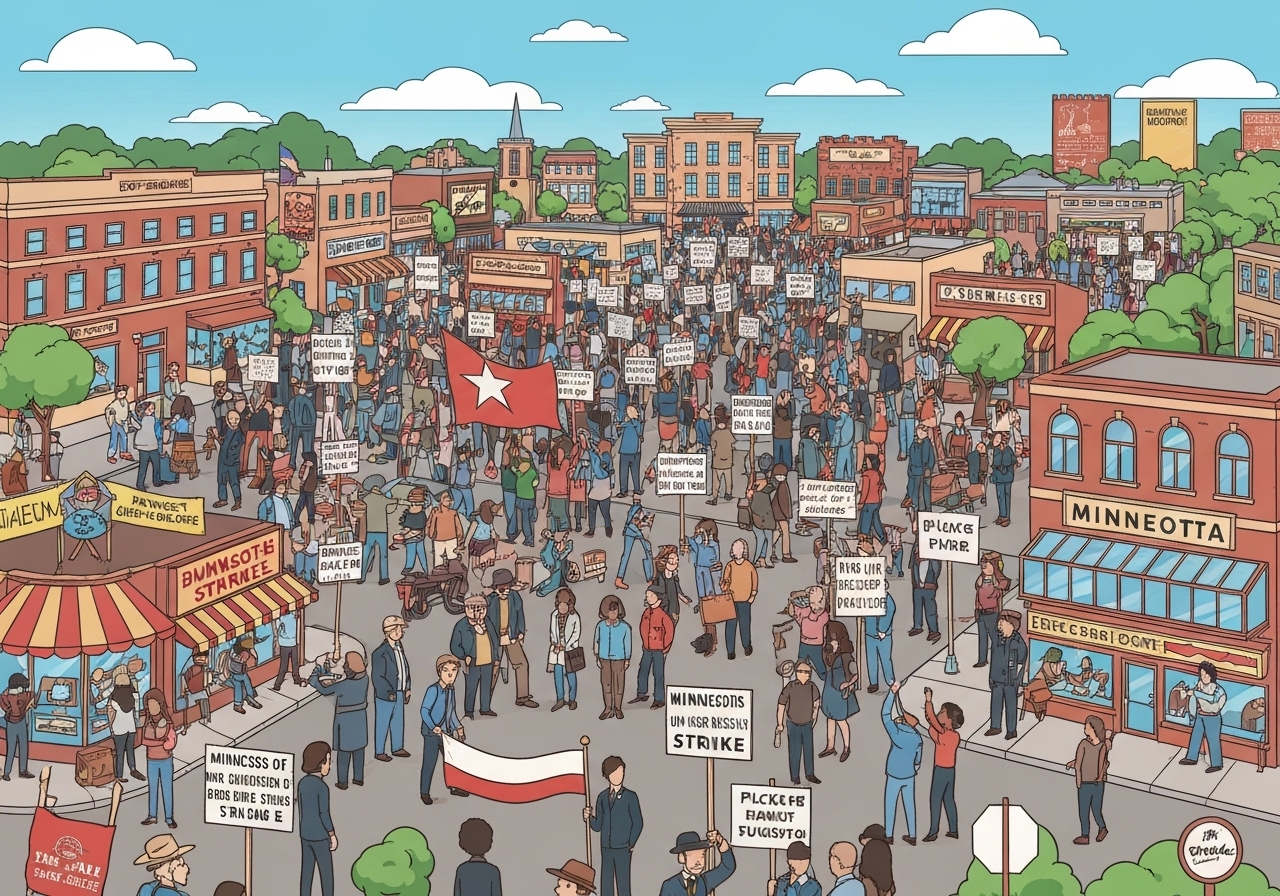
Lead: On Jan. 23, 2026, thousands of people flooded streets across Minneapolis and St. Paul as hundreds of locally owned businesses shut for the day to protest a months-long federal immigration enforcement operation. Demonstrations, which unfolded in subzero temperatures, aimed to force federal authorities to withdraw immigration agents who have been active in the Twin Cities for more than six weeks. Organizers and participants said pausing economic activity was a deliberate show of solidarity with people affected by sweeps that officials say have produced roughly 3,000 arrests. The action marked the largest coordinated civic response since the operation began late last year.
Key Takeaways
- On Jan. 23, 2026, thousands protested across Minneapolis–St. Paul while hundreds of businesses closed in solidarity to oppose a federal enforcement operation.
- The enforcement surge began in late 2025 and, as of this report, has led to approximately 3,000 arrests in the Twin Cities region.
- Protests took place despite subzero temperatures and followed at least two separate shootings in Minneapolis tied to the enforcement period.
- An ICE agent fatally shot Renee Good, an American citizen, in Minneapolis on Jan. 7, 2026, intensifying calls for agent withdrawal.
- Local officials and community groups have filed lawsuits seeking to limit federal agents’ actions and to block parts of the operation.
- Businesses said losing a single day’s revenue was an acceptable cost to join a coordinated effort to influence federal policy and public safety decisions.
Background
Federal immigration agents began a focused enforcement campaign in the Minneapolis–St. Paul area in late 2025, part of a broader multi-city effort the government describes as targeting individuals with criminal records or outstanding removal orders. The operation intensified community anxiety after clashes between residents and agents were reported across the Twin Cities over the following weeks. Local and state officials criticized the federal presence for eroding trust with immigrant communities and for acting without sufficient coordination with municipal authorities.
Tensions rose further after an ICE agent killed Renee Good, a U.S. citizen, on Jan. 7, 2026, an event that prompted public outrage and formal legal responses. Civil-rights groups, city leaders and the Minnesota attorney general’s office have since pursued lawsuits and injunctions aimed at curbing the agents’ tactics, arguing that the operation has produced chaotic street encounters and threats to public safety. For many community leaders, the spike in arrests—estimated at about 3,000—has stretched local services and deepened fear among immigrant residents.
Main Event
The day of action on Jan. 23 began in the morning with demonstrations at the Minneapolis–St. Paul airport and spread to commercial corridors and civic squares, where business owners locked doors in a planned closure. Organizers had coordinated with local coalitions and small-business associations to encourage workers and students to stay home and join picket lines or stay in solidarity by closing shops for the day. Despite temperatures below freezing, crowds marched through key thoroughfares, temporarily halting regular traffic and drawing national media attention.
Protesters chanted for federal agents to be withdrawn and for accountability after what many described as weeks of aggressive enforcement. City and state officials who have challenged the operation in court attended parts of the demonstrations and reiterated calls for federal restraint. The day passed without any single large-scale confrontation reported in the public record, but it served as the most widespread coordinated public demonstration since the initial deployment of agents more than six weeks earlier.
Business owners who closed shop said they weighed the economic cost of a lost day’s receipts against the political imperative of supporting families affected by the enforcement. Some storefronts displayed signs urging federal authorities to leave and calling for local governance of public safety priorities. Organizers said the coordinated shutdown was intended to signal to federal decision-makers that the enforcement approach was undermining community stability and local economies.
Analysis & Implications
The protest and business closures escalate pressure on the federal government at a politically sensitive moment and could influence how the Department of Homeland Security and ICE calibrate operations in urban areas. Sustained local resistance combined with legal challenges raises the likelihood of court-imposed restrictions or negotiated changes to tactics, particularly regarding patrol patterns, detention practices and public engagement. If lawsuits succeed, the federal operation may be curtailed or subject to clearer oversight and reporting requirements.
Economically, even single-day shutdowns by hundreds of small businesses can strain already thin margins, but organizers argue the symbolic effect outweighs immediate revenue losses. The visible solidarity between private-sector merchants, students and workers broadens the protest’s constituency and may spur similar actions elsewhere. For local elected officials, balancing public safety obligations with constituent demands will be politically fraught, especially as national attention mounts.
Nationally, the Twin Cities demonstration could become a template for municipal pushback against federal immigration sweeps in other jurisdictions. The combination of mass mobilization, legal strategy and economic pressure increases the chance that federal agencies will reassess deployment decisions where sustained resistance produces political and operational costs. Conversely, federal officials may respond by reinforcing rules of engagement or by defending the necessity of targeted arrests to national security and public-safety narratives.
Comparison & Data
| Metric | Reported Total |
|---|---|
| Estimated arrests since operation began | ~3,000 |
| Reported shootings in Minneapolis during period | At least 2 |
| Duration of operation (as of Jan. 23, 2026) | More than 6 weeks |
The table compiles the principal public figures reported about the enforcement campaign and its local consequences. Those numbers frame the scale of community response: thousands of protesters and hundreds of businesses participating in a single coordinated day of action suggest broad-based disruption. While arrests are concentrated among alleged targets of the operation, secondary impacts—public fear, legal costs and strained municipal services—are harder to quantify but inform the political calculus on both sides.
Reactions & Quotes
City and state leaders, community organizers and business owners offered distinct but overlapping responses, each situating the day of protest within broader demands for accountability and reform.
“Pull the federal agents out of our neighborhoods now,” chanted many demonstrators, encapsulating the protest’s central demand.
Local organizers / protesters
Organizers framed the closures as an act of collective civic disobedience meant to press the federal government to change course. Officials who filed legal actions emphasized that the lawsuits seek to limit specific conduct by agents rather than block lawful immigration enforcement in general.
“We are seeking judicial remedies to ensure public-safety practices are transparent and constrained,” a statement from state legal filings summarized.
Minnesota state legal filing (paraphrased)
Legal representatives and elected officials have said their filings focus on methods and oversight, arguing that local governance and civil-rights protections must be preserved. Federal authorities have defended the operation as necessary to apprehend individuals who pose public-safety concerns, while noting that enforcement actions follow federal priorities.
Unconfirmed
- The precise number of businesses that closed on Jan. 23 is reported as “hundreds” but has not been independently tallied by a central authority.
- Public reports do not specify the exact number of federal agents deployed in the Twin Cities at any single time during the operation.
- Some on-the-ground claims about specific arrests and targets remain subject to review and have not been fully corroborated by official records.
Bottom Line
The Jan. 23 coordinated shutdown by businesses and protesters elevated a local dispute over federal immigration enforcement into a broader civic confrontation. With roughly 3,000 arrests reported and at least two shootings in Minneapolis during the enforcement period, public concern has coalesced into legal challenges, mass demonstrations and economic protest that may compel changes in federal tactics.
In the coming weeks, courts and negotiations between federal and state authorities are likely to determine whether the operation continues unchanged, adopts new constraints, or is scaled back. Observers should watch filings in pending lawsuits, any public health or safety advisories tied to enforcement activity, and whether other cities replicate similar coordinated business actions.
Sources
- The New York Times (news)