
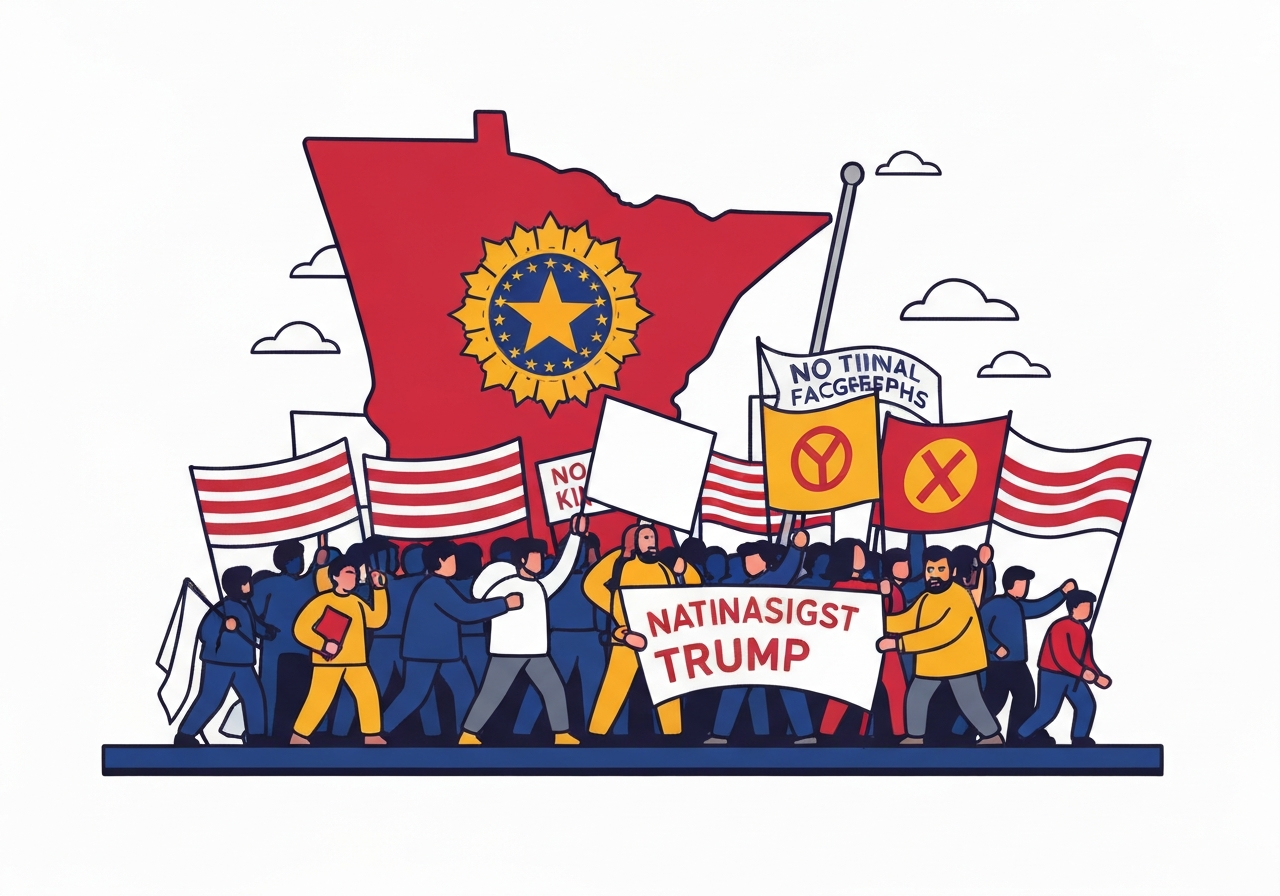
Organizers have designated the St. Paul rally on Saturday as the national flagship of a coordinated, nationwide series of “No Kings” protests aimed at President Donald Trump and his administration. More than 3,100 events are registered across all 50 states and organizers are projecting roughly 9 million participants, with Minnesota expecting up to 100,000 people on the Capitol grounds. The designation reflects Minnesota’s prominence after federal agents fatally shot two people who were monitoring immigration enforcement there, and the state has become a focal point of sustained public demonstrations. Headliners at the St. Paul event include Bruce Springsteen, Joan Baez, Jane Fonda and Sen. Bernie Sanders, among other activists and labor leaders.
Key Takeaways
- Organizers report 3,100+ registered events in all 50 states and an expected aggregate turnout of about 9 million people for the Saturday rallies.
- Minnesota’s St. Paul march is billed as the national flagship; local organizers estimate up to 100,000 attendees on the Capitol lawn, compared with an estimated 80,000 at a June event.
- Bruce Springsteen is scheduled to perform “Streets of Minneapolis,” a song written in response to the deaths of Renee Good and Alex Pretti; his Land of Hope & Dreams Tour begins Tuesday in Minneapolis.
- National groups leading the mobilization include Indivisible and MoveOn; Stand Up For Science will host a parallel virtual event for those who cannot attend in person.
- Organizers say past nationwide mobilizations drew more than 5 million in June and more than 7 million in October; they argue this round could surpass those totals.
- The White House dismissed the protests as driven by “leftist funding networks,” a characterization offered by a White House spokesperson.
- Organizers report that roughly two-thirds of RSVPs are coming from outside major urban centers, with noted surges in conservative-leaning and competitive suburban states.
Background
The “No Kings” campaign grew from months of grassroots mobilization responding to actions by the Trump administration, particularly its immigration enforcement policies. Minnesota moved to the center of that activism after federal agents shot and killed two people who, according to local reporting, had been monitoring immigration operations; those deaths intensified local protests and framed the state as an epicenter of resistance. Organizers have since expanded the framing of the rallies to a nationwide scale, coordinating with allied groups and listing headline performers and speakers to draw broad attention.
Previous rounds of the campaign were sizeable: organizers estimate the June protests drew more than 5 million people and the October events exceeded 7 million. The current series is described as both in-person and virtual, reflecting an effort to make the demonstrations accessible beyond large-city cores. National groups such as Indivisible and MoveOn have positioned the rallies as a bipartisan moment of civic pushback, citing RSVPs from rural and conservative-leaning areas as evidence of wider concern.
Main Event
St. Paul’s Capitol grounds are expected to host the flagship event, with local officials and organizers preparing for large crowds and logistical challenges. Organizers told state authorities they could see as many as 100,000 people converge on the lawn; local estimates reference an earlier June turnout of approximately 80,000. The program includes musical performances by Bruce Springsteen and Joan Baez, appearances by Jane Fonda and Sen. Bernie Sanders, and speeches from labor leaders and activists.
Springsteen plans to perform “Streets of Minneapolis,” a song he wrote in the wake of the deaths of Renee Good and Alex Pretti, and the performance is tied to his Land of Hope & Dreams American Tour, which carries a “No Kings” theme. National organizers say parallel rallies are scheduled in every state and in more than a dozen countries, with participants in constitutional monarchies using the phrase “No Tyrants” in place of “No Kings.” For people unable to attend physically, Stand Up For Science is hosting a virtual, accessible program to stream portions of the demonstration.
The White House responded to the organization of the events by attributing them to “leftist funding networks” and saying the gatherings lack broad public support, comments delivered by a White House spokesperson. Organizers have pushed back, emphasizing the diversity of RSVP locations and arguing that the movement extends into suburbs and rural communities as well as big cities. National leaders characterized the Saturday mobilization as not only large in scale but notable for its geographic spread.
Analysis & Implications
If turnout matches organizers’ projections, the protests would rank among the largest civic demonstrations in recent U.S. history and could alter the political conversation heading into upcoming electoral and legislative cycles. High participation across nonurban areas would complicate narratives that mass protest is confined to coastal or deeply blue population centers, potentially broadening the perceived electoral salience of the issues being raised. Organizers are signaling that grievances with the administration cross conventional partisan and geographic lines, which could influence campaigning strategies and messaging.
Beyond immediate politics, the choice to highlight Minnesota underscores how local incidents can nationalize protest movements. The deaths of Renee Good and Alex Pretti became a catalyst for wider mobilization, and cultural figures like Springsteen and Baez amplify the message through music and celebrity attention. The presence of well-known artists and elected officials may increase media coverage and logistical scrutiny by local authorities, raising questions about crowd management and public safety planning.
Internationally, the adaptation of the movement’s language to “No Tyrants” in countries with monarchies shows how protest branding is being tailored to local contexts while maintaining a shared theme of opposition to perceived authoritarianism. That cross-border resonance could strengthen global networks of solidarity but is unlikely to translate into uniform political outcomes given different domestic institutions and legal frameworks. Finally, the gap between organizer projections and verifiable attendance will be a key metric for outside observers measuring the movement’s lasting influence.
Comparison & Data
| Round / Measure | Organizer Estimate |
|---|---|
| June nationwide rallies | >5 million participants |
| October nationwide rallies | >7 million participants |
| Registered events for Saturday | 3,100+ events (all 50 states) |
| Projected total turnout (current round) | ~9 million participants |
| St. Paul flagship projection | up to 100,000 attendees (organizers) |
| St. Paul June turnout | ~80,000 (estimated) |
The table summarizes organizer-provided estimates; independent verification of total national attendance is typically delayed and may vary by source. Organizer figures show growth across rounds, but media and municipal crowd estimates have historically differed from organizer totals. Tracking turnout by state and comparing RSVP lists to on-the-ground counts will be important to assessing the movement’s reach.
Reactions & Quotes
Several official and organizational responses illustrate the political divide surrounding the rallies.
“The only people who care about these Trump Derangement Therapy Sessions are the reporters who are paid to cover them.”
Abigail Jackson, White House spokesperson
The White House framed the protests as the product of partisan funding networks and minimized public backing, a stance that organizers dispute and that sets up a public messaging battle ahead of Saturday’s events.
“This administration’s actions are angering not just Democratic voters… they are crossing a line for people in red and rural areas, in the suburbs, all over the country.”
Leah Greenberg, co-executive director, Indivisible
Indivisible’s leadership emphasizes geographic breadth of support and highlights surges in RSVPs from states often considered politically conservative, arguing the movement is not confined to urban Democratic strongholds.
“Millions of us are rising up from all walks of life… we will send the loudest, clearest message yet that this country does not belong to kings, dictators, tyrants.”
Katie Bethell, executive director, MoveOn
MoveOn frames the demonstrations as a broad civic assertion of popular sovereignty, stressing participation across backgrounds and regions as central to the movement’s message.
Unconfirmed
- The projected national total of about 9 million participants is an organizer estimate and has not been independently verified.
- The conversion rate from online RSVPs to actual in-person attendance, especially outside major urban centers, remains uncertain.
- The White House’s claim that the protests are primarily driven by “leftist funding networks” has been stated by a spokesperson but not substantiated within the public record provided by organizers.
Bottom Line
The Saturday demonstrations are intended to be a nationwide show of force, with Minnesota’s St. Paul rally positioned as the symbolic center of the movement. Organizers’ numerical projections, if realized, would make this one of the largest sustained protest efforts in recent U.S. memory, and the reported geographic spread of RSVPs could reshape perceptions of where large-scale civic unrest originates.
Observers should watch actual turnout figures, how authorities manage large gatherings, and whether the movement’s claimed cross-regional support translates into sustained political pressure. Independent crowd estimates and follow-up reporting in the days after the events will be essential to verify organizer claims and to assess the protests’ longer-term impact.