
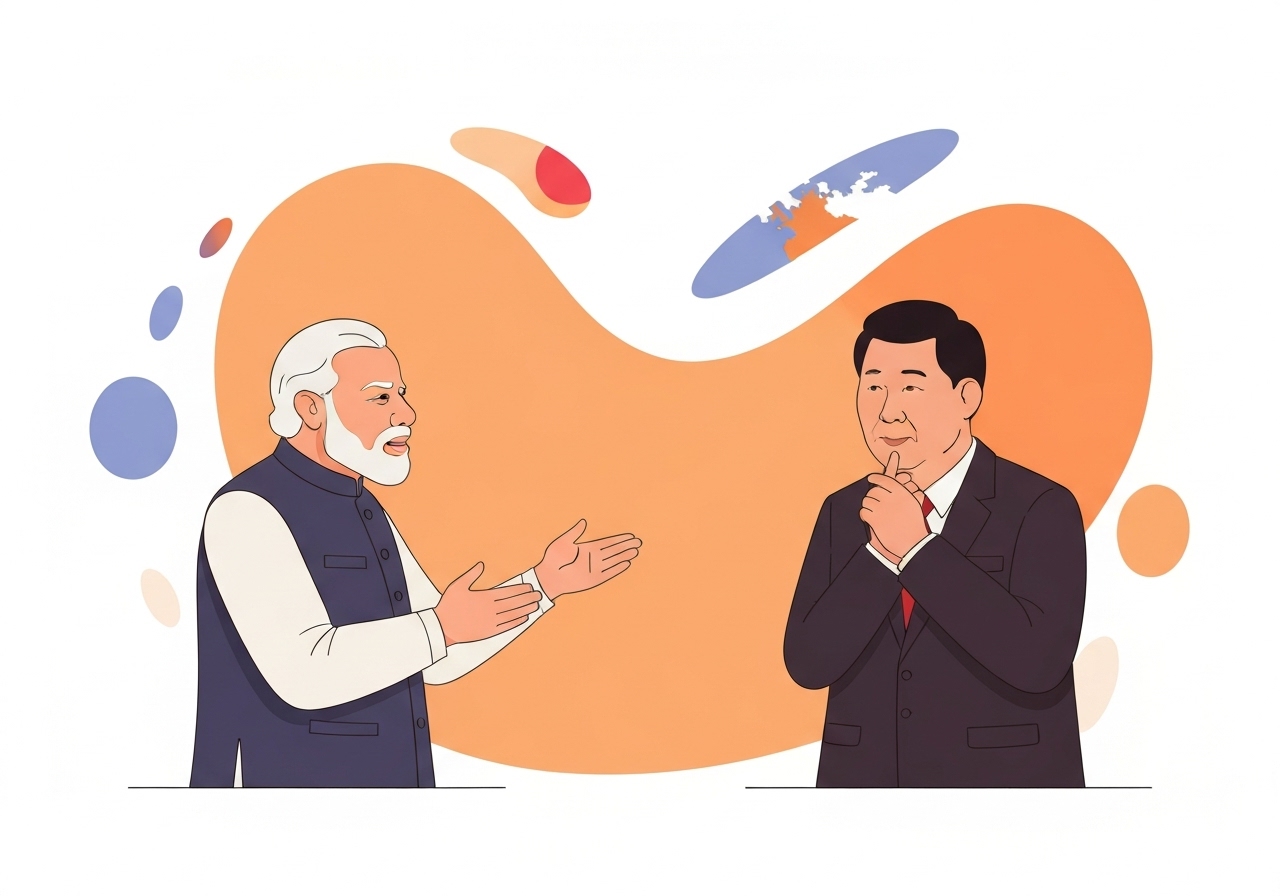
At a sideline meeting during the Shanghai Cooperation Organisation summit in Tianjin on , Indian Prime Minister Narendra Modi told Chinese President Xi Jinping that New Delhi is committed to improving relations with Beijing, citing a steadier Himalayan frontier and new steps to restart connectivity as both sides seek to move beyond years of border tensions.
Key Takeaways
- Modi and Xi met in Tianjin during the two-day SCO gathering, Modi’s first trip to China in seven years.
- Modi said the border environment has shifted toward “peace and stability” and noted a new understanding on border management; details were not disclosed.
- Xi said the border issue should not define the overall relationship, according to Chinese state media.
- The meeting came five days after Washington’s 50% tariffs on Indian goods took effect, a move tied to India’s purchases of Russian oil.
- India said direct flights between the two countries, suspended since 2020, are being resumed; no date was given.
- China recently agreed to lift export curbs on rare earths, fertilizers and tunnel boring machines during Foreign Minister Wang Yi’s visit to India.
- Despite a thaw, friction points remain: a record $99.2 billion India trade deficit with China this year, concerns over a planned Tibetan mega-dam, the Dalai Lama’s presence in India, and China’s support for Pakistan.
Verified Facts
Modi and Xi held their discussion on the sidelines of the SCO summit in Tianjin, which also drew Russian President Vladimir Putin and leaders from across Central, South and Southeast Asia and the Middle East. The trip marks Modi’s first visit to China since 2018, underscoring a cautious reset amid broader Global South consultations.
Modi said conditions on the disputed Himalayan frontier have improved, with both sides cultivating “peace and stability.” He added that the two countries reached an understanding on border management, though neither side provided specifics. The frontier has been a major flashpoint since deadly clashes in 2020 froze most bilateral cooperation.
The talks came soon after the United States imposed 50% tariffs on Indian goods, citing India’s purchases of Russian oil. Analysts say Beijing and New Delhi have incentives to present a more united front under tightening Western trade and technology pressures.
Steps to normalize ties have gathered pace. India said direct flights—halted since 2020—are being restored, and China has agreed to ease export restrictions on rare earths, fertilizers and tunnel boring machines. In recent months, China allowed Indian pilgrims to visit Buddhist sites in Tibet, and both sides lifted reciprocal tourist visa curbs. A breakthrough meeting in Russia last year, following a border patrol accord, set the stage for the latest thaw.
Context & Impact
Geopolitically, closer coordination between Asia’s two largest countries could reshape regional alignments as India balances relationships with the West and Russia, and China navigates a complex external environment. The SCO setting provided a convenient platform to signal Global South cohesion without formal treaty commitments.
Economically, China remains India’s largest bilateral trade partner, yet the trade gap hit a record $99.2 billion this year—a persistent concern for Indian policymakers. Easing export curbs and restoring flights could support supply chains, infrastructure projects and tourism, though India’s domestic manufacturing goals and security reviews will continue to shape market access.
Long-term sensitivities endure. New Delhi fears a planned Chinese mega-dam in Tibet could reduce dry-season flows on the Brahmaputra by up to 85% according to Indian government estimates, raising water security risks downstream. China’s backing for Pakistan and India’s hosting of the Dalai Lama also remain structural irritants.
Recent Milestones
| Date | Development |
|---|---|
| 2020 | Deadly clashes on the Himalayan frontier; direct flights suspended; ties freeze. |
| 2024 | Modi and Xi meet in Russia after a border patrol agreement, beginning a tentative thaw. |
| Aug 2025 | U.S. 50% tariffs on Indian goods take effect, citing Russian oil purchases. |
| Aug 2025 | China agrees to lift curbs on rare earths, fertilizers, and tunnel boring machines during Wang Yi’s India visit. |
| Aug 31, 2025 | Modi–Xi meeting in Tianjin at the SCO summit; flights set to resume, border management understanding noted. |
Official Statements
India is committed to advancing ties with China based on mutual respect, trust and sensitivities.
Narendra Modi, via his official X account
The border should not define the overall China–India relationship; both sides should view each other as partners.
Xi Jinping, as reported by Xinhua
China opposes steep U.S. tariffs on India and will stand with India on this issue.
Xu Feihong, Chinese Ambassador to India
Unconfirmed
- Exact provisions and timelines of the new border management understanding were not disclosed.
- No schedule was provided for the resumption of direct commercial flights.
- Scope, timing and implementation details of China’s easing of export curbs were not specified in official readouts.
Bottom Line
The Tianjin meeting signals a pragmatic thaw: both sides want to stabilize the border, restart travel and trade, and manage rivalry under intensifying global headwinds. Concrete, verifiable steps—flight resumptions, trade facilitation, and sustained disengagement along the frontier—will determine whether this opening endures.
With structural disputes still unresolved, progress is likely to be incremental. Yet even limited cooperation could reduce risks of miscalculation while offering economic and diplomatic breathing room for both governments.