
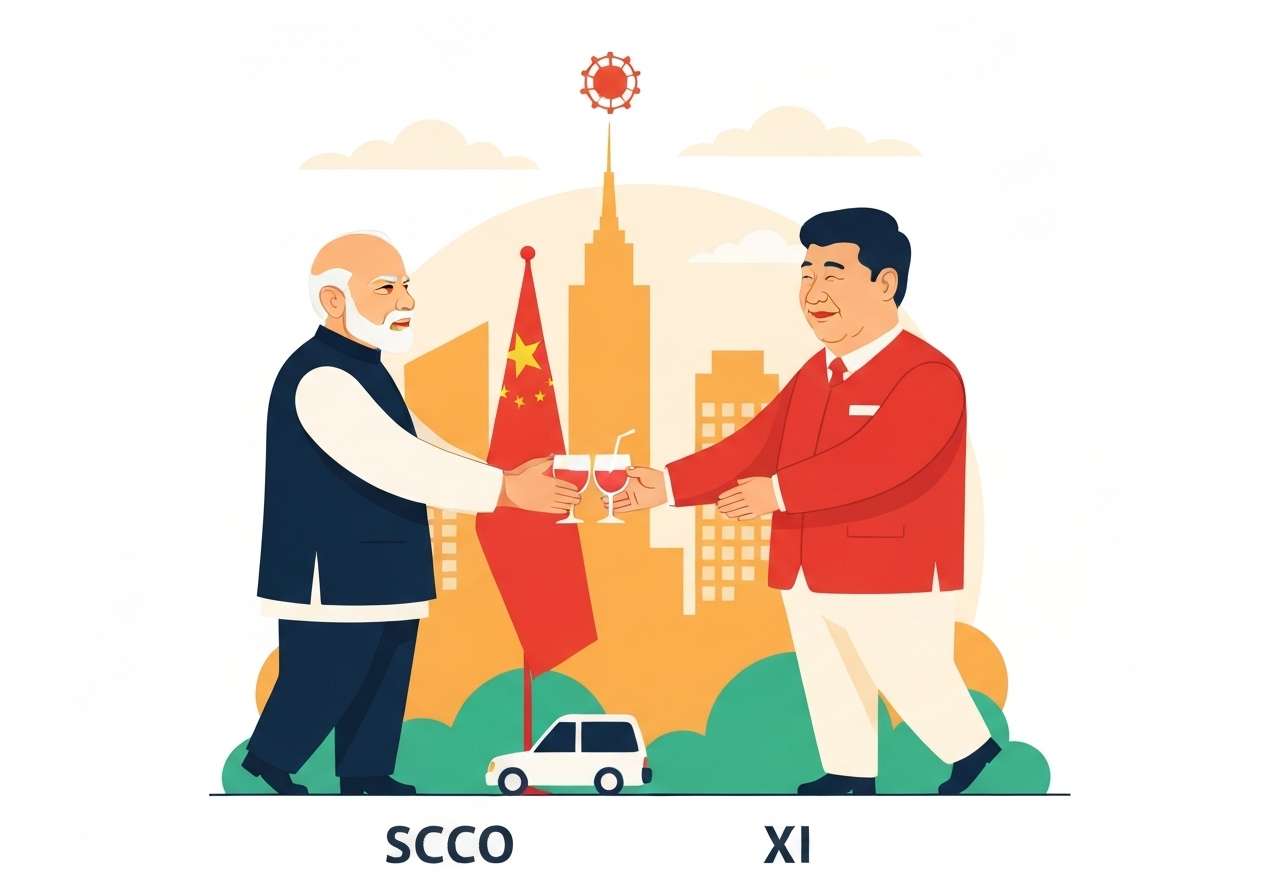
On in Tianjin, Chinese President Xi Jinping and Indian Prime Minister Narendra Modi used their meeting on the sidelines of the Shanghai Cooperation Organisation summit to frame the two countries as development partners rather than competitors, discussing trade, investment and steps to stabilise their disputed border in a bid to steady ties amid new global tariff pressures.
Key Takeaways
- Modi met Xi in Tianjin during the SCO summit, his first visit to China in seven years.
- Both leaders said the relationship should be partnership-focused, with plans to expand trade and investment.
- Modi highlighted an improving “peace and stability” environment along the Himalayan frontier following a 2024 patrolling accord.
- India’s trade deficit with China stands near $99.2 billion; talks addressed narrowing the gap and lifting curbs on key exports.
- The meeting came five days after the United States imposed tariffs totaling 50% on Indian goods, intensifying external economic pressure.
- Direct flights are set to resume after a four-year suspension; China has moved to ease export restrictions on rare earths, fertilisers and tunnel boring machines.
- Long-running disputes persist, including border management, water security tied to a planned Tibetan dam, and differences over the Dalai Lama and Pakistan.
Verified Facts
During their bilateral in Tianjin, Xi and Modi agreed to characterise India–China ties as an opportunity for mutual development. They discussed ways to boost trade and investment while addressing India’s large bilateral trade deficit, which reached about $99.2 billion this year, even as China remains India’s largest goods trade partner.
Modi stressed the importance of maintaining calm along the Line of Actual Control after the deadly 2020 clash—when 20 Indian and four Chinese soldiers were killed—triggered a prolonged standoff and heavy militarisation. India’s Foreign Secretary Vikram Misri said a border patrolling agreement reached in October 2024 has helped the situation “move toward normalisation.”
Xi signalled that the boundary question should not dominate the overall relationship, arguing that both sides should view each other as partners. The two leaders also discussed expanding practical cooperation on regional and global issues, including counterterrorism and fair trade rules in multilateral forums, according to India’s foreign ministry.
The outreach follows U.S. tariffs totaling 50% on Indian goods announced by President Donald Trump, which analysts say were influenced in part by India’s purchases of Russian oil. The move complicates Washington’s effort to deepen strategic ties with New Delhi as a counterweight to Beijing and adds urgency to India’s search for economic diversification.
Specific steps to thaw ties are advancing. Modi said direct flights—suspended since 2020—will be restored, though no start date was provided. Beijing has also moved to lift export curbs on rare earths, fertilisers and tunnel boring machines after Chinese Foreign Minister Wang Yi’s recent visit to India. China’s ambassador in New Delhi, Xu Feihong, publicly opposed the U.S. tariff hike and said Beijing would “stand with India” on the issue.
| Indicator | Latest detail |
|---|---|
| Border length | 3,800 km (2,400 miles), poorly demarcated |
| 2020 clash casualties | 20 Indian, 4 Chinese soldiers |
| India’s trade deficit with China | ~$99.2 billion (2025) |
| U.S. tariffs on Indian goods | Totaling 50% (took effect five days before meeting) |
| Direct flights | Suspended since 2020; resumption announced (timing TBD) |
Context & Impact
The Tianjin summit brought together leaders from Russia, Iran, Pakistan and Central Asian states, underscoring a broader Global South push for policy coordination. For Beijing and New Delhi, presenting a less adversarial relationship reduces friction at a time of volatile tariffs and realignment of supply chains.
Border stabilisation—if sustained—could unlock incremental confidence-building, more cross-border exchanges and a clearer runway for trade talks. Easing export curbs on critical inputs such as rare earths and fertilisers may offer near-term relief to Indian manufacturers and farmers, while the return of direct flights would restore vital people-to-people and business links.
Enduring fault lines remain. India worries a planned Chinese mega-dam in Tibet could, in the dry season, sharply reduce Brahmaputra River flows—Indian government estimates suggest up to an 85% cut—while political sensitivities over the Dalai Lama and China’s close partnership with Pakistan continue to complicate trust.
Official Statements
We intend to advance ties grounded in mutual respect and sensitivities, with border calm enabling progress.
Narendra Modi
The boundary question should not overshadow the broader relationship; both sides are development partners.
Xi Jinping
Following the October 2024 patrolling arrangement, the frontier situation is moving toward normal.
Vikram Misri, India’s Foreign Secretary
Unconfirmed
- No official timetable has been announced for restoring direct flights.
- Details of the scope and pace of lifting Chinese export curbs were not published.
- The cited 85% dry-season flow reduction on the Brahmaputra is an Indian government estimate; Chinese authorities have not endorsed that figure.
- Analysts link U.S. tariffs partly to India’s Russian oil purchases; the precise weighting of factors has not been formally disclosed by Washington.
Bottom Line
Beijing and New Delhi are engineering a cautious thaw—signalling partnership, reviving connectivity and easing some trade frictions—without resolving core disputes. If border stabilisation holds and economic steps materialise, expect incremental normalisation; setbacks remain possible given sensitive security, water and geopolitical issues.