
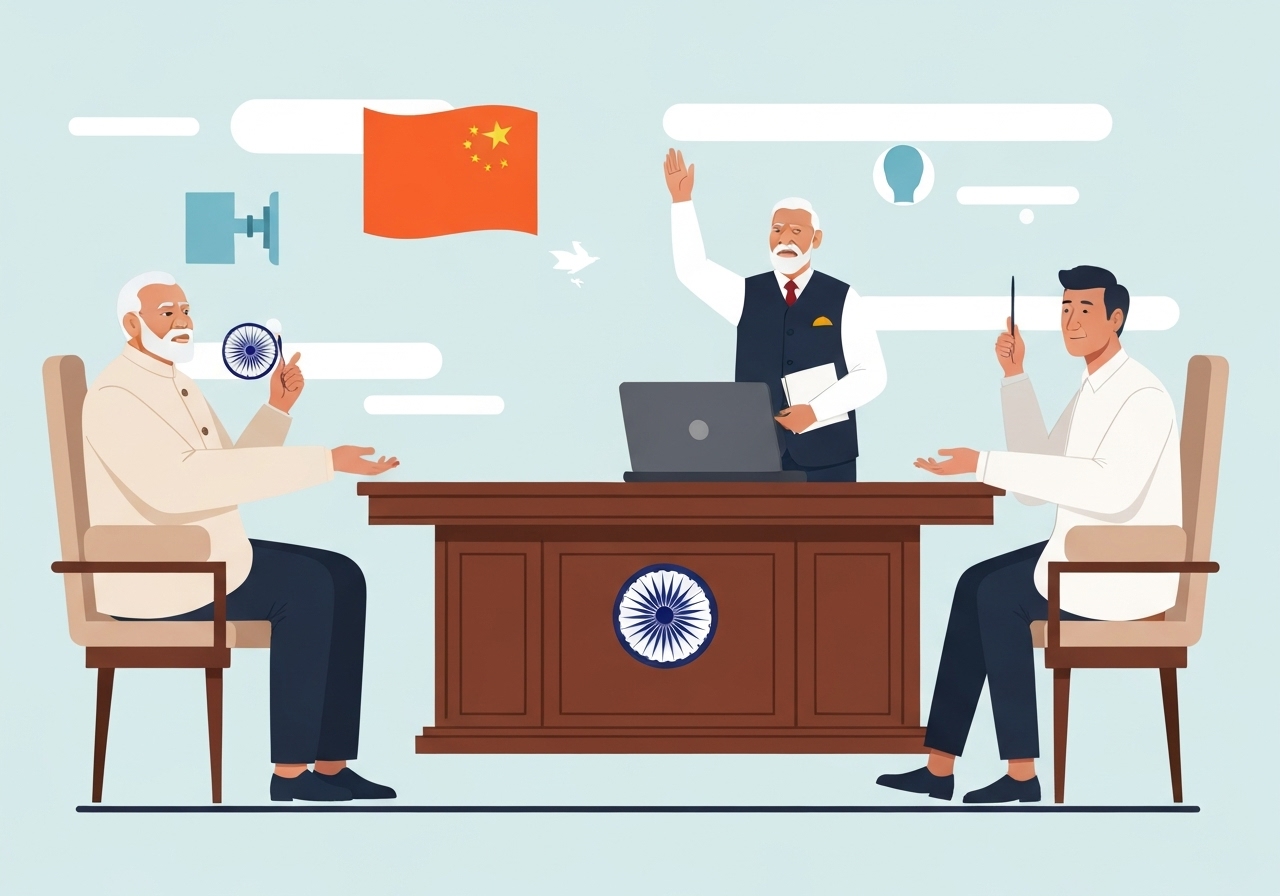
Indian Prime Minister Narendra Modi met Chinese President Xi Jinping in Tianjin on Monday, 1 September 2025, on the sidelines of the Shanghai Cooperation Organisation summit, seeking to steady ties after years of friction as fresh US tariffs of up to 50% on Indian goods reshape New Delhi’s strategic calculus.
Key Takeaways
- Modi and Xi agreed to resume direct flights and simplify visa procedures, signaling a tentative reopening of people-to-people and business links.
- Both sides pledged to manage the disputed border by “not turning differences into disputes,” while military and diplomatic talks continue.
- US tariffs of up to 50% on Indian exports, imposed amid India’s continued purchase of Russian oil, are pushing New Delhi to diversify partners.
- India’s trade deficit with China exceeds $99bn, a core obstacle to deeper market access discussions.
- The meeting fits India’s “strategic autonomy” approach but complicates coordination with the US-led Quad ahead of its summit later this year.
- Interactions had slumped after the deadly 2020 border clash; this is Modi’s first China visit in seven years.
- Chinese and Indian readouts emphasized stabilizing ties during a broader regional reset involving Russia and other SCO members.
Verified Facts
Modi and Xi met in Tianjin alongside the SCO gathering, where leaders including Russia’s Vladimir Putin and delegates from countries such as Turkey, Saudi Arabia, Iran, Qatar, Egypt, and Pakistan were present. Photographs of the leaders together were released on Monday.
The United States has enacted tariffs of up to 50% on Indian goods entering the US market, citing New Delhi’s refusal to halt oil purchases from Russia. India has not introduced retaliatory tariffs and continues to describe the US as its largest trading partner.
New Delhi and Beijing said they would improve practical cooperation and avoid letting disagreements escalate into disputes, while reaffirming ongoing military and diplomatic mechanisms to de-escalate along their contested frontier. Tens of thousands of troops remain deployed on both sides of the Line of Actual Control, though officials say talks are making incremental progress.
India’s merchandise trade deficit with China is above $99bn, and both countries maintain various tariffs and regulatory barriers. Beijing wants greater access to India’s 1.4bn-strong market; New Delhi seeks risk reduction, deficit correction, and safeguards before broader opening.
| Indicator | Latest signal |
|---|---|
| Tariffs on Indian goods to US | Up to 50% |
| India–China trade deficit | Over $99bn |
| Combined population | ~2.8bn |
| Border posture | Tens of thousands of troops; talks ongoing |
| Travel links | Direct flights to resume; visas to be eased |
Context & Impact
Since taking office in 2014, Modi had invested in outreach to China, visiting five times through 2018. The 2020 Galwan Valley clash derailed the momentum and froze high-level engagement for years. Monday’s optics suggest both sides see value in compartmentalizing disputes to revive selective cooperation.
Washington’s tariff shock adds urgency. India’s insistence on continuing discounted Russian oil purchases reflects both economic imperatives and a long-standing partnership with Moscow. In this environment, a limited thaw with Beijing could give New Delhi negotiating leverage and supply-chain options while it seeks to cushion export headwinds.
Yet risks loom. Any fresh tensions on the frontier could rapidly undercut progress. Trade opening without deficit management could face political resistance in India. Conversely, a visible tilt toward China may strain India’s coordination with the Quad just as it prepares to host the grouping later this year.
Regional Signaling
For Beijing, images of a cordial Modi–Xi amid US tariffs on India carry powerful symbolism and suggest Beijing’s desire to cast the SCO as a stabilizing forum. Chinese officials recently highlighted “win-win cooperation” and marked the 75th anniversary of ties, indicating an appetite for a pragmatic reset if border frictions are contained.
Official Statements
“The dragon and the elephant should come together.”
Xi Jinping, during the Tianjin meeting
Both sides will “maintain peace and tranquility at the border and not turn differences into disputes.”
Official readouts from New Delhi and Beijing
Unconfirmed
- Whether US President Donald Trump will attend the upcoming Quad summit and what stance he might take on China.
- A claim by a senior Indian officer that China provided “live inputs” to Pakistan during their recent conflict; this has not been publicly corroborated by Beijing.
- Exact timelines and capacity for restored direct flights and faster visas have not been published.
Bottom Line
The Tianjin meeting offers a narrowly focused reset: restart travel, lower temperatures on the border, and test selective economic cooperation. US tariff pressure and India’s energy pragmatism create incentives for both sides to recalibrate. The durability of this thaw will hinge on border management, trade deficit safeguards, and how deftly New Delhi balances the Quad with a working relationship with Beijing.