
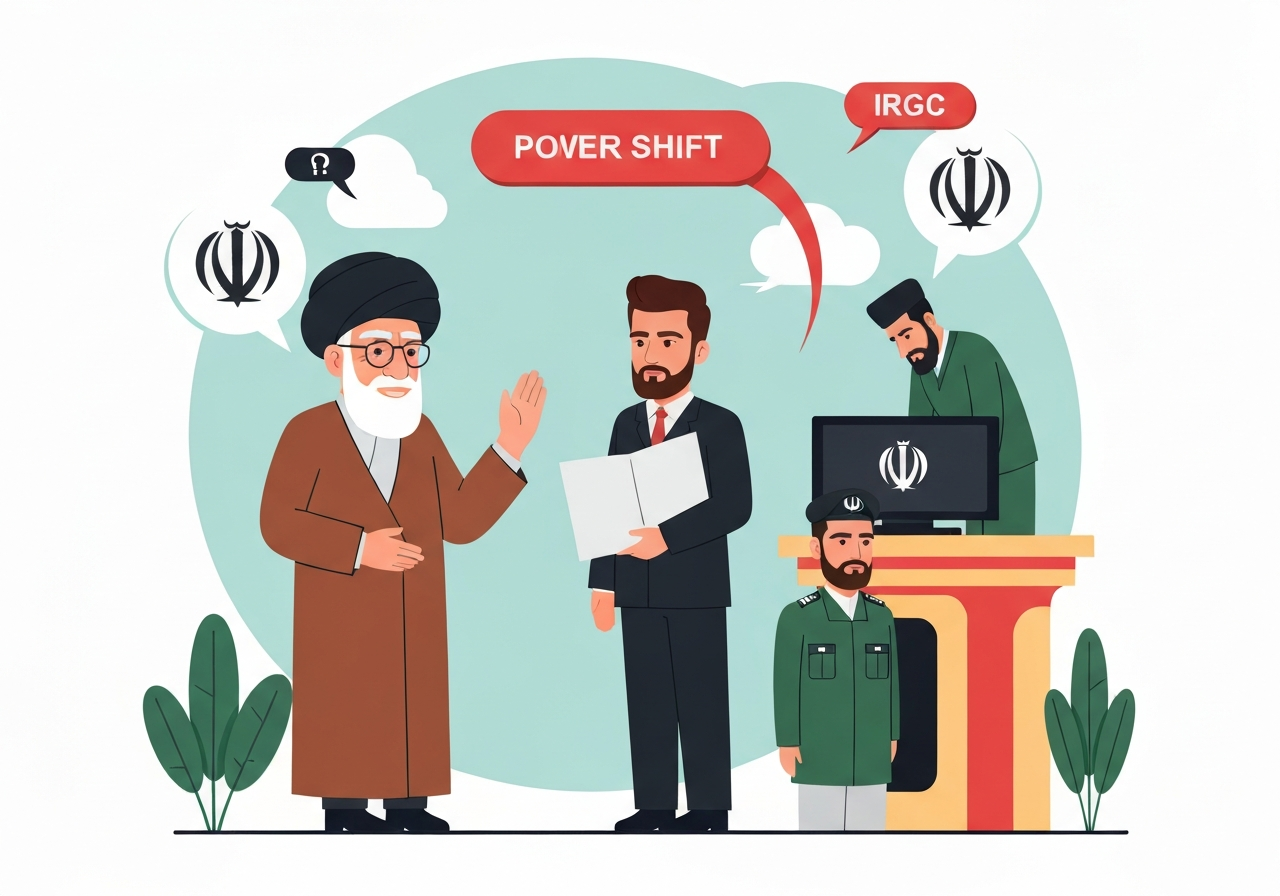
On March 21, 2026, U.S. and Israeli assessments indicated that Iran’s Supreme Leader Mojtaba Khamenei is alive but does not wield the same centralized authority associated with his father. Multiple intelligence contacts told The Jerusalem Post that the Islamic Revolutionary Guard Corps (IRGC) appears to be the dominant actor within Iran’s power structure. Officials described Khamenei as wounded but physically capable of some duties; yet, the real decision-making influence seems to rest with IRGC commanders. Expectations around a Nowruz address that would signal stability were unmet — only a written statement and still photographs were released, with the timing of those images unclear.
Key Takeaways
- Multiple U.S. and Israeli sources on March 21, 2026, assessed Mojtaba Khamenei to be alive but medically and politically constrained.
- Analysts told reporters the IRGC likely holds the balance of power, with one source saying the Guards are ‘‘controlling him,’’ not vice versa.
- Officials described Khamenei as wounded but able to perform at least limited functions; no credible reporting has confirmed incapacitation or death.
- During Nowruz (Iranian New Year), expected live or recorded messaging did not appear; Tehran released a written statement plus still images of Khamenei, whose dates are uncertain.
- The apparent diffusion of authority marks a shift from the centralized control associated with Ayatollah Ali Khamenei to a more institutionally dominant IRGC.
- Immediate regional implications include potential changes in operational command, diplomatic posture, and decision timelines inside Tehran.
Background
Since the 1979 revolution, Iran’s power has been organized around the office of the Supreme Leader, a role that combined religious authority with command over the state’s security and foreign policy levers. Under Ayatollah Ali Khamenei, that center was notably centralized: the Supreme Leader exercised final authority over the IRGC, the judiciary, and core elements of foreign policy. The succession to Mojtaba — while closely watched inside and outside Iran — has been accompanied by questions about personal legitimacy, institutional loyalties, and the IRGC’s expanding domestic and regional footprint.
In recent years the IRGC has grown more assertive across economic, security, and political domains, deploying special units, controlling strategic industries, and projecting force abroad. That accumulation of capabilities has increased observers’ debate over whether Iran’s command is concentrated in a single figure or diffused across powerful institutions. The context for the current assessments includes heightened U.S.-Iran tensions, regional proxy conflicts, and an Iranian domestic scene marked by protests and factional maneuvering.
Main Event
On Nowruz — an occasion often used by Tehran’s leadership to demonstrate legitimacy — expectations rose that Mojtaba Khamenei would appear in person or via recorded address to reassure the public and elites. Instead, state outlets issued a written statement and released several still photographs. Intelligence sources told reporters the timing of those images could not be independently verified, which deepened questions about his condition and capacity to lead.
U.S. and Israeli contacts separately indicated that intelligence points to Khamenei being alive but wounded. Those assessments stop short of asserting a full medical profile and instead emphasize operational implications: a wounded leader can still carry out some functions while being politically constrained. The Jerusalem Post quoted an informed source saying, “The more likely scenario is that the Revolutionary Guards are controlling him, not the other way around,” signaling a notable shift in internal dynamics.
Officials emphasized that formal officeholders and state institutions remain in place, and no orderly transfer of authority has been publicly announced. In practice, however, IRGC commanders—who oversee some of Iran’s most potent military and security assets—appear to be exercising greater influence over strategic choices and day-to-day governance. The combination of a potentially impaired leader and a powerful security institution creates a different decision-making profile than Iran has exhibited in recent decades.
Analysis & Implications
If the IRGC is indeed the de facto power broker, several predictable effects follow. First, foreign-policy decision cycles may shorten or lengthen depending on internal bargaining; the IRGC has its own priorities, notably regional deterrence and proxy networks. Second, domestic politics could tilt toward security-first governance, with possible crackdowns on dissent and consolidation of economic levers under IRGC-affiliated actors. Third, ambiguity about the Supreme Leader’s authority complicates external diplomacy—foreign capitals must decide whether to negotiate with institutions, individuals, or both.
Economically, IRGC ascendancy could accelerate integration of military-linked conglomerates into priority sectors, affecting sanctions dynamics and international business risk. Financial flows and procurement channels controlled by IRGC entities would remain primary vectors for capability maintenance. This institutional tilt could also harden Iran’s posture in regional theaters where the Guards operate through proxy forces, raising the probability of calibrated but persistent asymmetric actions.
From a succession and legitimacy perspective, a sidelined Supreme Leader weakens the traditional vertical chain of command that has underpinned regime stability. If the Guards effectively broker key decisions, factions within the clerical establishment and Revolutionary institutions may jockey for influence, increasing the chance of internal friction. International actors will watch for signs of either a return to centralized leadership or a durable IRGC-dominated governance model.
Comparison & Data
| Characteristic | Under Ayatollah Ali Khamenei | Current Assessment (March 21, 2026) |
|---|---|---|
| Centralization of authority | High — Supreme Leader exercised final say | Reduced — IRGC appears to assert decisive influence |
| Public leadership signals | Frequent public addresses and clear directives | Limited; Nowruz saw only a written statement and still images |
| IRGC role | Powerful but formally subordinate | De facto dominant in operational decisions |
The table above synthesizes qualitative differences between the prior decades-long pattern of centralized leadership and the emerging dynamics reported on March 21, 2026. While hard metrics (e.g., command orders, internal memos) are not public, observable signals — types of public messaging, IRGC deployments, and official statements — support the assessment of an institutional shift.
Reactions & Quotes
“The more likely scenario is that the Revolutionary Guards are controlling him, not the other way around.”
Well-informed source, as reported to The Jerusalem Post (media/anonymous intelligence source)
Officials described Mojtaba Khamenei as “wounded but alive,” a formulation that underlines uncertainty about his operational authority.
U.S. and Israeli officials (government sources, described to media)
Public reaction inside Iran was muted in state-controlled outlets, while regional capitals and Western diplomatic centers issued cautious statements emphasizing continued monitoring. Analysts urged restraint in drawing long-term conclusions until corroborating evidence — medical, administrative, or public — emerges.
Unconfirmed
- The precise nature and severity of Mojtaba Khamenei’s wounds remain undisclosed and unverified by independent medical or official reports.
- It is unconfirmed whether the written Nowruz statement and released photographs were produced at the time they were published or were older materials distributed to project continuity.
- No public evidence yet confirms an official, durable transfer of decision-making authority from the Supreme Leader to the IRGC.
Bottom Line
The available reporting on March 21, 2026, points to Mojtaba Khamenei being alive but politically constrained, with the IRGC likely exercising significant de facto control. This represents a meaningful departure from the highly centralized model associated with his father and could reshape both Iran’s internal governance and its external behavior.
Observers should treat current assessments as provisional: verification of medical status, public messaging patterns, and institutional decisions over the coming days and weeks will clarify whether Iran has entered a period of temporary diffusion of authority or a more permanent IRGC-dominated configuration. For policymakers and regional actors, the immediate priority is cautious monitoring and contingency planning for a range of scenarios.
Sources
- The Jerusalem Post — Media report citing U.S. and Israeli intelligence assessments (March 21, 2026)