
Lead
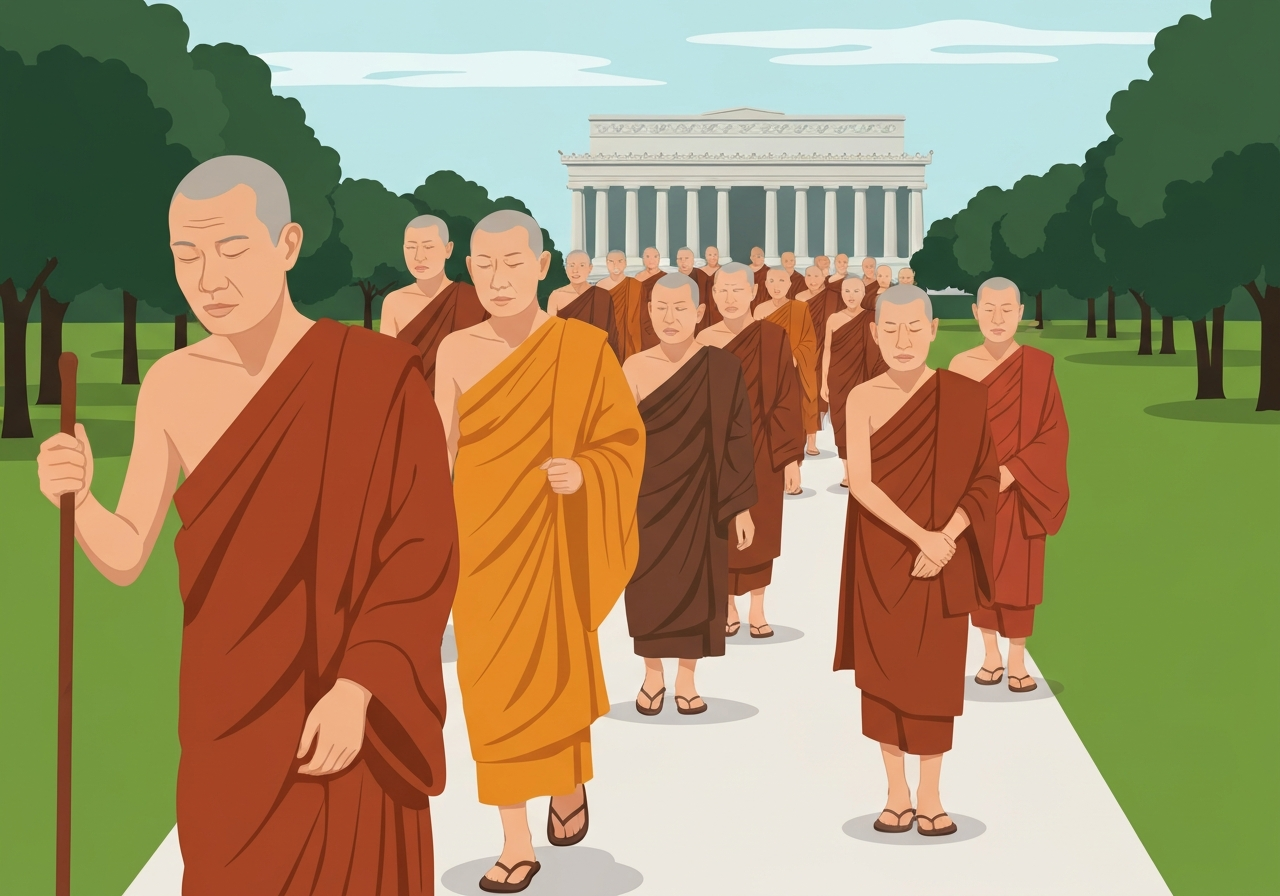
On Wednesday, Feb. 11, 2026, a group of Buddhist monks concluded a high-profile stop at the Lincoln Memorial after a 2,300-mile pilgrimage from Texas intended to promote peace, compassion and mutual understanding. The procession — led by Venerable Bhikkhu Pannakara and featuring 19 monks (and a rescue dog named Aloka) as well as roughly 100 monks and nuns who joined in Washington — drew thousands at the memorial and widespread attention online. Organizers say the walk began 108 days earlier and endured harsh winter storms, extreme cold and injuries, including two monks struck in a roadside crash outside Houston. The gathering mixed explicitly spiritual aims with moments that resonated in America’s civic center, beneath the statue of Abraham Lincoln.
Key Takeaways
- The Walk for Peace covered about 2,300 miles from Texas to Washington, D.C., over roughly 108 days and is scheduled to finish in Annapolis, Maryland on Thursday, Feb. 12, 2026.
- Approximately 19 core walkers and their rescue dog Aloka were joined by about 100 additional monks and nuns at the Lincoln Memorial; crowds of thousands assembled for the Washington stop.
- The group experienced serious harm in November when their escort vehicle was struck outside Houston; two monks were injured and Venerable Maha Dam Phommasan later had a leg amputated but returned to address the DC crowd from a wheelchair.
- Organizers deliberately framed the journey as nonpolitical, though observers at the memorial displayed a range of signs, including a Palestinian flag and messages of peaceful resistance.
- The walk generated substantial engagement on social platforms; Martin Luther King III posted support on X, calling the walk a model of endurance and moral example.
- Speakers at the memorial included a niece of the Dalai Lama who read a tribute letter, and Bhikkhu Bodhi, who described the event as among the 21st century’s notable moral demonstrations.
- The walkers used traditional Theravada peace-walking practices, including periods walking barefoot or in socks to cultivate presence and humility.
Background
Peace walks have a long history in Theravada Buddhist practice as public demonstrations of nonviolence, humility and compassion. The modern iteration emphasizes walking as both spiritual discipline and public witness, often drawing local communities together to mark moral commitments rather than policy demands. In this case the organizers called their route a “Walk for Peace,” spanning nine states and intentionally steering clear of partisan messaging while traveling through diverse political landscapes.
The Lincoln Memorial has served as a stage for defining civic moments in American history, from Marian Anderson’s 1939 concert to Martin Luther King Jr.’s 1963 address. Organizers chose the memorial for its symbolic association with national reconciliation; the monument’s inscription about binding up the nation’s wounds framed the walkers’ spiritual purpose. The route’s timing — through winter and a severe storm period — amplified public interest and underscored the physical demands of the pilgrimage.
Main Event
On Feb. 11, beneath the 19-foot seated statue of Lincoln, the monks arranged themselves on the memorial steps as a recorded or amplified song about peace played for the assembled crowd. Several spoke briefly: Tencho Gyatso, identified as a niece of the Dalai Lama, read a letter praising the walkers’ endurance and the international attention their journey drew. Venerable Bhikkhu Pannakara led chants and invited the audience to join in short, peaceful refrains.
Bhikkhu Bodhi, originally from Brooklyn and a prominent voice in American Theravada circles, addressed attendees and framed the walk as exemplifying American civic virtues tied to equality and shared humanity. Members of the public held roses and handmade signs reading slogans such as “Warriors of peace welcome” and “Equal rights for all humans.” The atmosphere mixed solemnity and celebration, with birdsong and occasional aircraft overhead as speakers and walkers interchanged remarks.
The route has not been without tragedy or sacrifice. In November, while walking near Houston, the group’s escort vehicle was struck by a truck; two monks were hurt and Venerable Maha Dam Phommasan later required amputation of a leg. Phommasan returned to Washington in a wheelchair and addressed the crowd, a vivid testament to the physical costs some participants bore to continue the mission.
Analysis & Implications
The Washington stop turned a spiritual exercise into a civically resonant moment. By choosing a site associated with national healing, the walkers invited comparisons between religious practice and public reconciliation. That framing allows the pilgrimage to operate as both interfaith witness and soft civic diplomacy, emphasizing personal example over policy prescriptions. In a polarized moment, a public ritual that stresses humility and endurance can serve as a neutral entry point for conversations about social cohesion.
However, the decision to remain formally nonpolitical does not fully insulate the walk from political readings. Signs and flags in the crowd indicate how audiences project their causes onto public acts of conscience. For organizers, staying above partisan debate preserves access to a broad audience; for some observers, the presence of explicit political symbols raises questions about how spiritual activism intersects with conflict and justice campaigns.
Practical impacts on policy or conflict dynamics are likely limited in the short term. Rituals and moral exemplars can shift public mood and sustain civil society networks, but translating symbolic momentum into concrete legislative outcomes requires organized follow-up, institutional partnerships and targeted advocacy. Still, sustained media attention and social-media amplification may strengthen local temple networks, boost volunteer recruitment, and expand cross-community dialogues in places along the route.
Comparison & Data
| Metric | Walk for Peace (2026) | Typical Long Peace Walks |
|---|---|---|
| Distance | ~2,300 miles | 100–1,500 miles |
| Duration | ~108 days | Days to months |
| Core participants in DC | 19 monks (+≈100 joined) | Varies widely |
| Serious injuries reported | 2 injured; 1 amputation | Occasional injuries |
The table places the 2026 Walk for Peace among the largest contemporary Buddhist peace pilgrimages in the United States by distance and duration. While some historical peace marches have had larger organized contingents or clearer political aims, the combination of length, winter conditions and public visibility in the U.S. capital makes this event notable in recent civic-spiritual history.
Reactions & Quotes
Public and notable responses ranged from praise to reflective support. Martin Luther King III framed the walk as an example of perseverance; his post on X amplified the event to a broad audience and linked it to the civic tradition of nonviolent moral witness.
“A powerful reminder that peace is practiced step by step.”
Martin Luther King III — social media post (X)
Religious leaders emphasized the walk’s moral and civic dimensions. Bhikkhu Bodhi spoke to the crowd about shared human dignity and the walk’s capacity to reveal common values across diverse communities.
“This walk for peace has brought out the greatest quality of the American character.”
Bhikkhu Bodhi — Buddhist leader
Local participants described why they had come: some followed the walkers for months; others sought community in a fractious moment. A longtime follower noted the group’s commitment and the personal inspiration she drew from its consistency, even while acknowledging that the walk alone will not end conflict.
“I admire their commitment to this cause.”
Jacquelyn Gray — supporter
Unconfirmed
- Exact social-media reach described as “millions” of people is based on organizers’ and platform amplification estimates and has not been independently audited.
- Any direct causal link between the walk and near-term policy changes in Washington is unproven; potential political influence remains speculative.
- Comprehensive participant counts across the full nine-state route vary by source and have not been consolidated into a single verified figure.
Bottom Line
The Walk for Peace was a sustained, highly visible act of spiritual witness that combined traditional Theravada practices with modern civic symbolism. The 2,300-mile route, the endurance through winter conditions, and the return of injured participants to address the crowd made the Washington stop especially poignant. While the walk’s immediate policy effects are uncertain, it generated moral attention, community connections and media visibility that may have lasting value for civic dialogue.
For policymakers and civic leaders, the pilgrimage offers a reminder that ethical exemplars and small-group perseverance can shift public tone even when they do not yield immediate legislative outcomes. Observers should watch whether organizers convert attention into organized, sustained programs — for example, community dialogues, temple-funded outreach, or partnerships with peacebuilding institutions — to translate the symbolic momentum into measurable change.