
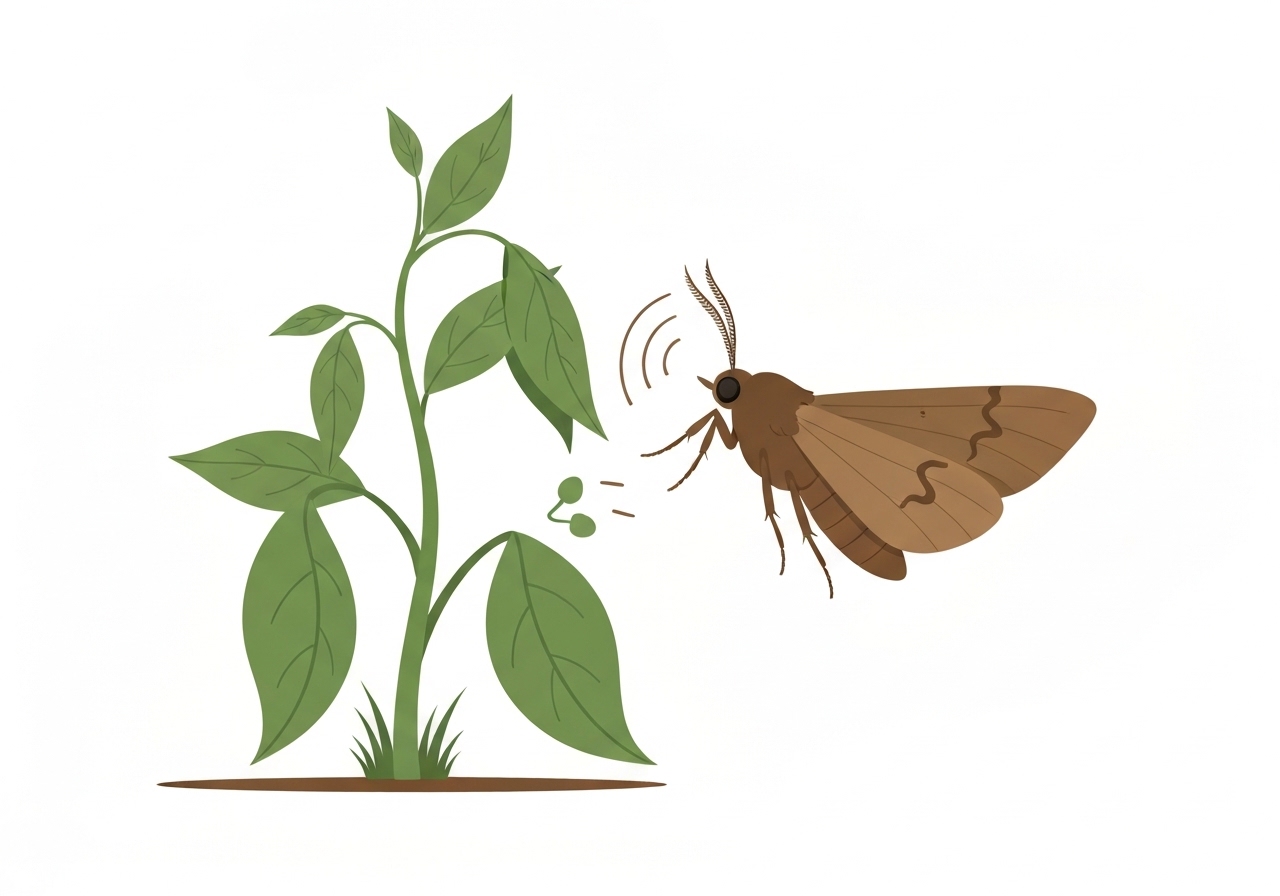
Female Egyptian cotton leafworm moths (Spodoptera littoralis) use more than sight and smell when choosing egg sites: researchers report that the insects detect ultrasonic clicks emitted by drought‑stressed plants and avoid laying eggs on them. The experiments, led by scientists at Tel Aviv University and published in eLife, showed females responded to airborne clicks in the 20–60 kHz band, with the moths’ tympanic ears most sensitive near 38 kHz. Controlled trials using recorded plant sounds, live tomato plants and deafened moths demonstrated that the behavior depended on hearing and was integrated with olfactory cues. The finding reveals an acoustic dimension to plant–insect interaction with possible ecological consequences for plant health and pest management.
Key takeaways
- The focal insect is the Egyptian cotton leafworm moth, Spodoptera littoralis; females have tympanic ears sensitive to roughly 20–60 kHz, peaking near 38 kHz.
- Stressed plants (e.g., drought) emit airborne ultrasonic clicks; natural click rates in tomato patches are about 20 clicks per minute, experimental tests used 30–60 clicks/min to simulate close proximity.
- In speaker-only arenas, moths preferred to lay eggs near speakers playing recorded plant stress clicks; this preference disappeared when moths were deafened, confirming an auditory mechanism.
- When real healthy and stressed plants were present, females avoided the stressed (clicking) plants, indicating integration of sound with visual/olfactory cues.
- Electroantennogram recordings revealed distinct odor signals from drying versus hydrated plants, showing moths can combine smell and sound in site selection.
- Researchers used sound levels comparable to those measured from live plants, supporting ecological relevance of the responses.
Background
Plants communicate through multiple channels: volatile chemicals, root networks mediated by fungi, and—as recent work suggests—airborne ultrasonic vibrations. Chemical signaling, both above and below ground, is well documented: plants emit volatile organic compounds when damaged, which can prime defenses in neighbors, while mycorrhizal networks redistribute nutrients and distress cues. Acoustic emissions from plants were previously recorded but largely thought to be a physical by‑product of water stress rather than a biological signal intended for receivers.
Insects perceive their environment through a mix of sensory modalities. Many moths have tympanic organs that detect ultrasonic pulses, usually studied in the context of bat echolocation or insect courtship. The hypothesis tested here was whether plant‑generated ultrasonics fall into that perceptual window and influence insect decisions, particularly female site selection for oviposition, which directly affects larval survival.
Main event
The research team ran a series of controlled laboratory experiments. In setups without plants, female moths showed a significant tendency to lay eggs near a speaker broadcasting recorded plant stress clicks. This attraction vanished when the moths were experimentally deafened, demonstrating that the response was auditory rather than driven by subtle air movements or other artifacts.
When healthy plants were added to arenas and the recorded clicks were played near one of them, females favored the silent, non‑clicking plant. The outcome held across multiple click rates and spatial configurations, indicating that moths can interpret clicking as an indicator of plant condition and avoid stressed hosts for their offspring.
The team also tracked movement: moths spent more time on the side of the arena producing plant clicks before making oviposition choices, suggesting an active evaluation rather than a simple reflex. Control tests showed female moths did not confuse male courtship sounds—which fall in a similar frequency band—for plant clicks; females did not prefer sites associated with male sounds for egg laying.
Physiological assays complemented behavior. Electroantennogram recordings from moth antennae showed altered odor responses to drying versus hydrated plants, indicating that olfactory information differs with plant water status and is available to the insect alongside acoustic cues. Together, the data point to multimodal assessment when females select egg sites.
Analysis & implications
This study extends the sensory ecology of plant–insect interactions by demonstrating that airborne ultrasonic emissions from stressed plants can serve as informative cues for insects. For a female moth, choosing a healthy host increases larval prospects; avoiding drought‑stressed plants therefore likely provides a fitness advantage by reducing the chance of offspring encountering poor food quality or increased plant defenses.
From an evolutionary perspective, the acoustic clicks may have originated as a physical consequence of cavitation or tissue desiccation during water loss. Whether selection has acted on plants or insects to accentuate or exploit these sounds remains unresolved, but the current data show insects can and do use the information. If widespread, acoustic cues could influence host selection across many herbivore taxa and alter plant–herbivore dynamics in drought‑prone systems.
Applied implications are notable: if pests avoid stressed hosts, agricultural management should consider how irrigation regimes influence pest distributions. Conversely, synthetic playback of plant stress sounds could be explored as a non‑chemical deterrent, though ecological side effects and long‑term efficacy would require careful field testing.
At the ecosystem level, the finding raises questions about multi‑species networks: pollinators, predators and parasitoids might also detect plant acoustics, creating cascading effects. The integration of sound with established chemical signaling pathways suggests a richer communication landscape with both direct and indirect consequences for community structure.
Comparison & data
| Measure | Natural/Measured | Experimental setting |
|---|---|---|
| Plant click rate (tomato patch) | ~20 clicks/min | 30–60 clicks/min (playback) |
| Moth ear sensitivity | 20–60 kHz (peak ≈ 38 kHz) | Playbacks centered on 20–60 kHz, levels matched to live plants |
| Behavioral result | Avoid stressed plants when live cues present | Preference for speaker playing stress clicks in absence of plants |
The table summarizes core empirical numbers: natural click rates measured in tomato patches, the frequency window of the moth tympanal organ, and the experimental playbacks used to approximate or slightly exceed natural click rates. The researchers matched playback amplitudes to field measurements to preserve ecological relevance while testing response thresholds under controlled conditions.
Reactions & quotes
Tel Aviv University team members framed the study as the first demonstration that plant‑produced ultrasonics can influence animal choices. They positioned the work as opening a new sensory axis in plant–animal ecology rather than closing a debate about origins or adaptive function.
“We hypothesized that animals capable of hearing these high‑frequency sounds may respond to them and make decisions accordingly.”
Prof. Yossi Yovel, Tel Aviv University (study co‑author)
The co‑authors emphasized the experimental chain of evidence—behavioral preference, loss of preference when deafened, and concordant olfactory differences—rather than asserting a definitive evolutionary narrative.
“We assumed females seek an optimal site to lay their eggs — a healthy plant that can properly nourish the larvae — so we tested whether moths would heed a dehydration warning.”
Prof. Lilach Hadany, Tel Aviv University (co‑author)
External experts asked for field replication before concluding broad ecological impact. Several ecologists noted the importance of testing other herbivores and of quantifying fitness outcomes for larvae in places with natural acoustic backgrounds.
“This adds a plausible sensory channel to consider, but we need multispecies field data to assess population‑level effects.”
Independent ecologist (comment to authors)
Unconfirmed
- Whether plant clicks evolved as signals intentionally directed at other organisms or are purely a physical by‑product of stress is not resolved by the current data.
- It is unconfirmed how widespread sensitivity to plant ultrasonics is across herbivore, pollinator or predator taxa; broader surveys are needed.
- Direct field evidence that use of plant clicks changes long‑term population dynamics or crop damage levels remains to be demonstrated.
Bottom line
This study provides robust laboratory evidence that female Spodoptera littoralis can detect ultrasonic clicks from drought‑stressed plants and use those cues—together with smell and sight—to avoid laying eggs on stressed hosts. The experiments combined behavioral assays, auditory manipulation and antennal recordings to show multimodal assessment rather than reliance on a single cue.
The broader implication is that acoustic emissions add a previously underappreciated channel to plant–animal communication, with potential impacts on ecology and agriculture. However, field validation, multispecies surveys and fitness measurements are needed before translating the finding into pest‑management strategies.