
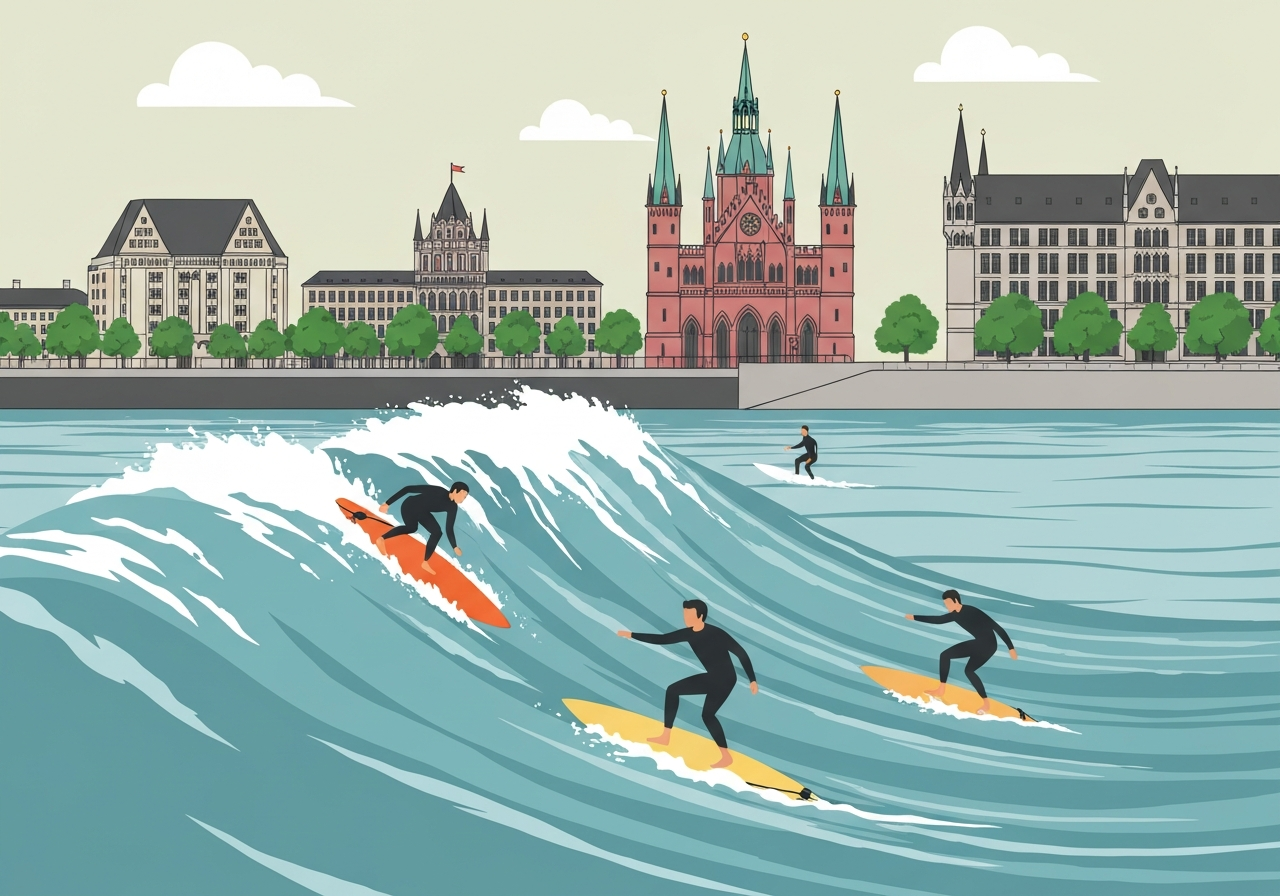
On March 7, 2026, a small group of surfers in Munich scrambled into the icy Eisbach creek in the Englischer Garten to try to recreate a once-famous standing wave that disappeared after a dredging operation last year. The river runs roughly 200 miles from the nearest sea, yet had drawn decades of riders until authorities altered the channel. As the city weighs safety concerns after a fatality in 2025, local riders, municipal officials and onlookers remain locked in a debate over how — or whether — to restore the wave.
Key Takeaways
- The Eisbach wave in Munich’s Englischer Garten was a decades-old urban surf spot located about 200 miles from the nearest coastline.
- City dredging in 2025 removed sediment and changed the creek bed, and the standing wave largely vanished afterward.
- Surfers attempted a field repair in early 2026, using a 20-foot metal bar to fashion a temporary obstacle; strong current repeatedly dislodged it.
- Authorities cite safety concerns following a death at the creek in 2025 and prefer fixed, bed-anchored wave structures over suspended devices.
- The previous popular wave-maker hung from a bridge; officials now seek devices fixed to the creek bed to reduce risk and liability.
- Local supporters argue the wave is part of Munich’s urban culture and draws visitors and community activity to the Englischer Garten.
- Technical and regulatory hurdles — from hydraulic forces to permitting and conservation rules — complicate any restoration plan.
Background
The Eisbach has been an unlikely but longstanding surf site in Munich, tucked inside the Englischer Garten near the city’s university quarter. For decades enthusiasts rode a standing wave created by flows and engineered obstacles, turning a small stretch of creek into a focal point for local recreation. The spot became culturally significant: riders and spectators treated it as a distinctive urban pastime far from traditional surf coastlines.
In 2025, city crews carried out dredging along the channel to address navigational, flood-control or maintenance concerns. That work altered the creek bed geometry and water profile, and the recognizable surfable wave largely dissipated. The change coincided with heightened scrutiny of creek safety after a death at the site in 2025, prompting municipal officials to reconsider how, or whether, to permit artificial structures in the waterway.
Main Event
In the first months of 2026, determined surfers returned with tools and plans to re-establish a surfable wave. On a cold morning two men in wetsuits attempted to install a makeshift obstacle by forcing a 20-foot metal bar into the creek bed. Helpers held the bar and wrestled with the current as they sought a configuration that would bend the flow into a standing wave.
The improvised effort repeatedly failed: the creek’s churn and altered bed profile prevented the bar from staying put. Where older installations hung from a bridge and relied on fixed points above the water, the city now prefers devices anchored below the surface to reduce the risk of floating debris or loose fixtures. That preference created a technical mismatch between what surfers historically used and what officials will accept.
City authorities have emphasized public safety and legal obligations following last year’s fatality, warning that any unauthorized or unstable structure could worsen danger to riders and swimmers. Surfers counter that a properly engineered, bed-anchored design could balance safety and the community’s desire to preserve the wave as part of Munich’s urban culture.
Analysis & Implications
The dispute around the Eisbach wave highlights a recurring urban policy question: how to accommodate informal recreational practices that evolved outside strict regulation. The wave was simultaneously a cultural asset and a liability; restoring it in its old form would risk repeating past safety incidents, while removing it alters local identity and reduces informal tourism tied to the Englischer Garten.
Engineering the river to support a controllable, safe standing wave is feasible in principle but expensive and complex. Designers must account for flow velocity, bed material, flood events and maintenance needs. Fixed bed anchors may meet safety and permitting standards, but they require civil-engineering plans, environmental review and ongoing municipal oversight.
Politically, the issue creates pressure on municipal leaders to reconcile competing priorities: public safety, liability exposure, conservation of a historic parkland and support for grassroots sporting culture. Any decision will set a precedent for how cities manage other informal urban sports that rely on public infrastructure.
Comparison & Data
| Item | Before 2025 | After 2025 Dredging |
|---|---|---|
| Wave status | Regular standing wave; frequent use | Wave largely gone |
| Wave-maker type | Suspended device from bridge | Officials prefer bed-anchored structures |
| Notable incidents | Decades of riding, occasional injuries | Fatality in 2025 prompted review |
| Distance to sea | Approximately 200 miles from nearest coastline | |
The table summarizes core changes after the 2025 dredging. Restoring a surfable wave will require re-engineering the channel profile and resolving permitting and safety conditions; those steps generally extend timelines and raise costs compared with ad hoc repairs.
Reactions & Quotes
“We just want the wave we had back — it’s part of the city’s character,”
Local surfer and longtime rider
The remark reflects a common sentiment among users who see the Eisbach wave as more than sport: it is a communal practice and an attraction for visitors.
“After last year’s fatality, our priority is reducing risk. Fixed, bed-anchored options are safer than suspended gear,”
Munich parks department (official)
City officials stress that public safety and legal standards guide their recommendations, particularly where structures interact with public waterways and parkland.
“Hydraulically, a standing wave depends on very specific bed geometry and flow rates; improvisation rarely produces a stable, long-term result,”
Water-safety engineer (academic/consultant)
Experts note that successful restoration will need certified engineering, monitoring and maintenance plans to remain safe and durable under variable flows.
Unconfirmed
- Whether a formal engineering plan and funding have been secured to build a permanent, permitted bed-anchored wave device is not publicly confirmed.
- Precise environmental impact assessments for a restored wave — including effects on fish passage and sediment transport — have not been published.
- The timeline for any municipal permitting or community consultation process remains unclear.
Bottom Line
The Eisbach episode is a case study in how cities manage informal recreation that becomes culturally significant. The vanished wave raises technical, legal and ethical questions: can authorities restore a beloved feature while meeting modern safety and environmental standards? Answers will require engineering work, regulatory decisions and funding commitments that could take months or years.
For residents and visitors who valued the wave, the immediate reality is a patchwork of small, temporary attempts and a larger municipal review process. Observers should watch for formal engineering proposals, environmental reviews and any pilot projects that reconcile public-safety demands with the neighborhood’s desire to keep a unique urban tradition alive.