
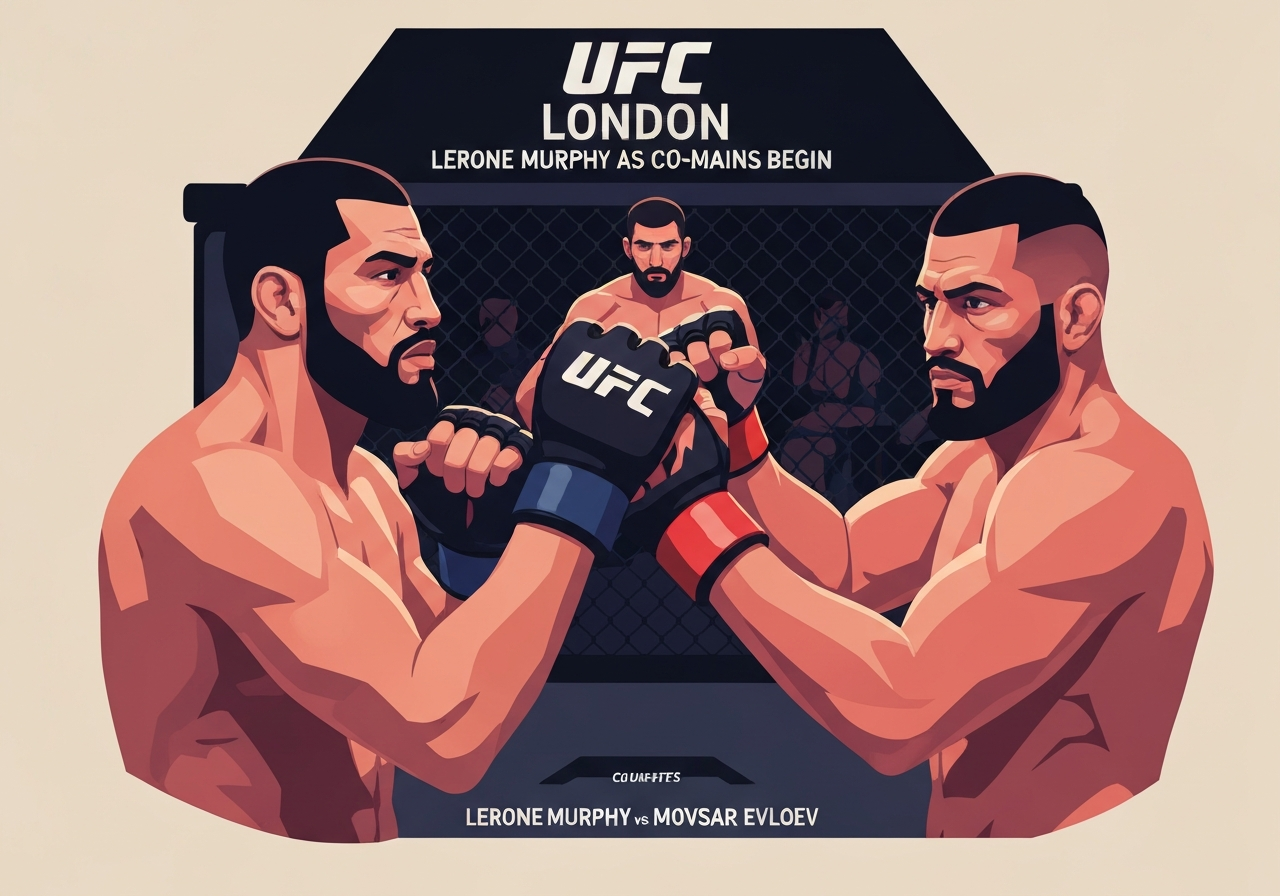
On Mar. 21, 2026 at The O2 in London, the UFC returned with a high-stakes card headlined by unbeaten Lerone Murphy and Movsar Evloev. The matchup carries immediate title implications — a potential pathway toward Alexander Volkanovski’s featherweight belt — while co-main bouts featuring Luke Riley vs. Michael Aswell Jr. and Michael “Venom” Page vs. Sam Patterson kept the card lively. This live recap synthesizes the action, context, and likely fallout from the evening’s fights.
Key Takeaways
- Lerone Murphy and Movsar Evloev served as the main event at The O2 in London on Mar. 21, 2026; both fighters entered the night unbeaten.
- The main event has immediate title ramifications: the winner positions for a possible challenge to Alexander Volkanovski’s featherweight title.
- Co-main attractions included Liverpool’s Luke Riley vs. Michael Aswell Jr., and Michael “Venom” Page vs. Sam Patterson on the main card.
- Michael “Venom” Page publicly questioned the Patterson matchup before promising a decisive finish, framing his outings as the true spectacle of any card.
- Kurtis Campbell made his UFC main-card debut against Danny Silva, opening the televised portion of the event.
- Middleweight Roman Dolidze returned to London to face Christian Leroy Duncan in a bout with divisional implications.
- The event combined established contenders and rising local names, underlining the UFC’s strategy of mixing global stars with regional draws at The O2.
Background
The UFC’s London stop at The O2 is a recurring fixture on the promotion’s international calendar and often features British or Europe-based fighters to maximize local interest. Tonight’s headline pairing — Lerone Murphy versus Movsar Evloev — was billed as a clash between two unbeaten featherweights, with clear short-term stakes: a win could fast-track a title opportunity against champion Alexander Volkanovski. That setup elevated the bout beyond a standard main event into a potential ranking-defining contest.
Michael “Venom” Page, one of the card’s biggest marketable names in the U.K., had publicly questioned the matchmaking that paired him with Sam Patterson, saying he sought higher-profile opponents. Page’s presence on the card nonetheless amplified attention, as he has historically provided highlight-reel moments that draw broadcast and ticket sales. The rest of the main card mixed UFC newcomers and established contenders, including Liverpool’s Luke Riley and Roman Dolidze, each with their own division-level stakes.
Main Event
The main event unfolded with both fighters aware of the featherweight ramifications. Lerone Murphy, fighting in front of a largely home crowd, approached the matchup as a “homecoming” opportunity to cement his place among the division’s elite. Movsar Evloev, the unbeaten Russian contender, framed the fight as another step in a run toward a title shot. The bout’s pacing, tactical shifts and key exchanges determined immediate rankings movement regardless of the long-term path to Volkanovski.
Through the early rounds the styles and strategy were evident: Murphy looked to leverage home-crowd energy and forward pressure, while Evloev prioritized positional control and defensive counters. Corner adjustments between rounds influenced momentum swings as both camps sought openings to change the fight’s trajectory. Significant moments — successful combinations, takedown attempts or decisive defensive sequences — carried outsized importance given the implied payoff of a title eliminator.
Beyond the technical exchange, the bout mattered for matchmaking logistics. A clear winner would not only climb the featherweight ladder but also give UFC matchmakers a marketable challenger to pitch for a showdown with champion Alexander Volkanovski. For the losing side, a competitive showing could still preserve ranking and future opportunity, while a lopsided loss would likely require several rebound wins to restore title contention.
Analysis & Implications
This London main event exemplifies how single fights now function as tournament-like gates to title contention in the UFC’s featherweight division. Because both participants entered unbeaten, the promotion and media framed the outcome as a near-automatic determinant of next-in-line status. That dynamic increases pressure on fighters and influences fight strategy; competitors may balance aggression with risk aversion to protect status, or conversely push for a stoppage to eliminate subjectivity from judging.
For Lerone Murphy, a victorious home performance would strengthen his marketability in the U.K. and strengthen the UFC’s case for a high-profile title contest. For Movsar Evloev, maintaining an unblemished record on foreign soil reinforces his durability and adaptability as a contender. Either result alters matchmaking equations across the division, affecting how the promotion sequences defenses and superfights for Alexander Volkanovski.
Economically and promotionally, the card demonstrates the UFC’s dual aims: cultivate regional stars (Murphy, Riley, Campbell) while protecting the path for global title narratives. If the winner advances toward Volkanovski, the UFC can leverage this London card as the narrative pivot in promotional materials for a future title bout — a valuable piece of story-driven marketing that drives PPV and ticket sales.
Comparison & Data
| Fight | Status | Context |
|---|---|---|
| Lerone Murphy vs. Movsar Evloev | Both unbeaten | Main event; potential featherweight title implications |
| Luke Riley vs. Michael Aswell Jr. | Co-main slot | Local interest; Liverpool representation |
| Michael Page vs. Sam Patterson | Main card | High-profile British headliner; Page seeks a decisive finish |
The table above summarizes roles and context for the card’s top matchups. While numerical records and strike/takedown statistics are essential for deeper performance analysis, available public reporting emphasized unbeaten status and matchmaking implications rather than detailed per-minute metrics. For readers seeking fight-by-fight statistics, official fight metrics will be released post-event by the promotion’s statisticians.
Reactions & Quotes
“I was looking for bigger, more exciting fights against established names,”
Michael “Venom” Page
Page voiced frustration at the matchmaking but also used the moment to promise an emphatic finish, reinforcing his brand as an entertainer who demands marquee opponents.
“I promise a big finish,”
Michael “Venom” Page
That commitment framed Page’s approach to the bout and set audience expectations for a highlight-driven performance that could boost his negotiating leverage for future matchups.
“Any fight with him in it is the real ‘main event’ of any card,”
Michael “Venom” Page
Page used this claim to emphasize his drawing power; regardless of the card’s official billing, his rhetoric aims to shape public perception and promotional leverage.
Unconfirmed
- Whether the winner of Murphy vs. Evloev will receive an immediate, contractually guaranteed title fight with Alexander Volkanovski — this remains subject to official UFC matchmaking announcements.
- Finalized statistical breakdowns (strike counts, takedowns, control time) are pending official post-fight reports and were not available at the time of this recap.
Bottom Line
UFC London at The O2 delivered a high-stakes night that mixed unbeaten title hopefuls with popular regional draws. The main event’s outcome reshapes featherweight narratives and likely tightens the short list for Alexander Volkanovski’s next opponent, while co-main and undercard performances affect divisional depth and local market momentum.
Fans and analysts should watch subsequent official announcements from the promotion for confirmed title pathways and detailed stats. In the near term, the card’s most immediate value is as a narrative inflection point: a clear winner gains leverage in rankings and matchmaking, while a close contest will feed debates about who truly deserves the next shot.