
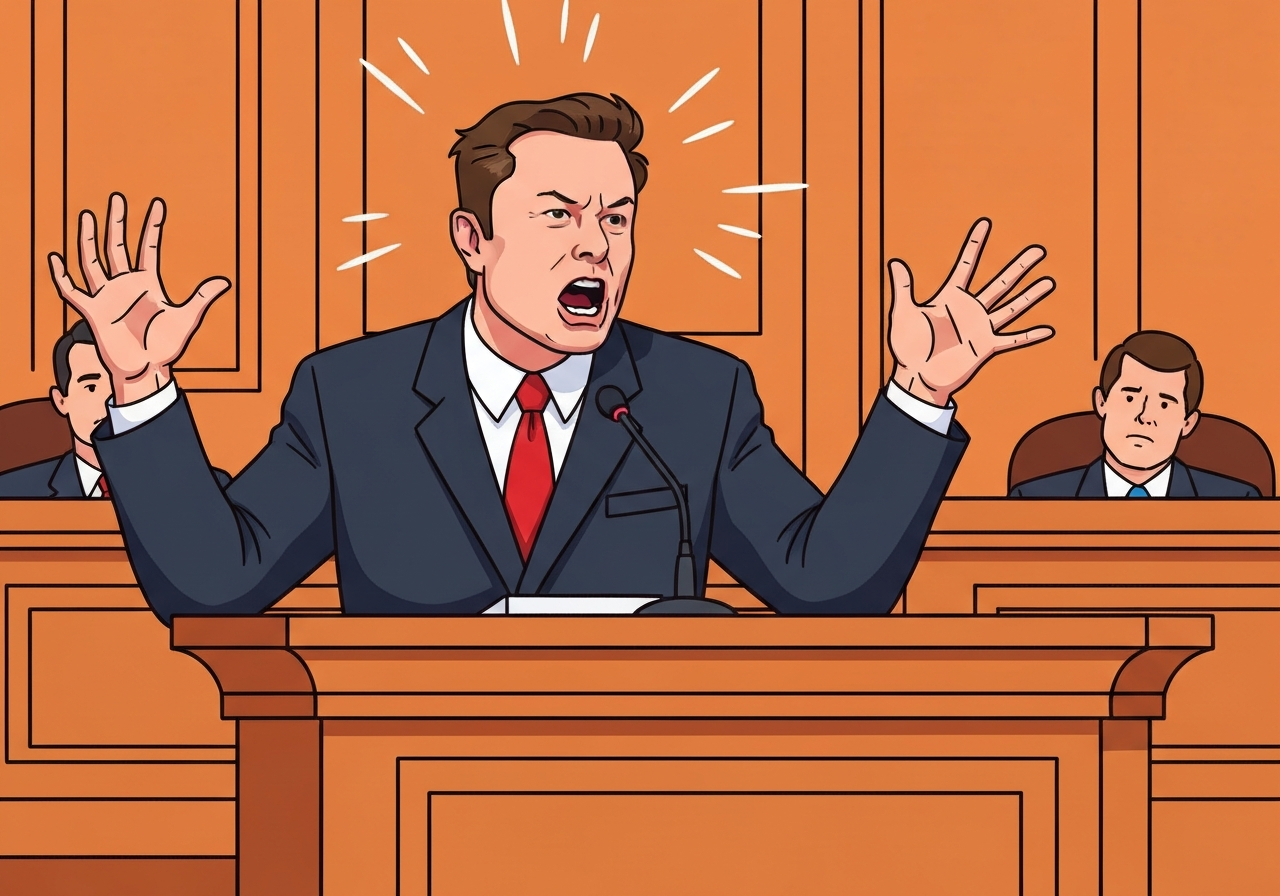
Lead: Elon Musk testified Wednesday in a San Francisco civil jury trial defending himself against accusations that he misled investors to push down Twitter’s stock as he sought to abandon a $44 billion acquisition. The class-action lawsuit covers shareholders who sold between May 13 and Oct. 4, 2022, during a period of public brinkmanship. Musk said he believed Twitter’s board had misrepresented the percentage of automated or “bot” accounts and that his actions reflected a dispute over information, not a calculated scheme to harm sellers. The trial is set to continue through March 19, with testimony expected to resume Thursday.
Key Takeaways
- The lawsuit covers Twitter shareholders who sold stock from May 13 to Oct. 4, 2022, a window when the deal was uncertain and trading was volatile.
- Musk agreed to buy Twitter for $44 billion at $54.20 per share and closed the takeover in October 2022, roughly six months after announcing the agreement.
- Plaintiffs allege Musk made a series of misleading statements that drove shares below $33 at one point—about 40% under the agreed price—harming sellers.
- Twitter previously paid $809.5 million in 2021 to settle claims about overstated user metrics; the company long disclosed bot estimates to the SEC, often noting the figures might undercount bots.
- Musk testified he believed Twitter’s 5% bot estimate was inaccurate and described the board’s disclosures as “BS,” while insisting his completion of the deal delivered value to long-term holders.
- Legal questions include whether Musk’s communications violated securities law and whether attorney-client privilege shields his reasoning about ending or completing the deal.
- U.S. District Judge Charles Breyer signaled he may review whether Musk personally concluded that Delaware Chancellor Kathleen McCormick was biased, which could affect privilege limits.
Background
The dispute traces to Musk’s April 2022 move to buy Twitter for $44 billion, or $54.20 per share, a deal that quickly became public and contentious. Over the following months Musk publicly questioned Twitter’s count of automated accounts and paused the transaction in July, citing concerns about bots and the company’s disclosures. Twitter sought to enforce the agreement in Delaware chancery court, prompting a separate enforcement battle that ended when Musk ultimately completed the purchase in October 2022. The takeover followed a high-profile period in which Twitter’s management, Musk and markets exchanged public statements and legal filings that heightened uncertainty and trading risk for shareholders.
Twitter had faced regulatory and legal scrutiny before Musk’s offer: in 2021 the company paid $809.5 million to settle allegations it had overstated user growth and related metrics. The company had also included bot-estimate disclosures in SEC filings for years, typically warning the numbers might be understated. That history framed Musk’s skepticism and gave context to his public complaints about platform metrics. Shareholders who traded during the dispute later alleged that Musk’s public statements and actions intentionally suppressed the price to pressure renegotiation or exit options, prompting this class-action suit.
Main Event
On the witness stand, Musk maintained that his concerns about bot prevalence justified renegotiation or termination of the agreement. He testified in a black suit and tie, repeatedly criticizing Twitter’s methods for estimating automated accounts and calling the company’s 5% figure “BS.” Musk acknowledged heated exchanges with Twitter’s board and did not dismiss the possibility he had issued stern warnings to push the company back to the negotiating table.
Plaintiffs assert a pattern: Musk publicly questioned Twitter’s disclosures, then informed the company in July that he was walking away, steps that allegedly produced market turmoil and share sales at depressed prices. Shares did dip below $33 while the takeover hung in limbo, which plaintiffs say reflects the financial harm to sellers who traded in that period. Twitter’s legal effort in Delaware to hold Musk to the merger agreement prompted him to reverse course and complete the acquisition on the original terms shortly before trial there was to begin.
Musk explained on the stand that his decision to close at the agreed price followed counsel’s view that the presiding Delaware chancellor, Kathleen St. Jude McCormick, was “extremely biased” against him, leaving little chance of prevailing in enforcement proceedings. Musk cited prior rulings by McCormick’s court concerning his compensation at Tesla, though the ruling he referenced was made months after the Twitter closing and later overturned by the Delaware Supreme Court. Judge Breyer flagged evidence suggesting Musk may himself have reached conclusions about bias, which could expose communications otherwise protected by attorney-client privilege.
Analysis & Implications
Legally, the case turns on whether Musk’s public statements and private actions meet the standard for securities fraud or are protected by opinion, negotiation tactics and counsel guidance. To sustain the class claims, plaintiffs must show actionable misstatements or omissions by Musk that were materially deceptive and caused measurable investor losses within the covered trading window. Defense arguments focus on Musk’s asserted uncertainty about Twitter’s data and his right to change course during complex merger negotiations.
Economically, the litigation highlights how high-profile takeover disputes can amplify market swings and create recoverable damages for sellers who trade amid misinformation or ambiguous disclosure. If the court finds Musk liable, it could increase scrutiny of executive statements during pending mergers and encourage firms and buyers to tighten disclosure practices and deal protocols to limit post-announcement volatility. Conversely, a defense victory would underscore the latitude parties have in negotiating and litigating conditional transactions where factual disputes over target metrics exist.
Privileged communications are a second critical axis. If Judge Breyer concludes Musk’s own conclusions about judicial bias negate privilege, internal counsel discussions may become discoverable, potentially revealing more about Musk’s contemporaneous state of mind and deal strategy. That outcome would reshape evidentiary scope not only here, but in future cases where executives claim litigation-based reasons for transactional reversals.
Comparison & Data
| Item | Figure / Date |
|---|---|
| Agreed purchase price | $54.20 per share ($44 billion) |
| Shareholders covered | Sales between May 13 and Oct. 4, 2022 |
| Lowest cited trading price during limbo | Below $33 per share (~40% under $54.20) |
| Twitter 2021 settlement | $809.5 million |
This quick table places key numeric facts side by side: the deal price, the covered trading window, the low intraperiod share price cited by plaintiffs, and Twitter’s earlier settlement. Those figures anchor the plaintiffs’ damage claims: a purchase price of $54.20 provides a benchmark against which declines and realized sales at lower prices are measured. The $809.5 million settlement illustrates prior regulatory exposure around Twitter’s user metrics, which informed both Musk’s skepticism and broader market concerns.
Reactions & Quotes
Supporters of the shareholder suit say the evidence shows repeated public statements by Musk contributed to market confusion and losses for sellers. Observers note the case could recalibrate how outspoken bidders communicate concerns about targets during live deal negotiations.
“There were a lot of threats going back and forth from both sides,” Musk testified, describing the acrimony that marked the months-long dispute.
Elon Musk
Before that, Musk used a blunt shorthand to dismiss Twitter’s bot estimate and the board’s disclosures, signaling why he believed renegotiation was warranted.
“I did make it clear that I thought it was BS,” Musk said, referring to Twitter’s calculation that roughly 5% of accounts were automated.
Elon Musk
Legal analysts have highlighted Musk’s broader public communications record, noting previous litigation where his social posts were examined. Musk acknowledged on the stand that his social-media habit often exposes his private thinking publicly.
“What I think privately is what I say publicly,” Musk testified, reflecting on his own posting style.
Elon Musk
Unconfirmed
- Whether Musk’s statements were intended specifically to depress the share price to secure a lower purchase price remains contested and not conclusively proven in the record so far.
- Claims that Chancellor McCormick’s alleged bias drove Musk’s decision to close lack independent confirmation beyond Musk’s recounting and counsel’s advice.
Bottom Line
The trial centers on whether Musk crossed the line from aggressive negotiation and public critique into securities misconduct that harmed sellers during the May–Oct 2022 trading window. Central factual anchors are the agreed $54.20-per-share price, the share declines below $33 during the dispute, and Twitter’s prior $809.5 million settlement related to its user metrics.
For markets and dealmakers, the case underscores the legal and financial risks of high-profile, public dispute during mergers. A ruling for plaintiffs could narrow the permissible boundary of public commentary during a pending deal; a defense win would affirm more latitude for disputing transaction terms when factual uncertainties about a target exist. The court’s handling of privilege issues may be decisive in revealing what Musk knew and when.
Sources
- The Associated Press (news outlet): original reporting and trial coverage.