
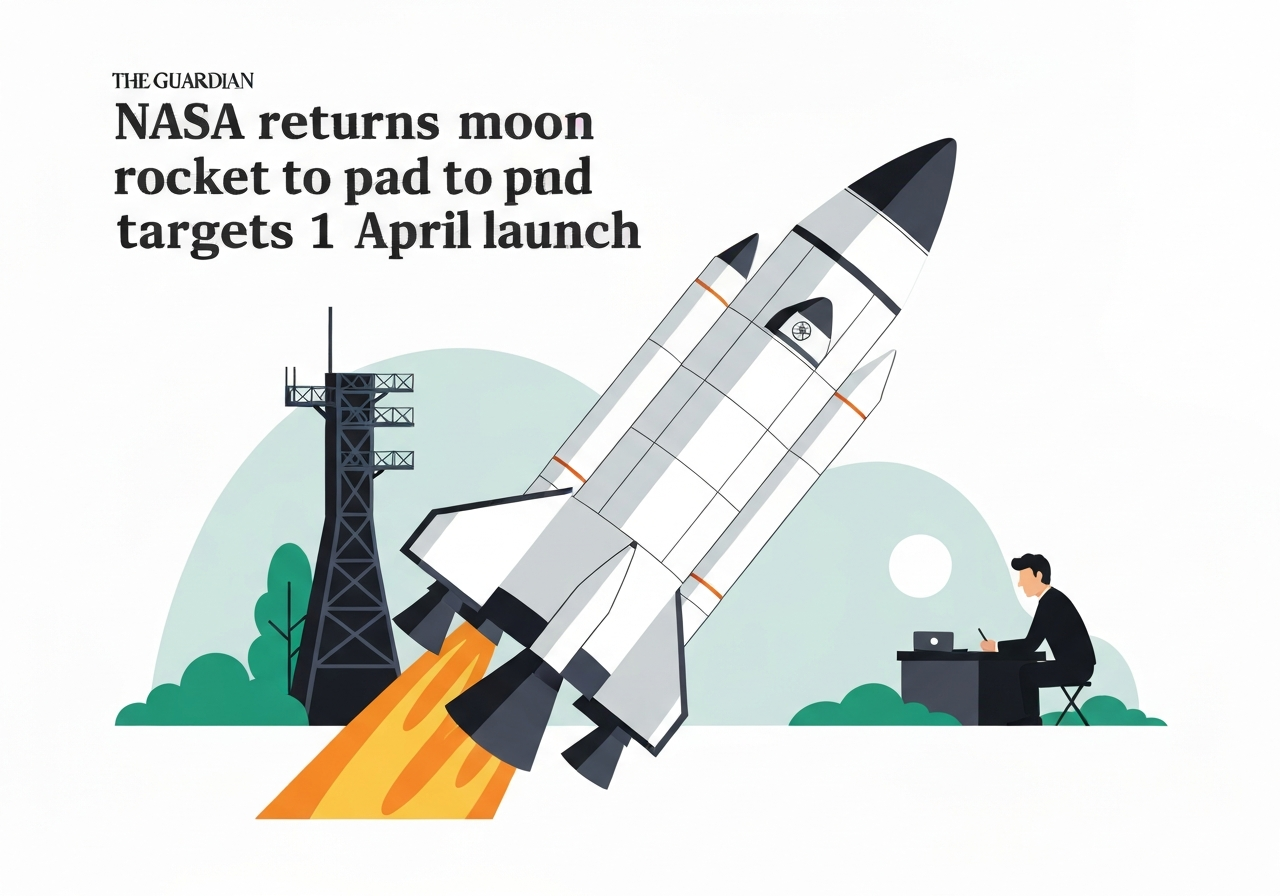
Lead: NASA has begun rolling its Space Launch System (SLS) rocket and the Orion crew capsule back out to launch pad 39B at Kennedy Space Center, Florida, ahead of a planned crewed lunar flyby with an earliest window on . Engineers started the move at 8pm local time and expect the transfer to take up to 12 hours over a 4-mile (6.5 km) route from the Vehicle Assembly Building to the pad. The action follows recent repairs to a helium-flow anomaly; if post-rollout checks go well, Artemis 2 aims to carry three US astronauts and one Canadian on a roughly 10-day circumlunar flight. The agency has resumed final pre-launch preparations while the astronaut crew entered quarantine in Houston ahead of liftoff.
Key Takeaways
- The Artemis 2 stack—SLS rocket and Orion capsule—weighs about 5,000 tonnes and began its transfer to launch pad 39B at 20:00 local time; movement can take as long as 12 hours.
- The pad transfer covers approximately 4 miles (6.5 km) from the Vehicle Assembly Building to pad 39B at Kennedy Space Center in Florida.
- NASA set the first available crewed-launch opportunity for , with additional windows in the days that follow; the mission is expected to last about 10 days.
- Engineers returned the stack to the pad after addressing a helium-flow issue detected late last month; earlier, a liquid-hydrogen leak forced a curtailed wet dress rehearsal.
- If tests remain satisfactory, the crew of three US astronauts and one Canadian will perform the first crewed lunar flyby in more than 50 years, a milestone for the Artemis program.
- The program remains subject to sequencing and technical checks; any anomaly during pad checkout could delay the targeted April opportunities.
Background
The Artemis programme is NASA’s multi-phase effort to resume human operations beyond low Earth orbit and ultimately return astronauts to the lunar surface. Artemis 2 is planned as the first crewed mission in the series to fly around the Moon since the Apollo era; its success is a key stepping-stone toward later crewed landings. The broader initiative involves extensive industrial partners, international contributors such as the Canadian Space Agency, and a complex ground infrastructure centered at Kennedy Space Center.
The goal of returning Americans to the lunar surface was publicly elevated during President Donald Trump’s first term and has shaped successive funding and scheduling decisions. However, the programme has faced a string of technical setbacks and schedule slips: the SLS/Orion stack experienced a liquid-hydrogen leak that ended a wet dress rehearsal early, and more recently a helium-flow anomaly prompted engineers to roll the Artemis 2 stack back into the Vehicle Assembly Building for inspection and repair.
Main Event
At around 8pm local time, Artemis engineers began the slow, carefully controlled movement of the assembled vehicle out of the Vehicle Assembly Building. Special rolling platforms will tow the 5,000-tonne stack the 4-mile (6.5 km) distance to pad 39B; crews monitor structural, electrical and pressurization systems continuously during the transit. Ground teams typically allow up to 12 hours for this transfer to ensure no rushed procedures compromise hardware integrity.
After the stack reaches pad 39B, teams will perform a series of integrated checks—propellant lines, avionics, communications links and cryogenic conditioning—before declaring the vehicle ready for the launch attempt. If those tests clear, the agency will transition into final countdown rehearsals and fueling campaigns timed to the opening of the window on . Several launch opportunities are available in the immediate days after that date, giving NASA flexibility if teams need extra time.
The Artemis 2 crew entered quarantine in Houston on Wednesday as a standard preflight precaution to limit illness risk. Crew health, ground-support readiness and range constraints must all align to proceed. The flight plan calls for a roughly 10-day mission that will loop the spacecraft around the Moon and return to Earth, without a planned lunar landing on this flight.
Analysis & Implications
The successful return of the stack to pad 39B, and any subsequent clean checkout, would represent a technical recovery from the recent helium-flow anomaly and the earlier hydrogen leak. Both issues underscore the challenge of integrating large cryogenic systems and high-pressure lines across an unprecedentedly heavy launch vehicle. A clean pad campaign would validate repair work and restore momentum to Artemis’ near-term schedule.
However, the schedule remains fragile. Launch dates for crewed missions hinge on a cascade of preflight tests, isolated component performance and range safety clearances. Even small issues discovered during pad checkout—or weather and range conflicts—could push the mission beyond the initial April windows. That uncertainty carries budgetary and programmatic implications for NASA and its contractors, potentially affecting downstream Artemis missions.
Politically, a successful April flight would be a high-profile demonstration of the United States’ deep-space ambitions and international partnerships, including Canadian participation. Conversely, another delay would renew scrutiny of timelines and costs, though many experts caution that cautious, test-driven pacing reduces risk for crewed operations. The industry watching these events—suppliers, launch-service firms and international agencies—will use Artemis 2 outcomes to calibrate their own planning.
Comparison & Data
| Item | Value | Notes |
|---|---|---|
| Transfer distance | 4 miles (6.5 km) | Vehicle Assembly Building to pad 39B |
| Stack mass | ≈5,000 tonnes | Combined SLS rocket and Orion spacecraft |
| Transfer start time | 20:00 local time | Move may take up to 12 hours |
| Earliest launch window | Multiple windows follow in subsequent days | |
| Mission duration | ~10 days | Crewed circumlunar flyby, no landing |
The table draws together the critical operational parameters for the rollout and the flight plan. These figures illustrate both the scale of the ground operation and the near-term scheduling pressure facing mission managers. Comparing this campaign with prior wet dress rehearsal attempts highlights how cryogenic plumbing and ground interfaces remain among the highest technical risk areas for SLS flights.
Reactions & Quotes
“Final pad checks will determine whether Artemis 2 can proceed to the April launch window,”
NASA (official statement)
NASA framed the operation as a cautious, procedural step: the agency emphasized testing and verification rather than rushing to meet a calendar date. That public posture signals an approach prioritizing crew safety and hardware integrity ahead of schedule milestones.
“The crew has entered pre-launch quarantine and is preparing for the possibility of a launch in early April,”
Canadian Space Agency (official)
The Canadian Space Agency noted its astronaut participant remains in quarantine and ready; international partners underscored the collaborative nature of the mission while deferring to NASA for final go/no-go decisions.
Unconfirmed
- Precise technical root cause of the helium-flow anomaly remains under investigation and has not been publicly disclosed in full detail.
- Whether the vehicle will clear all integrated pad tests in time for the opportunity is not yet confirmed; NASA has multiple backup windows.
- Any downstream schedule impacts to later Artemis missions tied to slips or additional corrective work are still being assessed by program managers.
Bottom Line
The controlled return of the Artemis 2 stack to pad 39B marks a critical checkpoint for NASA’s plan to mount the first crewed lunar flyby in over half a century. If post-rollout checks validate recent repairs, the mission could launch in early April and complete a roughly 10-day circumlunar flight with a four-person crew.
Nevertheless, the flight remains contingent on successful integrated testing, range availability and favorable weather; any new anomaly could push the attempt beyond the current windows. Observers should treat the April date as conditional and watch NASA’s status updates for definitive go/no-go calls.
Sources
- The Guardian — International news outlet reporting the rollout and program status.
- NASA — Official agency statements and press releases on Artemis activities (official).
- Canadian Space Agency (CSA) — National space agency information on Canadian participation (official).