
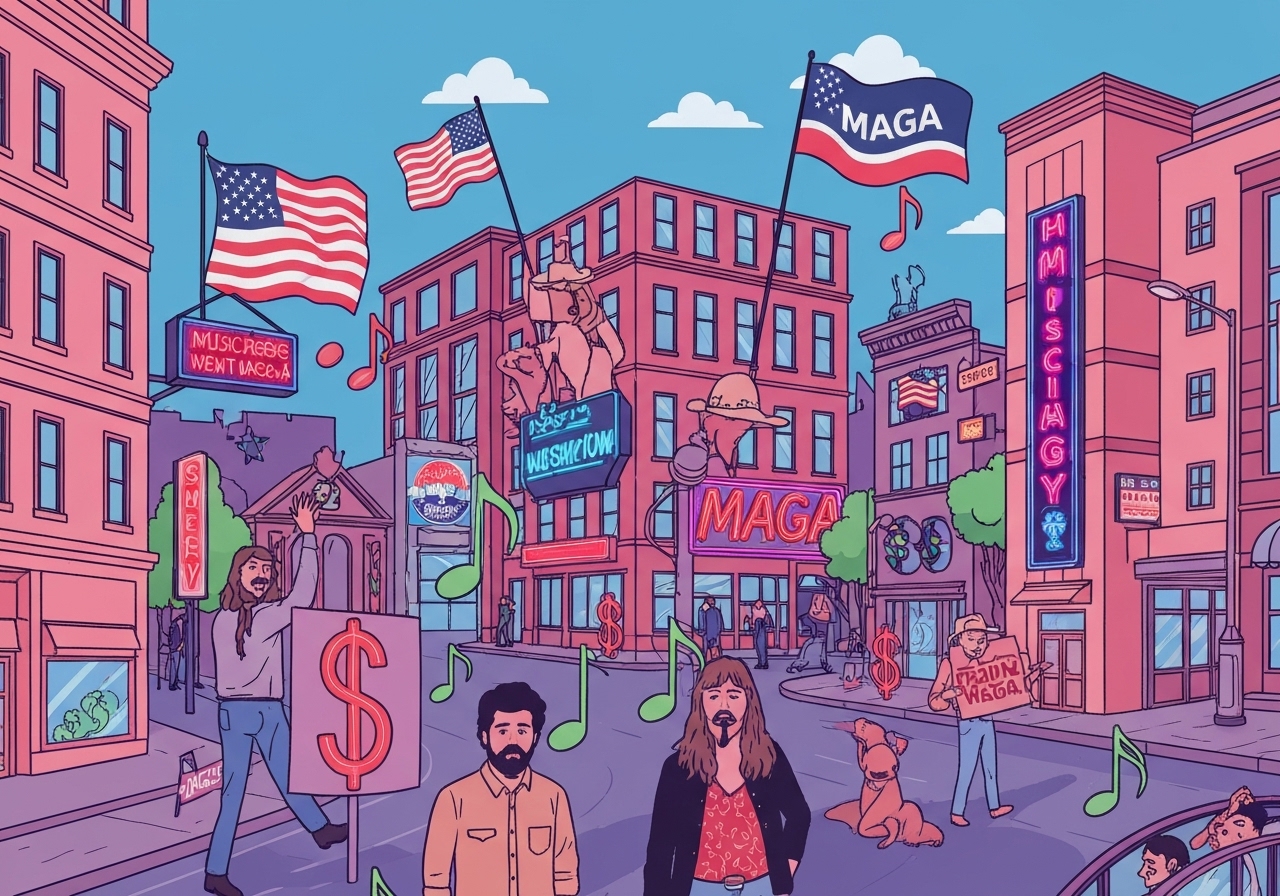
Lead: In 2025 Nashville’s commercial country industry shifted markedly from the cautious, post-2016 posture of bipartisan escapism to visible alignment with Donald Trump and the MAGA movement. The change accelerated after the 2024 election and was visible in high-profile appearances, chart-topping conservative anthems in 2023, and label-level decisions that prioritized revenue and audience alignment over earlier gestures toward unity. Artists from established stars to rising acts have openly courted the MAGA base, while institutions with Nashville ties adapted programming and partnerships to match the new landscape. The result is a more overtly political mainstream country ecosystem with cultural and commercial implications.
Key Takeaways
- By 2025, several mainstream country acts publicly embraced Trump; Chris Janson previewed a post-2024 single with overt pro-Trump lines and Jelly Roll met the president-elect in December 2024.
- High-profile performances tied to the administration included Carrie Underwood and Parker McCollum at the January 2025 Commander-in-Chief Ball; George Strait sat near President Trump at the 2025 Kennedy Center Honors.
- Two 2023 hits—Jason Aldean’s “Try That in a Small Town” and Oliver Anthony’s “Rich Men North of Richmond”—demonstrated commercial demand for conservative-leaning songs on the charts.
- Labels and corporate entities on Music Row have de-emphasized earlier unity-themed releases from the late 2010s and early 2020s, with mainstream country acts appearing at private events and donor functions in 2024–25.
- Upstart artists such as Warren Zeiders, Gavin Adcock, and Nate Smith adopted explicitly pro-Trump postures during the 2024 cycle, and some received public endorsement from the former president.
- Opry Entertainment Group holds a minority, non-controlling stake in the country lifestyle outlet Whiskey Riff, a site that has published anti-“cancel culture” commentary in 2024–25.
- Contemporary Christian and country music markets converged, with artists like Anne Wilson, Gabby Barrett, and Jelly Roll crossing over to both audiences and industry platforms in 2024–25.
Background
The commercial country sector known colloquially as Music Row is an ecosystem of major labels, publishers, managers and midlevel executives whose primary objective is monetizing songs and personalities. After the 2016 presidential election and during Trump’s first term, many country records leaned toward apolitical or bipartisan escapism—songs about small-town life, boats and beers—that avoided direct partisan advocacy. In 2017, for example, Chris Janson’s “Fix a Drink” exemplified that retreat from political conflict.
Two broader developments set the stage for the industry shift. First, the 2020 election and its aftermath intensified political polarization among artists and audiences, prompting some conservative-leaning performers to adopt more outspoken stances. Second, in August 2023 several conservative-tinged songs surged on the all-genre charts, signaling commercial viability for grievance-oriented material. That combination of audience appetite and artist willingness created incentives for labels and promoters to embrace a different set of acts and messages.
Main Event
The pivot became unmistakable following the 2024 presidential contest. In December 2024 Jelly Roll greeted the president-elect and posed with political figures at a public sporting event; in January 2025 Carrie Underwood and Parker McCollum performed at the Commander-in-Chief Ball, signaling mainstream artists’ acceptance of high-profile, pro-administration stages. Chris Janson, who had previously produced nonpolitical barroom anthems, previewed a new track that openly aligned with flag-and-patriot themes and criticized left-leaning viewpoints.
Throughout 2024 and into 2025 there were frequent, visible encounters between country stars and MAGA-aligned settings: Zach Bryan photographed with Trump at the Super Bowl earlier in 2025, Cody Johnson used concerts to attack protest movements, and Keith Urban played at a private Mar-a-Lago event for a donor in November 2024. Simultaneously, emerging artists such as Warren Zeiders received public praise from Trump after appearing on conservative media, while performers like Nate Smith donned MAGA apparel onstage and framed it as authenticity.
Industry outlets and adjacent institutions adjusted as well. Whiskey Riff published pieces that criticized so-called virtue signaling and cancel culture, and the Grand Ole Opry’s parent company retained an ownership stake in that outlet. The Opry also marked a symbolic shift when it highlighted Jelly Roll’s membership announcement on a widely consumed podcast rather than during a traditional in-house induction, reflecting a tolerance for MAGA-adjacent platforms.
Analysis & Implications
The changes on Music Row reflect a mix of market calculation and cultural alignment. Labels and promoters responded to demonstrated demand for politically charged country singles—evidenced by 2023’s chart movements—and to a perceived expansion of a politicized audience after 2024. For executives whose priority is revenue and radio reach, catering to that audience reduces financial risk and can rejuvenate catalog sales among older listeners aligned with conservative positions.
Artist motivations vary. For some established names, association with the administration opened lucrative private-booking opportunities and reinforced a loyal base; for rising acts, public fealty to MAGA offered rapid audience-building, publicity and social-media momentum. That combination can harden genre boundaries, pushing away listeners who prefer inclusivity or less politicized material and narrowing the radio and streaming playlists over time.
The institutional entanglement of country and contemporary Christian music is also consequential. As crossover increases, industry gatekeepers—from talent shows to label A&R—may favor acts that perform well in both markets, altering the sonic and lyrical profile of mainstream releases. International exposure and festival bookings will be affected as well, since artists tied to polarizing politics can face scrutiny or boycotts outside core U.S. markets.
Comparison & Data
| Year | Representative Event |
|---|---|
| 2017 | Chris Janson releases “Fix a Drink”—apolitical, escapist country single |
| 2020 | Joe Biden elected; political tensions within country community intensify |
| Aug 2023 | Jason Aldean and Oliver Anthony achieve major chart success with conservative-leaning songs |
| Dec 2024–Jan 2025 | Jelly Roll meets president-elect; Underwood and McCollum perform at inaugural events |
| 2025 | Mainstream country acts and outlets increasingly visible in MAGA spaces |
The timeline shows a progression from cautious neutrality toward explicit political alignment over eight years. While exact revenue impacts and radio-play shifts require label-internal data, the public record of appearances, chart outcomes and media endorsements illustrates how audience demand and corporate incentives can reorient an entire sector.
Reactions & Quotes
Conservative performers framed the moment as newfound permission to speak. Below are representative remarks and the contexts in which they were delivered.
Before a Fox News interview in 2025, conservative singer Justin Moore explained that the political environment felt different than in 2016; he attributed the change to Trump’s return to the White House and said it encouraged people to be more vocal.
“It’s a different climate than it was, let’s say, the first time he ran,”
Justin Moore, interview on Fox News
Jason Aldean spoke at a conservative conference in late 2025 about religion and civic responsibility, casting public Christianity as a motive for speech and performance choices. His remarks tied artistic expression to perceived cultural defense.
“I think we live in a country now where if you’re a Christian, you’re made to feel like that’s a bad thing,”
Jason Aldean, AmericaFest appearance
When Jelly Roll accepted a modern-style Opry nod, he highlighted the novelty of being acknowledged through a popular podcast format, underscoring how institutions are meeting audiences where they consume culture.
“I bet I’m the first person to ever get invited to the Grand Ole Opry on a podcast!”
Jelly Roll, Joe Rogan podcast segment
Unconfirmed
- The claim that the split within Florida Georgia Line was caused by partisan disagreement remains unproven; Tyler Hubbard has publicly disputed that explanation.
- Whether labels coordinated a deliberate, industry-wide pivot toward MAGA messaging is not documented; observed changes may reflect decentralized market responses rather than a single strategy.
- The long-term effect on streaming and touring revenues for artists who publicly align with MAGA is uncertain and will depend on audience retention and venue markets.
Bottom Line
By early 2025 mainstream country music in Nashville shows a pronounced shift from the apolitical escape-themed singles of the late 2010s toward open alignment with MAGA-aligned audiences and platforms. That realignment is driven by demonstrated chart success for conservative-leaning songs, artists’ personal decisions, and the commercial calculus of labels and promoters seeking reliable revenue streams.
The consequence is a genre that may become more politically legible and polarizing: profitable for some acts in the near term, but potentially narrowing its mainstream appeal and complicating international and crossover opportunities. Observers should watch radio playlists, festival lineups and label signings as barometers of whether this moment represents a durable realignment or a cyclical shift tied to the current political cycle.
Sources
- Rolling Stone (longform journalism; original feature reporting and interviews)