
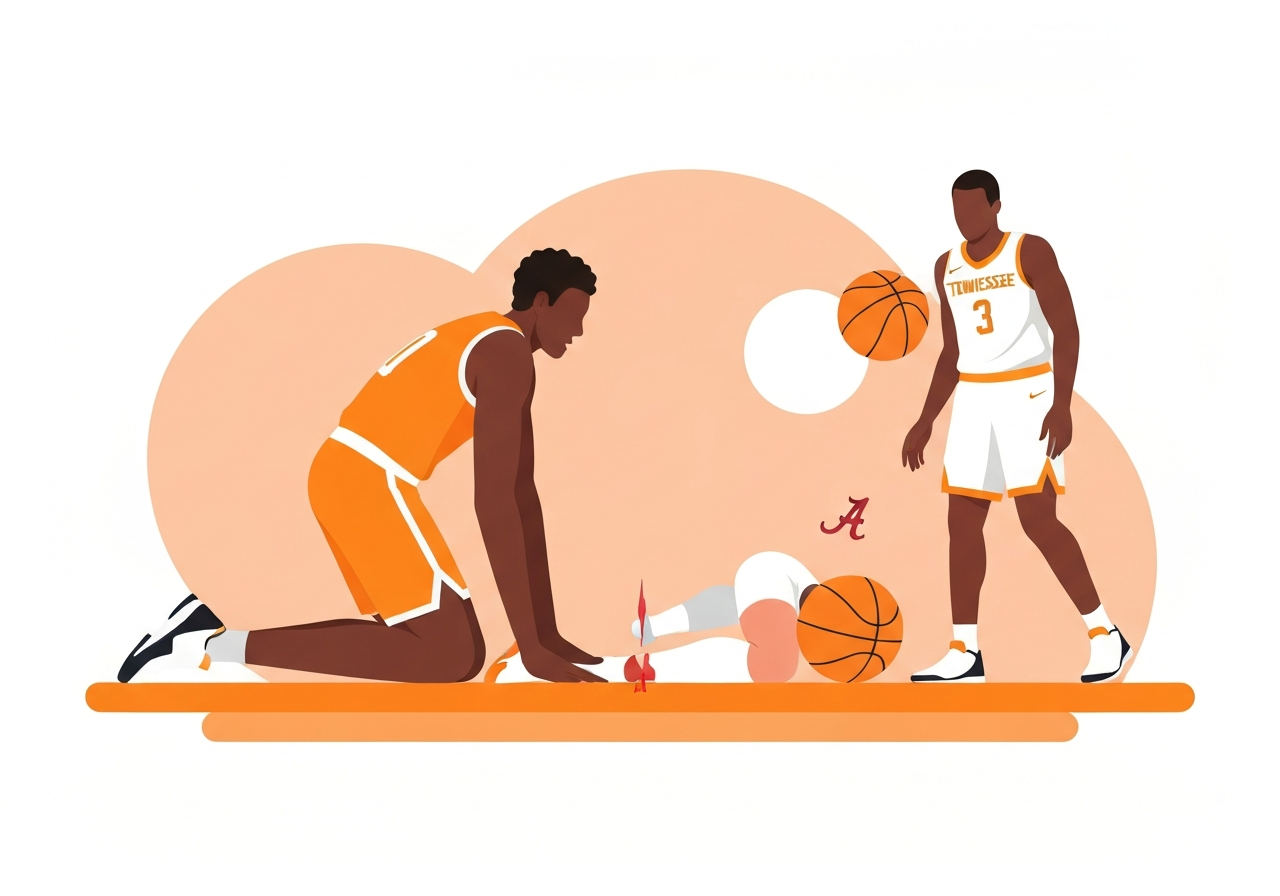
Tennessee forward Nate Ament left Saturday’s 71-69 loss to Alabama with a right‑leg injury, briefly returned after halftime and then exited again, finishing the game on the bench. Vols coach Rick Barnes said he could not offer a definitive diagnosis after the game but indicated Ament suffered trouble in multiple spots on his right leg, including the knee and an ankle area previously bothered at Missouri. Ament scored two points on 1‑for‑5 shooting; his lone field goal came early in the second half before he departed for good with 17:53 remaining. The team and medical staff will evaluate imaging and tests before a clearer timeline is available.
Key Takeaways
- Nate Ament left the game midway through the first half after contact to his right leg; UT trainer Chad Newman evaluated him on the floor and he walked to the locker room with 7:42 remaining in the half.
- Ament returned after halftime, scored a second‑half jumper (his only basket), and then exited again 11 seconds later — officially ruled doubtful to return with 17:53 left in the game.
- He finished with two points on 1‑for‑5 shooting; Tennessee fell 71‑69 to Alabama in Knoxville.
- Coach Rick Barnes said Ament appeared to have injured both his knee and an ankle area he had turned at Missouri, but provided no firm medical diagnosis postgame.
- Entering Saturday, Ament averaged 17.9 points per game and had recorded 20+ points in six of his previous 10 outings, underscoring his offensive importance to the Vols.
- The team’s medical staff will determine the severity through imaging; no official timetable for return was announced after the game.
Background
Nate Ament, a freshman forward who has become Tennessee’s primary scorer this season, entered Saturday averaging 17.9 points and had been particularly prolific in recent weeks, registering at least 20 points in six of his last 10 games. His emergence has been central to the Vols’ offensive identity; coaches often rely on him late in close contests. Tennessee faced Alabama in a tightly contested Southeastern Conference matchup on March 1, 2026, with the Crimson Tide edging the Vols 71‑69. The game carried postseason implications for seeding and momentum as both programs close the regular season.
Physically, Ament has dealt with on‑court knocks typical for a high‑usage forward—coaches have previously noted a turned ankle at Missouri that required attention. Collegiate teams routinely assess such injuries with sideline trainers and then pursue imaging when necessary; the Vols’ trainers followed that protocol Saturday when Ament left the floor. With conference play intensifying, player availability for the final regular‑season games and the upcoming SEC tournament becomes a strategic concern for coaching staffs and medical teams alike.
Main Event
The sequence began in the first half when an Alabama player rolled onto Ament’s right leg as Ament reached for a loose ball following a turnover by Alabama guard Amari Allen. Ament remained down briefly before walking off under his own power and being examined by UT trainer Chad Newman on the court. He departed the arena and did not return before halftime, though he was seen stretching in the tunnel with strength coach Garrett Medenwald.
After the intermission Ament warmed with teammates and rejoined the lineup. He hit a second‑half jumper at the 18:04 mark — his only field goal — but left again almost immediately; the official play clock shows he exited with 17:53 to play and was listed as doubtful to return. From that point he remained on the bench for the remainder of the contest, participating in limited ways while medical staff monitored him.
Coach Rick Barnes described the injury as involving multiple areas of the right leg. He conveyed uncertainty about the exact diagnosis postgame while praising Ament’s toughness and willingness to try to play through discomfort. Tennessee ultimately could not overcome Alabama’s closing offense and fell by two points, a result that may be viewed differently if Ament is sidelined moving forward.
Analysis & Implications
Ament’s immediate absence in the latter stages of Saturday’s game had an obvious on‑court effect: Tennessee lost its most consistent scorer and primary interior threat during the final stretch, which likely influenced late possession design and matchup choices. Losing a 17.9 PPG contributor — who had multiple 20‑point outings recently — forces other perimeter and frontcourt players into higher‑usage roles they have not filled as consistently this season. Over the short term, that can create turnover and spacing issues that opposing coaches will try to exploit.
From a medical and roster‑management standpoint, the mixed description of knee and ankle involvement complicates prognostication. Knee‑related injuries can range from mild contusions and sprains to more serious ligament or meniscal damage; concurrent ankle irritation can prolong symptoms and delay return to full strength. The Vols’ staff will likely pursue MRI and specialist consultation if pain or instability persists, and conservative management (rest, immobilization, progressive rehab) is common when imaging is non‑definitive.
Strategically, Tennessee’s rotation depth will be tested in the coming days. Opponents preparing for the Vols will adjust scouting reports if Ament is limited, focusing more on isolations for other scorers and exploiting mismatches inside. For Tennessee, the coaching staff must balance short‑term competitiveness with the long‑term health of a freshman who figures to be central in postseason play; erring on the side of caution is a common approach when a high‑value player faces uncertain knee/ankle issues.
Comparison & Data
| Metric | Season average | Past 10 games |
|---|---|---|
| Points per game | 17.9 | 20+ in 6 of 10 games |
| Saturday vs Alabama | 2 | 1‑for‑5 FG |
The table highlights the gap between Ament’s season scoring profile and his output against Alabama. A single absence or limited minutes from a player averaging nearly 18 points shifts offensive load and efficiency expectations across the roster. Coaches and analysts will track usage rate and effective field goal percentage in the next games to quantify the impact if Ament’s availability changes.
Reactions & Quotes
Barnes said Ament appeared to have pain in more than one spot on his right leg, mentioning an issue near the knee plus an ankle tweak from an earlier game, and that he could only play if cleared and able.
Rick Barnes, Tennessee head coach (paraphrased)
Sideline video showed Ament down after contact and later walking out of the arena under his own power; he was seen stretching with strength staff before returning after halftime.
Emilie Rae Cochrane (sideline reporter/Twitter, paraphrased)
Unconfirmed
- No official imaging results (MRI/X‑ray) were announced postgame; the precise diagnosis—sprain, contusion, or structural tear—remains unconfirmed.
- There is no public timetable for Ament’s return to full practice or game action; any recovery estimate is currently speculative.
Bottom Line
Nate Ament’s second exit against Alabama turned a close game into a more difficult finish for Tennessee, and coach Rick Barnes emphasized uncertainty about the injury’s scope while noting the freshman’s toughness. The immediate priority for the Vols will be medical evaluation to determine whether this is a short‑term issue treated conservatively or an injury requiring longer rehab.
How Tennessee responds in its upcoming schedule will hinge on Ament’s availability: a quick return would preserve the team’s offensive structure, while any extended absence will force tactical adjustments and increased roles for other contributors. Fans and analysts should watch for official medical updates and imaging results before drawing conclusions about postseason availability.