
Lead
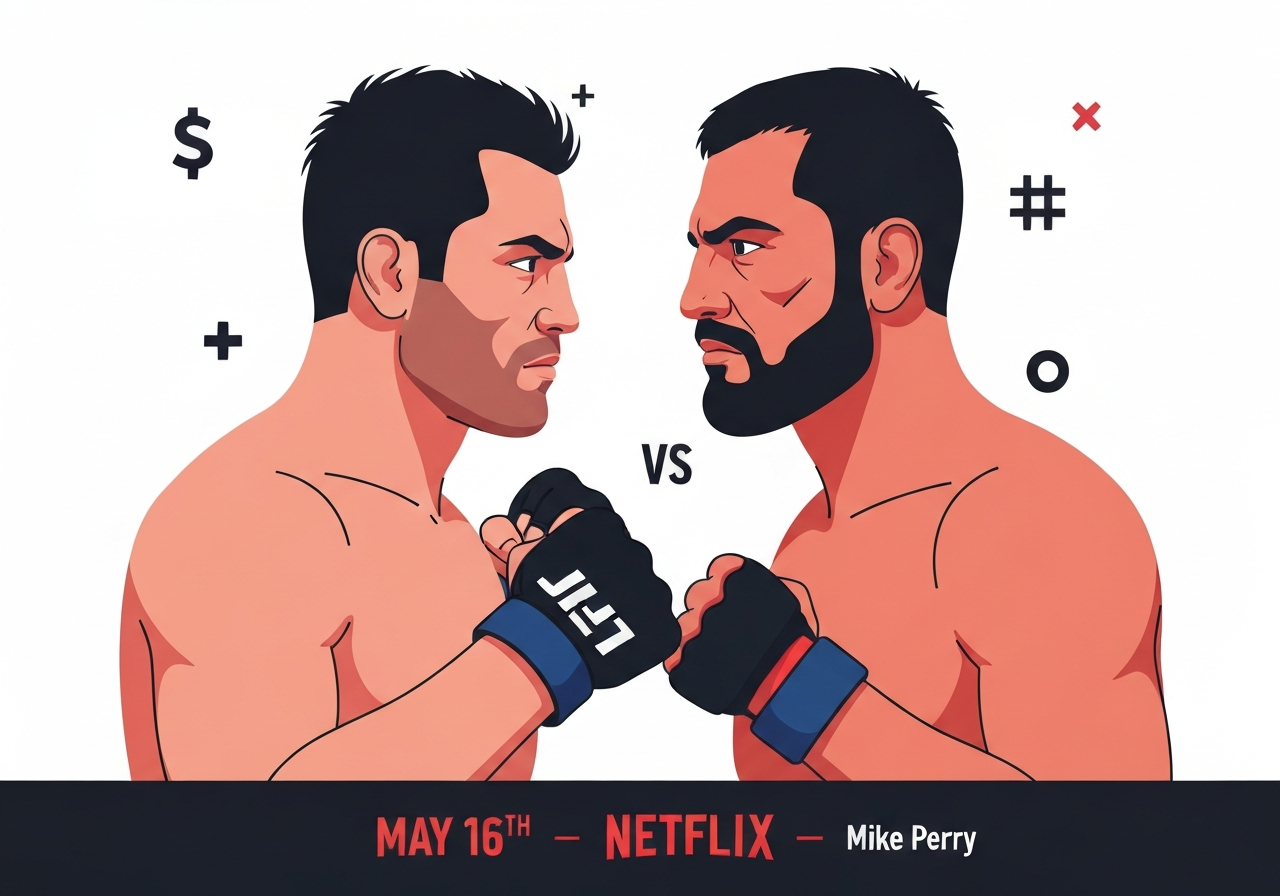
Nate Diaz will make his first mixed‑martial‑arts appearance in nearly four years on May 16 at the Intuit Dome in Los Angeles, the promotion confirmed. Diaz, 40, is scheduled to meet bare‑knuckle standout Mike Perry in a five‑round welterweight bout as part of Most Valuable Promotions’ inaugural MMA card on Netflix. The event is a triple‑header that also features Ronda Rousey vs. Gina Carano and Francis Ngannou vs. Philipe Lins. Promoters say the card is built for massive global viewership and will be contested under the Unified Rules inside a hexagon cage.
Key Takeaways
- Nate Diaz (40) returns to MMA on May 16 at Intuit Dome in Los Angeles after last fighting in MMA at UFC 279 (Sept. 2022), where he beat Tony Ferguson.
- Diaz’s recent boxing detour includes a unanimous decision loss to Jake Paul in 2023 and a majority decision win over Jorge Masvidal in 2024.
- Mike Perry, formerly a UFC welterweight with a 14–8 MMA record, is 6–0 in bare‑knuckle competition with wins over Michael Page, Jeremy Stephens, Luke Rockhold and Eddie Alvarez.
- The Diaz–Perry fight will be five five‑minute rounds under the Unified Rules and will take place inside a hexagon cage rather than a ring.
- MVP bills May 16 as its first MMA event and markets the card as a triple‑header — Rousey vs. Carano, Ngannou vs. Lins and Diaz vs. Perry — with Netflix as the distribution partner.
- Promotion CEO Nakisa Bidarian projected record viewership, citing MVP’s previous boxing audience as precedent for the card’s scale.
- Both fighters have crossed between MMA, bare‑knuckle and boxing, adding stylistic intrigue to the matchup and raising questions about ring‑to‑cage adjustments.
Background
Most Valuable Promotions (MVP), run by Nakisa Bidarian, expanded from boxing into MMA with a high‑profile May 16 card at the new Intuit Dome in Inglewood, Los Angeles. The company previously promoted a hugely watched boxing event on cable and is positioning this MMA night — headlined by Rousey vs. Carano — as a signature moment to establish itself in mixed martial arts. Netflix has signed on as the distribution partner, reflecting a broader trend of streaming platforms investing in live combat sports to draw subscribers.
Nate Diaz rose to prominence in the UFC for his gritty style and high‑profile rivalries, notably his 2016 submission of Conor McGregor and his 2019 match with Jorge Masvidal for the UFC’s symbolic ‘BMF’ title. Since stepping away from regular UFC competition he has explored boxing against crossover opponents, keeping his profile high with mainstream audiences. Mike Perry’s trajectory has been the opposite of a straight UFC path: after a 14–8 run in mixed martial arts he found renewed commercial success in bare‑knuckle boxing, earning the promotion’s “King of Violence” billing before also competing in boxing.
Main Event
The matchup between Diaz and Perry was announced as part of MVP’s triple‑header on May 16. Promoters confirm the bout will follow Unified Rules and comprise five five‑minute rounds at welterweight, fought inside a hexagonal cage. The production will be stacked on the same card as Rousey‑Carano and Ngannou‑Lins, giving Diaz–Perry significant co‑main attention and inflating the event’s promotional push.
Diaz released a concise statement expressing eagerness to return to combat sports competition and indicating plans to remain active over the next decade across disciplines. His recent contests in boxing and high‑profile name‑value fights have kept him in the public eye, and the move back to MMA restores the rule set and environment where he built his reputation. Perry framed the return to MMA as a continuation of his violent, comeback narrative after a successful bare‑knuckle run and a 2024 boxing loss to Jake Paul.
Fight logistics are straightforward: welterweight limit, five five‑minute rounds, and a hexagon cage rather than the UFC’s branded “Octagon.” MVP’s promotional materials emphasize spectacle and crossover appeal, leveraging Diaz’s mainstream recognition and Perry’s notoriety in multiple combat formats. Matchmakers and regulatory bodies will need to clear medicals, licensing and weight arrangements in the weeks ahead, which is standard for fighters moving between promotions and codes.
Analysis & Implications
The Diaz–Perry pairing is calculated for attention. Diaz brings mainstream star power, a long UFC résumé and a fanbase that follows his every move; Perry delivers a narrative of dangerous finishing power proven in bare‑knuckle competition. Together they form a clash that is marketable beyond hardcore MMA audiences, especially when stacked with Rousey and Ngannou on the same bill. That crossover dynamic is central to MVP’s strategy: assemble names with recognition across combat disciplines to drive streaming viewership.
From a sporting perspective, both fighters carry stylistic caveats. Diaz’s volume striking and cardio are assets in the five‑round format, but his recent time spent in boxing alters timing and range dynamics. Perry’s bare‑knuckle résumé indicates comfort with close‑quarters, damage‑oriented exchanges and aggressive elbows — traits that translate differently under MMA rules where grappling and clinch work are decisive. How each man adapts to unified MMA enforcement, takedown defense, and cage wrestling will likely determine the outcome more than mere pugilistic bravado.
Commercially, putting Diaz back in the cage on a Netflix platform and alongside two other headline‑grade fights creates a compound effect on global distribution and revenue potential. If viewers tune in beyond the core MMA demographic, MVP could validate its claim of producing blockbuster combat cards. However, sustained success will depend on regulatory approvals, fighter health, and the ability of the promotion to follow through on live‑event execution — including fighter safety and officiating, which remain sensitive for crossover matchups.
Comparison & Data
| Fighter | Recent MMA status | Notable cross‑code results | Key record |
|---|---|---|---|
| Nate Diaz | Last MMA bout: win over Tony Ferguson at UFC 279 (Sept. 2022) | Boxing: loss to Jake Paul (2023, UD); win vs. Jorge Masvidal (2024, MD) | 40 (age) |
| Mike Perry | Former UFC competitor — 14–8 MMA record before leaving promotion | Bare‑knuckle: 6–0 with wins over Michael Page, Jeremy Stephens, Luke Rockhold; Boxing: stopped by Jake Paul (July 2024) | Transitioned to BKFC and boxing |
The table highlights that both fighters have recent activity across multiple combat sports, which complicates predictive models that rely solely on MMA form. Diaz’s extended layoff from MMA competition is balanced by high‑level boxing tests, while Perry’s undefeated bare‑knuckle streak demonstrates comfort with hard exchanges but less exposure to wrestling‑led MMA scenarios. Analysts will watch takedown mixes, clinch control, and gas tank management as primary indicators for the fight’s likely trajectory.
Reactions & Quotes
MVP’s leadership framed the card as a watershed moment for the promotion and a chance to build on prior boxing viewership milestones. CEO Nakisa Bidarian emphasized viewership ambitions and plugged the stacked lineup as the formula for a record audience, reflecting the company’s business objectives and partnership with Netflix.
“MVP delivered the most‑viewed boxing event since the advent of cable, and now we’re set to break records again with the biggest viewership in MMA history with the addition of Diaz vs Perry.”
Nakisa Bidarian, CEO of Most Valuable Promotions (statement)
Bidarian’s rhetoric aims to frame the event as historic and commercially decisive, a messaging approach common to promoters launching a new product in a crowded market. Independent verification of projected viewership will only be possible after the event; for now the claim serves promotional positioning and investor signaling.
Diaz issued a brief public message conveying readiness to fight and long‑term plans to remain active across formats. His statement mixes competitive intent with a personal narrative of longevity that appeals to fans who follow his career arc rather than a single organization.
“Glad to be in action. It’s time. Don’t forget where this all came from. I got plans on doing a lot more in the next 10 years, no matter where it is.”
Nate Diaz (fighter statement)
Diaz’s remarks reinforce that his return is part of a broader career trajectory, not a one‑off spectacle. For matchmakers and opponents, the statement signals intent to continue competing frequently and to do so across different promotions and rulesets.
Mike Perry’s comment leaned into persona and promise of violence, consistent with his bare‑knuckle branding. He framed the return to MMA as a direct, physical continuation of the identity he has cultivated since leaving the UFC.
“The King of Violence returns to MMA to elbow his opponent in the f–king face. Saturday, May 16th, on Netflix, Nate Diaz is going lights out.”
Mike Perry (fighter statement)
Perry’s language is intentionally incendiary and promotional; it signals his preference for short, decisive encounters and is designed to stoke interest among fans who favor high‑impact finishes. Officials will enforce rules on strikes such as elbows inside the Unified Rules framework.
Unconfirmed
- MVP’s projection that the card will become “the biggest viewership in MMA history” is a promoter claim and has not been independently verified.
- Specific medical clearances, contract terms, fighter purses and final weight arrangements for Diaz and Perry have not been publicly disclosed.
- Potential matchup contingency plans (replacement fighters or rescheduling) have not been published and remain speculative.
Bottom Line
Nate Diaz’s return to MMA on May 16 is a strategic, high‑visibility booking that leverages his name recognition and crossover appeal. Paired with Mike Perry — a fighter with a reputation for aggressive, finish‑oriented fights — the matchup has been designed to attract both hardcore MMA fans and a broader streaming audience. The fight’s placement on an MVP card headlined by legacy and crossover stars suggests the promotion is prioritizing spectacle to establish credibility in MMA.
From a competitive standpoint, adaptation to the Unified Rules and the cage will be decisive: Diaz’s cardio and volume striking versus Perry’s close‑range power and bare‑knuckle seasoning create a contrast that could favor technical patience or explosive aggression depending on how the fighters modulate pace. For observers, the event will be as much a test of MVP’s production and Netflix’s live‑sports strategy as it is a contest between two fighters.
Sources
- ESPN (sports news report)
- Most Valuable Promotions (official promotion website / statement)
- Netflix (distribution partner / streaming platform)