
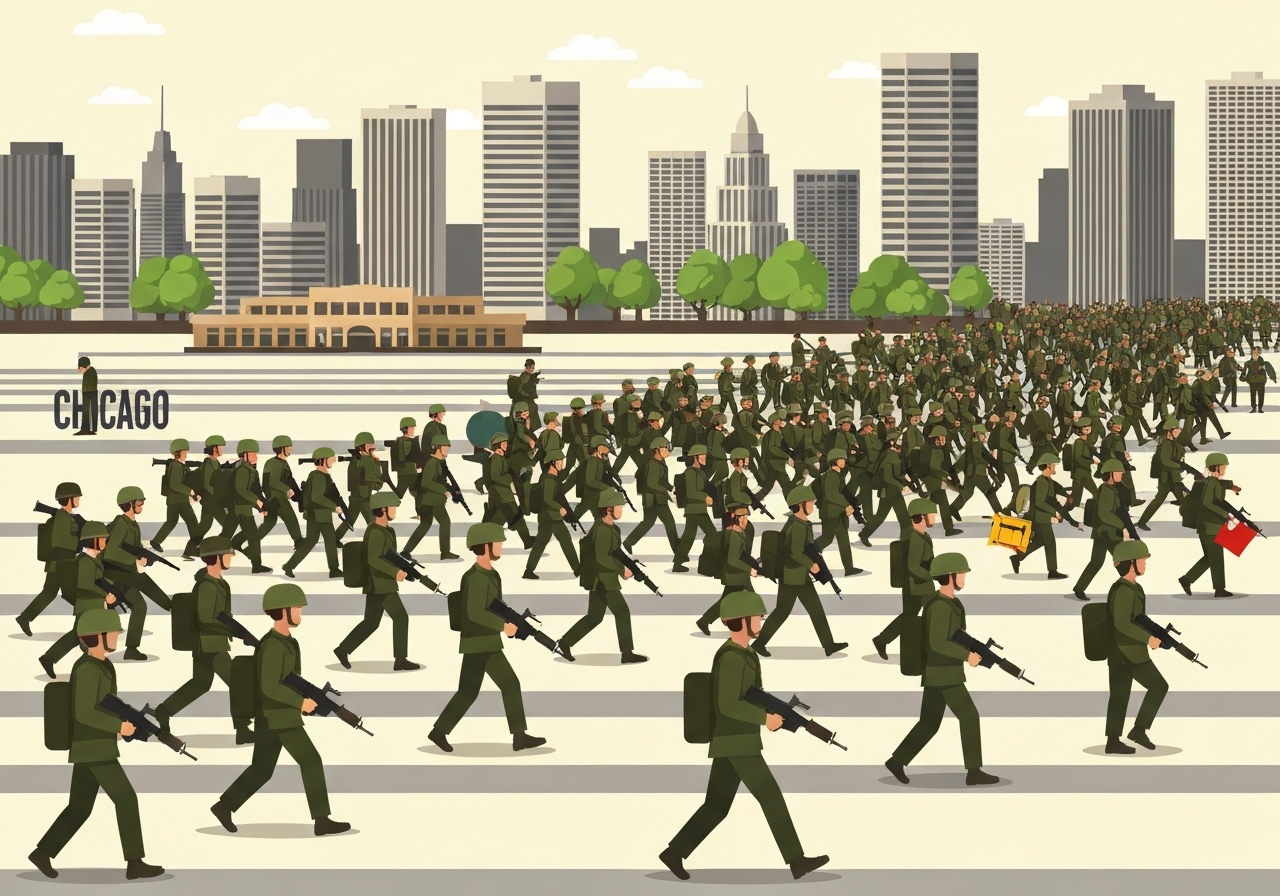
Lead: Hundreds of National Guard troops dispatched to Portland, Oregon, and Chicago, Illinois, in response to protests over the Trump administration’s immigration enforcement will be sent back to their home states, a Defense Department official told CBS News on Nov. 16, 2025. About 200 federalized California Guard members had been sent to Portland and roughly 200 federalized Texas Guard members to Chicago; both contingents are being withdrawn. The Defense official also said Oregon’s federalized presence will be cut from 200 to 100, while approximately 300 Illinois Guard members remain under federal control. Federal judges previously blocked street deployments in Portland and Chicago; the administration has appealed the Portland ruling to the Supreme Court.
Key Takeaways
- Approximately 200 California National Guard soldiers were federalized and sent to Portland in October 2025; those troops will return to California.
- Roughly 200 Texas National Guard soldiers were federalized and sent to Chicago; that contingent will also be withdrawn.
- Federalized Oregon Guard numbers will be reduced from 200 to 100, according to a Defense Department official.
- About 300 Illinois National Guard members remain federalized and under federal control as part of the same operation.
- Federal judges blocked the deployment of federalized troops onto Portland and Chicago streets; the administration appealed the Portland decision to the Supreme Court on Nov. 14–15, 2025.
- U.S. Northern Command said the Pentagon would “shift and/or rightsize” its Title 10 footprint in Portland, Los Angeles and Chicago to maintain an enduring presence.
- Local and state officials have criticized the federal deployments as an unnecessary escalation amid months of demonstrations at ICE facilities.
Background
Since the summer and into autumn 2025, Portland and Chicago experienced prolonged demonstrations focused on U.S. Immigration and Customs Enforcement (ICE) facilities. The Trump administration, citing protection of federal property and personnel, invoked Title 10 authority to federalize state National Guard units and augment federal law enforcement in those cities. Past uses of Title 10 to deploy forces in domestic settings have prompted legal and political disputes over whether such federalization circumvents local control.
In recent weeks the White House framed the mobilizations as necessary to protect federal assets; state and municipal leaders, plus civil liberties groups, challenged that rationale in court. Federal judges in separate actions have so far blocked the physical deployment of federalized Guard troops onto Portland and Chicago streets, creating a legal limbo for personnel held under federal orders but not actively patrolling. The administration moved swiftly to appeal the Portland injunction to the Supreme Court, seeking to overturn the permanent bar on using those troops in the city.
Main Event
On Nov. 16, 2025, a Defense Department official confirmed to CBS News that hundreds of Guard members sent from California and Texas will be returned to their home states. The decision follows a period in which troops were federalized under Title 10 but largely kept from deploying on city streets by court orders. Officials framed the withdrawals as a reshaping of the federal presence rather than a full disengagement from affected cities.
The official also said the federalized Oregon National Guard will be scaled back from 200 to 100 members. In Illinois, about 300 Guard members that had been federalized as part of the broader operation will remain under federal control, the official added. Those numerical adjustments reflect both operational reassessment and the impact of ongoing litigation restricting how and where federalized troops can be used.
The moves occur against a backdrop of sustained protests at ICE sites and prior federal deployments to other cities, including Washington, D.C., Los Angeles and Memphis. Local leaders have repeatedly criticized the federal response as an overreach that escalates tensions rather than addressing root causes of the unrest. The administration insists the deployments are defensive measures to shield federal property and personnel from potential threats tied to demonstrations.
Analysis & Implications
The withdrawal of California and Texas Guard contingents marks a notable retrenchment of a federal posture that had been publicly defended as necessary for asset protection. Reducing Oregon’s federalized numbers from 200 to 100 suggests officials are balancing operational needs with mounting legal constraints and political costs. Keeping roughly 300 Illinois Guard members federalized indicates Washington wants to retain options there, possibly because legal barriers or perceived risk differ between jurisdictions.
Legally, the situation underscores friction between federal Title 10 authority and state and municipal control over domestic deployments. Federal judges have imposed limits that prevent practical use of some federalized troops, which complicates command-and-control calculations and raises questions about the executive branch’s ability to rely on Title 10 for sustained domestic operations. The pending Supreme Court appeal over Portland could set a national precedent on the limits of federalizing state forces for civil contingencies.
Politically, the withdrawals may ease immediate tensions in Portland and Chicago but are unlikely to resolve broader disputes over immigration policy or protest dynamics. Local elected officials have used court actions to constrain federal options, a tactic that can influence future deployment planning. Internationally, visible federal responses to domestic protests attract attention and may affect perceptions of U.S. civil-military norms, prompting commentary from allied governments and human rights organizations.
Comparison & Data
| State/City | Initial Federalized Troops | Current Status |
|---|---|---|
| California → Portland | ~200 | Returning to home state |
| Texas → Chicago | ~200 | Returning to home state |
| Oregon (federalized) | 200 | Reduced to 100 |
| Illinois (federalized) | ~300 | Remain under federal control |
The table shows the principal numerical adjustments announced by DoD sources on Nov. 16, 2025. The return of California and Texas troops contrasts with the retained federal control over roughly 300 Illinois Guard members; Oregon’s cut reflects a mid-operation drawdown. Numbers are those confirmed by a Defense Department official and align with prior public reporting in November 2025.
Reactions & Quotes
Local and federal responses varied quickly after the announcement. City leaders who filed lawsuits to block deployments framed the move as legally compelled rather than voluntarily conciliatory.
“We are here to protect federal assets and personnel.”
White House official (statement)
The administration has repeatedly used that formulation to justify the initial federalization and continued presence of federal law enforcement and Guard elements near federal facilities.
“We will be shifting and/or rightsizing our Title 10 footprint in Portland, Los Angeles and Chicago to ensure a constant, enduring, and long-term presence in each city.”
U.S. Northern Command (official statement)
U.S. Northern Command framed the adjustments as a reconfiguration intended to maintain a long-term capability, even as individual contingents are moved or reduced.
“The decision to federalize and deploy troops was seen locally as an unnecessary escalation.”
City officials and community leaders (paraphrase)
Local voices emphasized that judicial actions were central to constraining how those federal forces could be used in practice.
Unconfirmed
- Whether the federalized Illinois contingent will be redeployed onto Chicago streets in the coming weeks remains unclear; no public court ruling has authorized street deployments there.
- The exact timetable for the California and Texas troops’ return to their home states was not specified by the Defense Department source and has not been publicly confirmed.
- Any additional reductions or transfers of federalized forces to other cities beyond Portland, Los Angeles and Chicago have not been confirmed.
Bottom Line
The announced withdrawals and reductions mark a tactical recalibration by the Defense Department: some federalized Guard units will return home while others remain under federal control. The changes appear driven by a mix of judicial limits, operational reassessment and political pressure from local leaders and demonstrators.
Legal challenges—especially the Portland injunction and the administration’s appeal to the Supreme Court—will shape the practical boundaries of federalized domestic deployments going forward. Observers should watch court rulings and any further official statements from DoD and U.S. Northern Command for signals about future troop movements or shifts in federal policy.
Sources
- CBS News (news report)
- U.S. Department of Defense (official department website)
- U.S. Northern Command (official command site)