
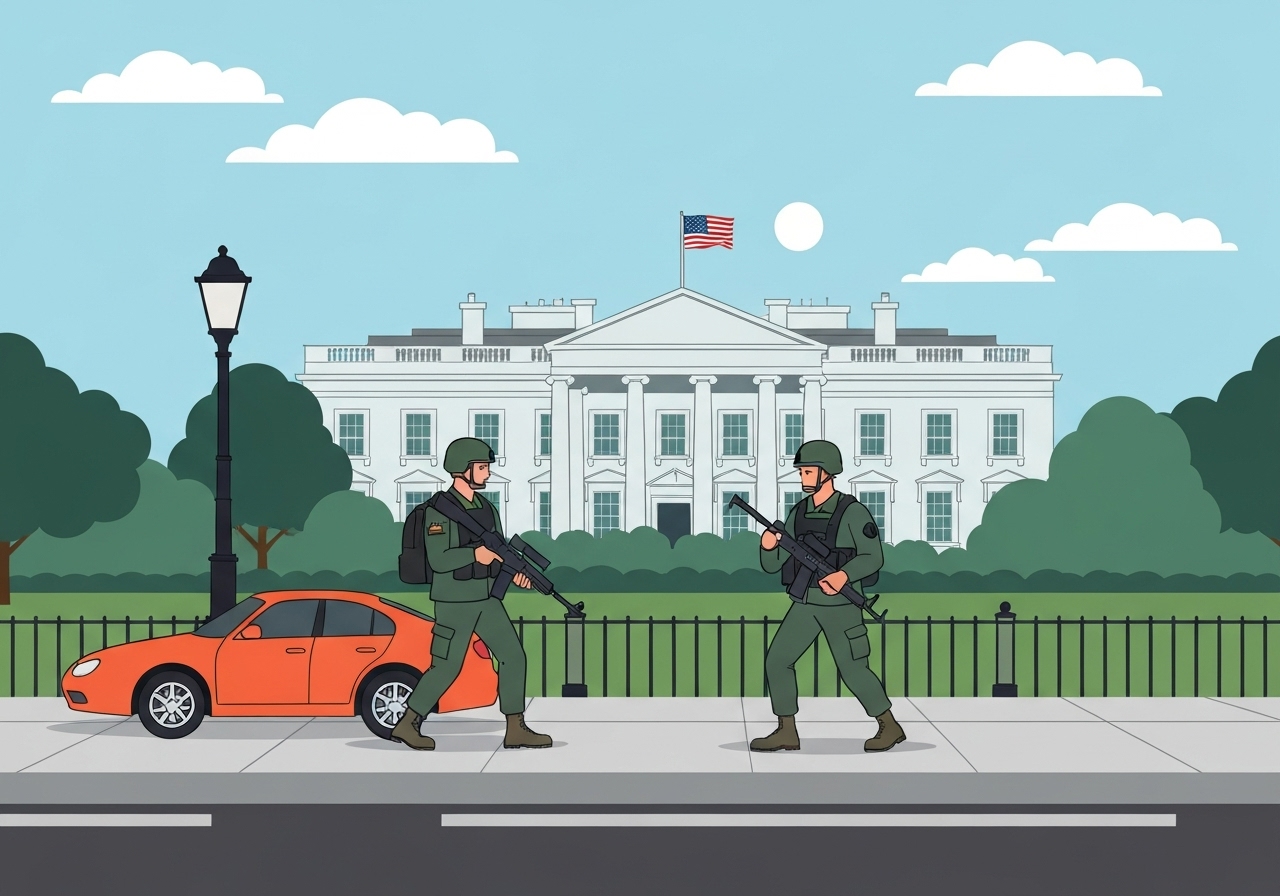
On Wednesday afternoon, November 26, 2025, two members of the West Virginia National Guard were critically wounded by gunfire near the White House, officials said. The shooting occurred around 2:15 p.m. at the entrance to the Farragut West metro station, a busy tourist corridor a few blocks from Lafayette Square. Authorities said a single suspect was taken into custody and appeared to have acted alone; it was not immediately clear who shot the assailant. The incident prompted an order from the Defense Department to deploy 500 additional Guard troops to Washington, where more than 2,000 Guard members are already on duty.
Key Takeaways
- Two West Virginia National Guard members were shot near the White House on November 26, 2025, and were reported in critical condition by FBI Director Kash Patel.
- The attack occurred at about 2:15 p.m. at the Farragut West metro entrance; witnesses reported a short burst of gunfire followed by a longer barrage.
- Police said one suspect was in custody and described the shooting as appearing to be the act of a lone gunman.
- President Trump, in Palm Beach, Florida, ordered 500 additional National Guard troops to Washington after the shooting, bringing total deployed forces above 2,000.
- The guard presence in D.C. began in August and has been legally contentious; a federal judge recently issued a temporary suspension of the deployment but paused enforcement for three weeks to allow appeals and phased removal.
- Mayor Muriel Bowser labeled the incident a “targeted shooting,” and the Secret Service raised, then lowered, the White House threat level from red to orange as the situation developed.
- Governor Patrick Morrisey of West Virginia initially posted that the guardsmen had died but later said his office had received conflicting reports and would provide updates.
Background
The National Guard presence in Washington began in August after the president moved to federalize operations in parts of the city as part of a high-profile crime-response initiative. Troops from D.C. and multiple states — including West Virginia, Alabama, Louisiana, Mississippi, Ohio, South Carolina and Georgia — were dispatched to patrol metro stations, tourist areas and public spaces, and to support federal and local law enforcement. That deployment has been legally controversial: a federal judge recently found the deployment likely unlawful under applicable statutes and issued a temporary order to block it, though she delayed the order’s effect for three weeks to permit an orderly transition and an appeal process.
The hybrid status of the Guard contributes to the legal and political complexity: the force serves both state governors and the federal military, and past conflicts over domestic use of troops have raised concerns about the Posse Comitatus Act and the boundary between military and civilian law enforcement. Critics say large federalized troop deployments risk militarizing public spaces; supporters counter that Guard support can provide necessary manpower and logistics for security operations in high-traffic areas. The deployment to Washington has also been a focal point in broader debates over federal authority and public safety in the run-up to holiday travel and events.
Main Event
Authorities say the shooting occurred just around the corner from the White House at the Farragut West metro entrance. Jeffery Carroll, executive assistant chief of the Washington Metropolitan Police Department, described the sequence as the suspect rounding a corner, raising a firearm and firing at the soldiers standing near the escalator. Several bystanders reported hearing multiple shots; emergency responders converged on the corner of 17th and I Streets NW as police established a large crime scene with evidence markers and yellow tape.
Officials reported that three gunshot victims were taken to trauma centers; two of those victims were identified by state officials as West Virginia National Guard members and were in critical condition. Police said the suspect was also wounded, though it was not immediately determined who fired the shot that injured him. The suspect was in custody by midafternoon and faces charges that include assault on a federal officer, according to prosecutors and investigators briefed on the case.
In response to the attack, the Defense Department announced a rapid deployment of 500 additional National Guard troops to the capital, Defense Secretary Pete Hegseth said. Where those additional troops would come from was not immediately specified. Local officials said the White House was briefly placed on condition red, then downgraded to orange as the immediate perimeter threat diminished; Reagan National Airport briefly instituted a ground stop tied to downtown law enforcement activity before resuming normal operations.
Analysis & Implications
The shooting sharpens scrutiny over the decision to station large numbers of federalized National Guard troops in high-traffic civilian locations. Proponents of the deployment will point to the rapid apprehension of a suspect and the visible security presence as evidence of a preventive posture; critics will argue that concentrating uniformed military personnel in tourist corridors changes the character of public space and may increase the risk of confrontations. The incident will likely be cited in legal and political arguments as parties press or resist further troop presence in the city.
Legally, the case could affect the pending court fight over whether the federal government overstepped by maintaining out-of-state Guard forces in Washington. The federal judge’s pause of her own order until Dec. 11 was intended to limit operational disruption, but a shooting near a highly symbolic site such as the White House could complicate the calculus for both the administration and the court. Expect renewed filings and expedited appeals as stakeholders seek clarity on command authority and permissible domestic missions for Guard units.
Operationally, an additional 500 troops strains already stretched logistics and may require shifting units from other duties or states. That in turn raises questions about how long additional forces can be sustained and whether governors will continue to cooperate if state Guard units are committed far from home. For local residents and tourists, the event may deepen anxiety in the short term while prompting adjustments to security protocols at transit hubs and public squares.
Comparison & Data
| Metric | Figure | Context |
|---|---|---|
| Guardsmen in D.C. | 2,000+ | Deployed since August from multiple states |
| Additional troops ordered | 500 | Announced after Nov. 26 shooting |
| Time of shooting | ~2:15 p.m. | Nov. 26, 2025, Farragut West entrance |
The table quantifies the force levels and the timing of the incident. More than 2,000 Guard members had been deployed to the capital since August, and the new 500-troop order represents roughly a 25% near-term increase in visible personnel if carried out. Those numbers do not reflect support staff or federal law enforcement agents operating alongside Guard units. Observers will watch whether the increase alters patrol patterns around transit hubs, tourist sites and federal buildings.
Reactions & Quotes
Mayor Muriel Bowser called the attack a targeted shooting and coordinated with federal partners as the scene was secured. Her office emphasized support for the injured service members and urged patience while investigators work the case.
“This was a targeted shooting and our priority is the safety of residents and visitors while the investigation continues.”
Mayor Muriel Bowser (Office of the Mayor)
The president, from Palm Beach, posted a social media message condemning the attacker and praising National Guard and law enforcement personnel. The president’s comment stressed accountability for the suspect and support for the Guard members who were wounded.
“The animal that shot the two National Guardsmen … will pay a very steep price. God bless our Great National Guard.”
President of the United States (social media)
Governor Patrick Morrisey of West Virginia initially posted that the guardsmen had died, then issued a clarification after receiving conflicting reports and said his office would provide further updates. The earlier report underscored the confusion that can occur during fast-moving incidents and the importance of verified information from investigative authorities.
“We are receiving conflicting reports about the condition of our two Guard members and will provide additional updates once we have complete information.”
Governor Patrick Morrisey (Office of the Governor of West Virginia)
Unconfirmed
- Early public statements conflicted on whether the two West Virginia guardsmen had died; official sources later described them as critically wounded but alive. This discrepancy remains under review.
- It was initially unclear who fired the shot that wounded the suspect; investigators have not publicly confirmed whether the wound was self-inflicted, sustained from responding officers, or from another source.
- Reports about a third gunshot victim are inconsistent across early accounts; authorities have not yet released a consolidated victim list identifying all wounded parties and their statuses.
Bottom Line
The shooting near the White House on November 26, 2025, exposes the tensions between a heavily visible National Guard presence and the legal, operational and community consequences of militarized security in public spaces. Even as a suspect was taken into custody, the incident has already reverberated through courts and policy debates that have questioned the lawfulness of sustained, out-of-state Guard deployments in the capital.
In the coming days expect intensified legal activity over the federal deployment pause, expedited investigative updates from law enforcement, and practical shifts in how Guard and police units position themselves around transit hubs and tourist corridors. For residents and travelers, the immediate focus will be transparent communication from authorities about safety, the status of the injured, and any changes to public access near federal sites.
Sources
- The New York Times (live coverage) — media (live reporting and official statements)