
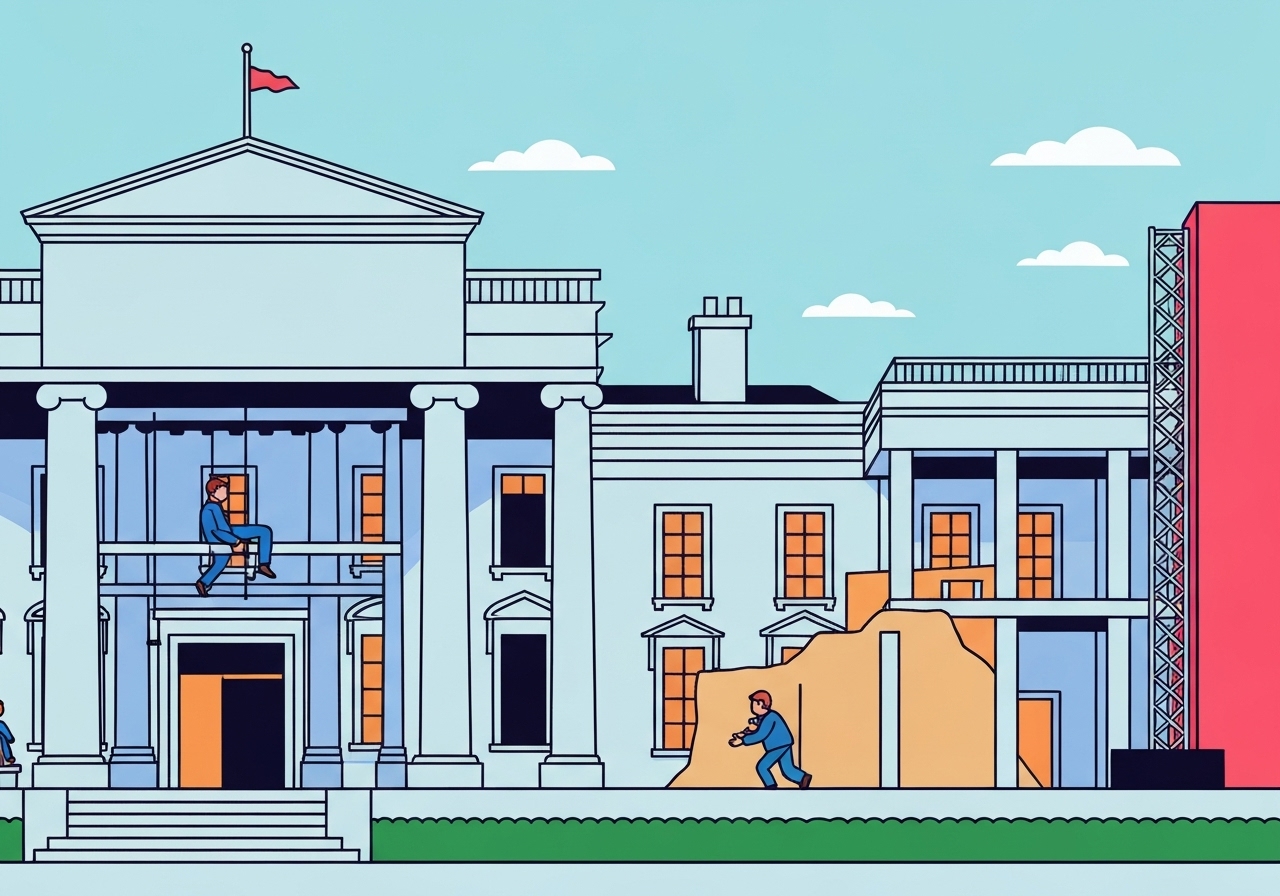
Lead: On Dec. 12, 2025, the National Trust for Historic Preservation filed a federal lawsuit to halt President Trump’s plan to build a 90,000-square-foot ballroom on White House grounds after the East Wing was demolished in October. The suit, filed in federal court, asks judges to require formal reviews and congressional authorization before construction proceeds. The National Trust says the administration bypassed multiple federal rules; the White House maintains the grounds are exempt from certain preservation review. Plaintiffs seek injunctions and a mandate that plans be submitted for public and congressional review.
Key Takeaways
- The lawsuit was filed Dec. 12, 2025 by the National Trust for Historic Preservation seeking to stop construction of a 90,000-square-foot ballroom.
- The White House’s East Wing was demolished in October 2025 to make room for the project, and President Trump has said work is audible through the night.
- Plaintiffs argue the administration violated at least four federal statutes, including provisions tied to congressional authorization for structures on federal reservations.
- The trust requests that detailed plans be submitted to federal review bodies and Congress for public input before any further work proceeds.
- The White House contends the site is exempt from the National Historic Preservation Act; the suit focuses on other statutes and code sections to challenge that position.
Background
The National Trust for Historic Preservation is a congressionally chartered nonprofit that advocates for protecting historic places. Its legal action reflects long-standing tensions over how changes to federal landmarks should be reviewed, especially when those changes involve the executive mansion in Washington, D.C. Federal law includes multiple overlapping review regimes—some based in preservation law, others in planning, aesthetics, environmental review and administrative procedure—that typically apply to significant federal projects. Historically, major alterations to public grounds in the District of Columbia have required consultation with planning authorities and, in many cases, explicit congressional authorization.
The White House complex sits on federally controlled land in the District and occupies a unique position in federal law: while the president controls the residence and immediate grounds for official functions, Congress retains authority over federal reservations and appropriations. The statutes cited in the complaint—the National Capital Planning Act, rules governing the Commission of Fine Arts, the National Environmental Policy Act (NEPA) and the Administrative Procedure Act (APA)—each impose procedural or substantive limits that can trigger review or public input. Past administrations have navigated these rules with differing degrees of transparency; plaintiffs say the current project breaks with customary practice by moving forward without formal review.
Main Event
On Dec. 12, 2025, the National Trust filed a complaint in federal court arguing that the administration proceeded without required approvals and public review. The suit cites a provision of federal law that prohibits erecting a building or structure on federal reservations in the District without Congress’s express authority, and it alleges violations of the National Capital Planning Act, Commission of Fine Arts rules, NEPA and the APA. The complaint asks the court to halt further construction until plans are submitted to the relevant agencies and Congress and until required procedures are followed.
According to the complaint, the East Wing was demolished in October 2025 to clear space for the ballroom and demolition work has continued since. President Trump has publicly said construction makes noise at night; plaintiffs highlight those statements to underscore the immediacy of the project and potential irreversible changes to historic fabric. The White House has responded that its grounds are exempt from the National Historic Preservation Act—an argument the trust rejects, noting other statutory regimes that it says still apply.
The trust’s filing seeks preliminary and permanent injunctive relief as well as declaratory relief that the administration must submit its plans for review. Attorneys for the plaintiffs argue that bypassing standard reviews denies the public and Congress the opportunity to weigh in on a major alteration to a national landmark. The complaint requests the court to compel agencies and the administration to follow established procedures before any additional work continues.
Analysis & Implications
Legally, the case will turn on statutory interpretation and procedural posture. The White House’s claim of an NHPA exemption narrows one avenue for challenge, but the trust’s reliance on other statutes—particularly the clause requiring congressional authority for new structures on federal reservations—raises a distinct constitutional and statutory question. If the court finds that express congressional approval is required, the administration could be forced to stop work immediately and seek legislation or other formal authorization.
NEPA and the APA provide procedural pathways that often lead to judicial review when agencies fail to consider environmental or public impacts. A successful NEPA claim could require an environmental assessment or a more detailed environmental impact statement, both of which take time and introduce public comment periods. An APA claim could succeed if the court finds the administration acted arbitrarily or failed to follow required procedures, which again could lead to injunctions while agencies remedy procedural defects.
Beyond immediate procedural remedies, the suit raises questions about precedent and separation of powers. Requiring congressional approval for the ballroom would reinforce legislative oversight over federal reservations; conversely, a ruling favoring the administration could broaden executive discretion over federal grounds. The case may also prompt Congress to clarify statutory authority or to pass specific authorizations, a political route that would reshape the debate from courts to Capitol Hill.
Comparison & Data
| Statute/Rule | Primary Requirement |
|---|---|
| District reservation clause (U.S. Code) | Congress must expressly authorize structures on federal reservations in D.C. |
| National Capital Planning Act | Requires planning review for changes to federal land and coordination with planning bodies. |
| Commission of Fine Arts law | Advisory review of design and appearance for federal projects in D.C. |
| NEPA | Requires environmental review and public comment for federal actions with significant impacts. |
| APA | Sets procedural standards and allows judicial review for arbitrary or unlawful agency actions. |
The table summarizes the principal legal frameworks the trust cited. While some statutes are advisory (the Commission of Fine Arts) and others are procedural (NEPA, APA), the District reservation clause and the National Capital Planning Act carry potential substantive barriers to new construction without higher-level authorization. If a court finds any of these obligations unmet, remedies can range from requirements to complete reviews to halting construction via injunction.
Reactions & Quotes
The filing prompted immediate responses from both sides and drew commentary from legal experts and preservation advocates. Below are representative brief statements and their context.
“We filed because major federal landmarks cannot be altered without required review and public input,” the trust said in a statement accompanying the suit.
National Trust for Historic Preservation (plaintiff, press statement)
“The grounds are exempt from the National Historic Preservation Act,” a White House spokesperson said in response, defending the administration’s authority to act on the complex.
White House (official statement)
Legal scholars noted that an injunction is a likely early remedy if procedural statutes are found to have been ignored, since those statutes focus on process and public participation.
Constitutional law expert (analysis)
Unconfirmed
- Whether Congress will intervene proactively by drafting specific authorization language for the ballroom is not confirmed and remains speculative.
- The full extent of demolition completed in October 2025 and whether any irreversible alterations have been made has not been independently verified outside the complaint.
Bottom Line
The National Trust’s lawsuit turns a high-profile construction plan into a test case about executive authority, historic-preservation norms and statutory review processes. If the court finds procedural or substantive violations, the administration may be required to pause work, complete formal reviews and potentially seek congressional authorization—delays that could be lengthy and politically charged.
If courts decline to intervene, the ruling could expand executive latitude over federal reservations and complicate future preservation enforcement. For now, the dispute shifts to the courtroom, with quick procedural rulings likely defining whether the project continues immediately or is paused pending fuller review.
Sources
- The New York Times — news report (The New York Times, Dec. 12, 2025)