
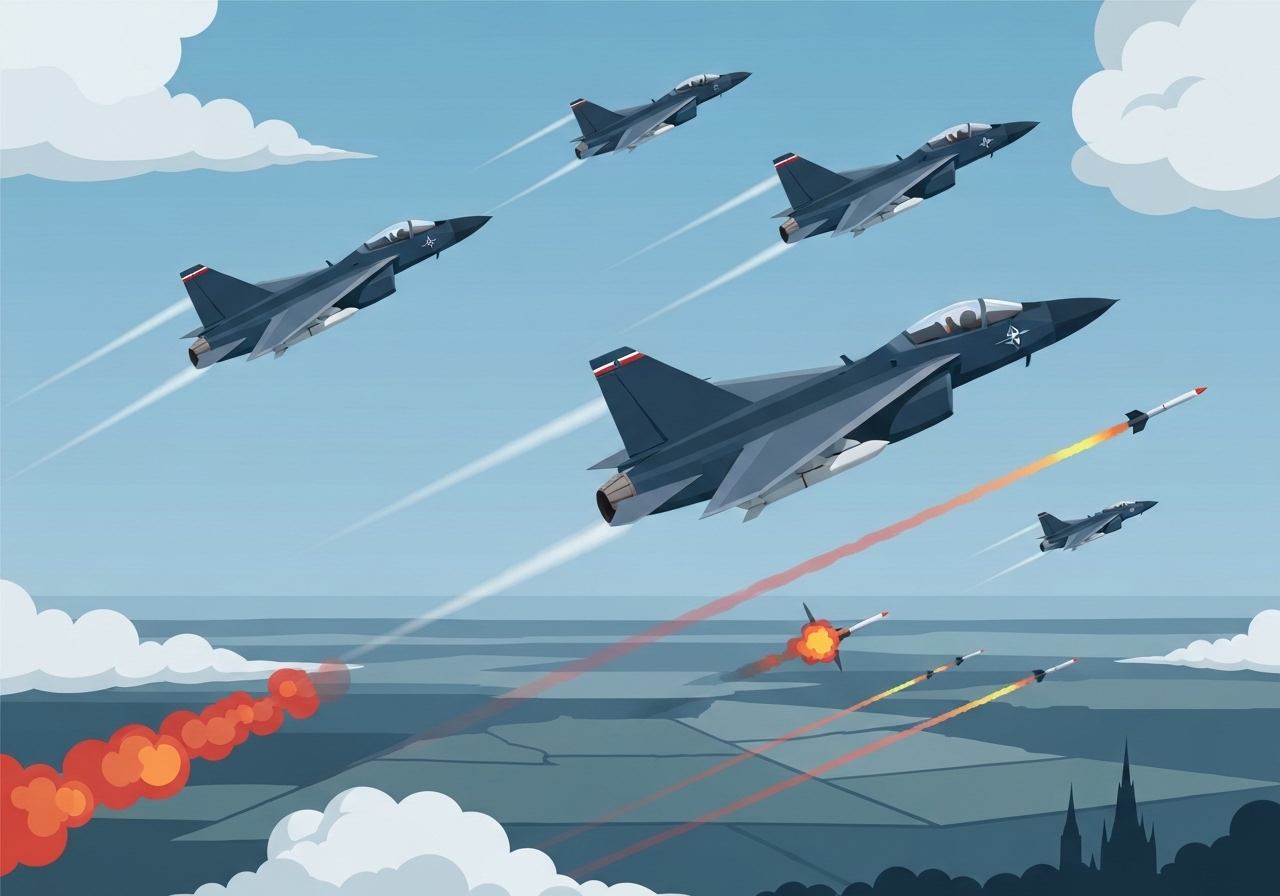
In the early hours after Russia launched a major overnight drone and missile attack on Ukraine, NATO fighter jets were scrambled and ground-based air defenses in Poland were put on heightened readiness, Warsaw’s Armed Forces Operational Command said. The alert, described as preventive, began as strikes hit multiple Ukrainian regions and lasted just under four hours before forces returned to routine operations. Polish officials reported no breach of national airspace. Ukrainian authorities said the assault struck energy and civilian infrastructure across several regions and caused injuries and service disruptions.
Key Takeaways
- Ukraine reported 653 drones and 51 missiles used in the attack, including 17 ballistic missiles; 585 drones and 30 missiles were intercepted or suppressed, according to Ukrainian air force figures.
- The strike used 704 air attack weapons, the highest single-night total since 705 munitions were used on Oct. 29, and the fourth occasion in the war that attacks exceeded 700 weapons.
- Impacts were recorded in 29 locations; Kyiv authorities reported at least three people injured, and multiple regions reported damage to energy infrastructure.
- In Odesa, authorities said an energy facility was damaged, leaving about 9,500 customers without heating and 34,000 without water as of 9:30 a.m. local time.
- Poland’s Armed Forces Operational Command said fighter jets were scrambled and ground-based air defense and radar systems reached a state of readiness for just under four hours, with no Polish airspace violations observed.
- The Spanish and Czech air forces were involved in the response, and German and Dutch air defense systems were reported active in the region.
- Russia’s Defense Ministry claimed it shot down at least 121 drones during the same period, a figure that differs from Ukrainian tallies.
Background
Since Russia launched its full-scale invasion of Ukraine in 2022, both sides have increasingly deployed long-range missiles and attack drones to strike military and critical civilian infrastructure. Attacks on power grids and heating systems have become a recurrent tactic in winter months, aimed at degrading civilian resilience and complicating logistics for Ukrainian authorities. NATO members bordering Ukraine have maintained an intensive air policing posture to prevent spillover, with rotating multinational assets and integrated ground-based air defenses stationed near threatened regions.
Poland, a frontline NATO member, has repeatedly reported high operational tempo for its air forces and close coordination with allied partners, including Spain, the Czech Republic, Germany and the Netherlands. NATO doctrine emphasizes defending member airspace and preventing inadvertent escalation, so alerts inside NATO territory are treated as precautionary measures unless an incursion is confirmed. Past large-scale Russian aerial assaults, notably the nights of Sept. 6 and Oct. 29, set a precedent for spikes in munitions and prompted renewed discussions in allied capitals about air defense aid.
Main Event
According to Warsaw’s Armed Forces Operational Command, fighter jets were scrambled and ground-based air defense and radar reconnaissance systems were elevated to a state of readiness after Russia launched a synchronized drone and missile campaign against Ukraine overnight. The command described the actions as preventive and intended to secure airspace near threatened regions. After just under four hours, aircraft and defenses returned to standard operational activities, and officials reported no violation of Polish sovereign airspace.
Ukraine’s air force released figures stating that 653 attack drones and 51 missiles were employed in the barrage, of which Ukrainian defenders neutralized or suppressed 585 drones and 30 missiles. Impacts were reported across 29 locations, with authorities in Kyiv, Chernihiv, Zaporizhzhia, Lviv and Dnipropetrovsk noting damage to infrastructure. Kyiv’s State Emergency Service said at least three people were injured in the capital during the strikes.
Regional officials in Odesa said an energy facility was damaged, causing power and heating losses affecting thousands of residents and water service interruptions for tens of thousands. Ukrainian leaders, including the foreign minister and the president, framed the attack as part of a pattern of strikes targeting civilian systems to inflict widespread suffering and stressed the need for sustained international pressure and enhanced air defenses.
Analysis & Implications
The scale of the attack underscores Moscow’s ability to mount massed drone and missile operations that can saturate defenses and force costly responses. Even with high interception rates reported by Ukraine, the strike nevertheless caused localized damage and civilian harm. For NATO, such episodes produce acute readiness demands on neighbors like Poland and test the alliance’s integrated air defense networks, particularly the interoperability of national systems.
Poland’s decision to elevate fighter and ground defenses was defensive and aligned with NATO rules of engagement that prioritize sovereignty protection without escalating to offensive action. Nevertheless, repeated proximity alerts raise political pressure on allied governments to accelerate air defense deliveries, intelligence sharing and coordination to mitigate spillover risk. The involvement of Spanish and Czech aircraft and German and Dutch systems highlights ongoing burden-sharing but also the limits of current inventories against massed attacks.
Economically and socially, damage to energy infrastructure ahead of winter risks humanitarian stress and strains on municipal services. If attacks on utilities continue at this tempo, reconstruction and emergency response costs will rise, complicating Ukraine’s fiscal planning and foreign aid priorities. Diplomatically, such large-scale strikes tend to harden allied resolve to sustain military assistance while prompting renewed debate over sanctions and measures intended to degrade strike capabilities at source.
Comparison & Data
| Night | Air Attack Weapons Reported |
|---|---|
| Sept. 6, 2025 | 823 |
| Oct. 29, 2025 | 705 |
| Dec. 6, 2025 | 704 |
By Ukrainian air force tallies, the Dec. 6 barrage at 704 air attack weapons ranks as the largest single-night assault since Oct. 29 and the fourth time totals surpassed 700 during the conflict. While interception rates reported by Ukraine are high, the absolute number of incoming munitions increases the probability of successful strikes on critical targets and amplifies cumulative damage over time.
Reactions & Quotes
Poland framed its actions as precautionary steps to protect national airspace and neighboring regions while emphasizing that no breach occurred. The command underscored the readiness of both domestic and allied systems during the incident.
“Fighter jets have been scrambled and ground-based air defense systems … reached a state of readiness,”
Armed Forces Operational Command, Poland (official post)
Ukrainian leaders described the strikes as deliberate attacks on civilian infrastructure and called for sustained international pressure and more robust air defenses. Their statements tied humanitarian consequences to broader strategic aims attributed to Moscow.
“Energy facilities were the main targets of these strikes. Russia’s aim is to inflict suffering on millions of Ukrainians,”
President Volodymyr Zelenskyy (social media post)
Russia’s Defense Ministry offered a different account, saying its forces downed at least 121 drones, a figure that contrasts with Ukrainian tallies and highlights information divergences common in wartime reporting.
“Our forces downed at least 121 drones”
Russian Defense Ministry (official statement)
Unconfirmed
- Attribution of specific launch sites inside Russian territory for the Dec. 6 salvo remains publicly unverified by independent open-source analysis.
- Comprehensive casualty counts across all affected regions have not yet been consolidated and may change as emergency services complete assessments.
- Reports of any debris crossing into NATO territory during the incident have not been confirmed by allied or independent sources.
Bottom Line
The Dec. 6 overnight barrage was one of the largest single-night aerial campaigns of the war in terms of the number of attack vehicles reported, and it again highlighted the strain that mass drone and missile strikes place on Ukraine’s civil infrastructure and allied air defenses. Poland’s precautionary scramble of fighter jets and elevated air defenses illustrates NATO’s readiness posture but also the recurring challenge of preventing escalation while protecting member airspace.
Expect allied capitals to intensify discussions on replenishing and expanding integrated air defense capabilities, accelerating deliveries, and enhancing multinational coordination. For Ukraine, repeated strikes on energy and transport infrastructure will prolong humanitarian and reconstruction needs and keep international support and sanctions debates central to the next phase of the conflict.
Sources
- ABC News — international news report summarizing official statements and Ukrainian figures