
Lead
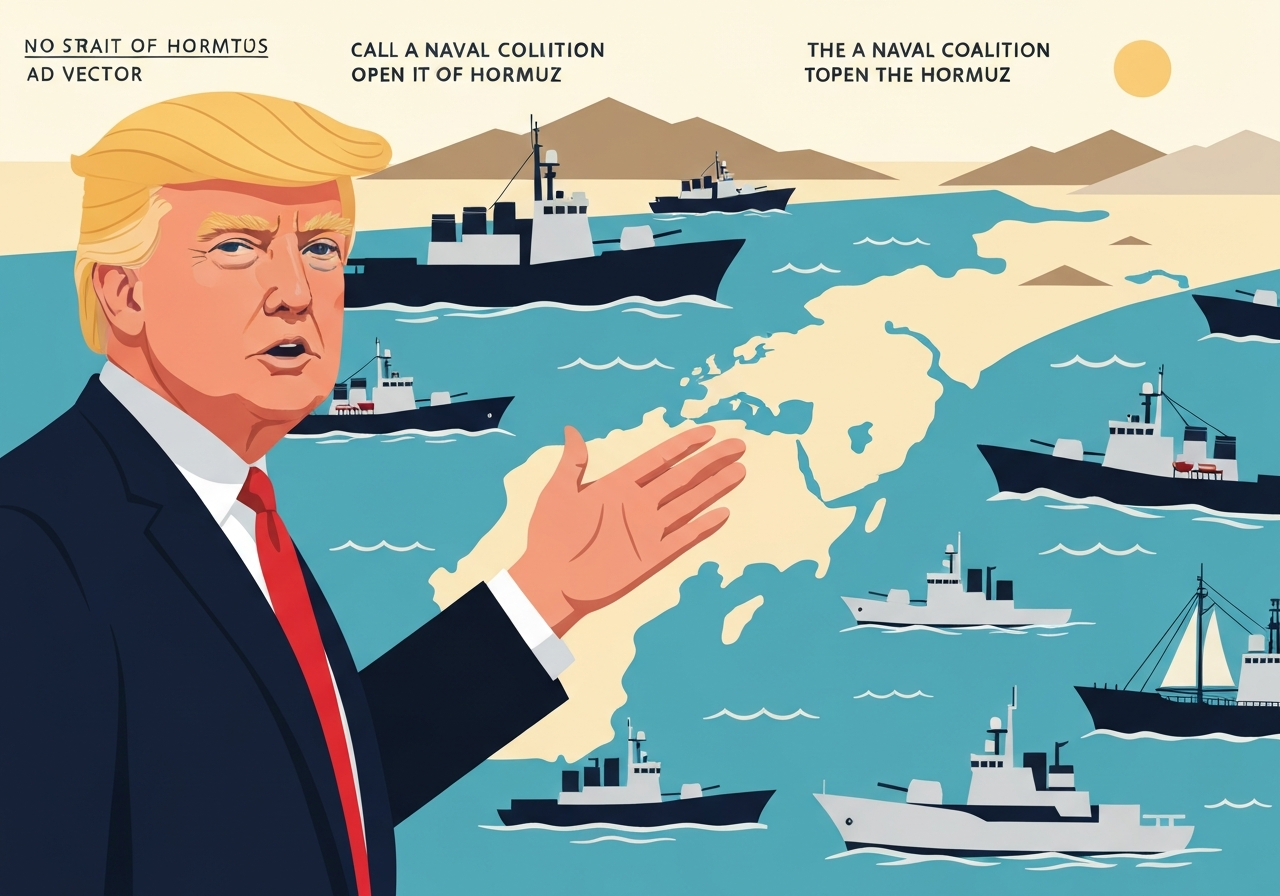
On 15 March 2026, US President Donald Trump urged an international naval coalition to deploy warships to secure the Strait of Hormuz, a narrow choke point through which about one-fifth of global oil shipments flow. The call came as Tehran’s retaliation in the US–Israel war with Iran has curtailed transits through the strait and pushed oil above $100 per barrel. Iranian authorities, including the newly declared supreme leader Mojtaba Khamenei, have said the waterway will remain closed to adversaries, and Tehran has struck more than a dozen vessels since the strikes began. The proposal raises immediate operational, political and legal questions about the feasibility and risks of an escorted reopening.
Key takeaways
- About 20% of global oil traffic transits the Strait of Hormuz; disruptions have helped push crude prices above $100 per barrel.
- The strait narrows to roughly 21 nautical miles (39 km) at its tightest point; shipping lanes inside it are significantly more confined and vulnerable.
- Iran has reportedly attacked over a dozen vessels in the two weeks since hostilities began; one documented incident was the March 11 attack on the Thai bulk carrier Mayuree Naree.
- No state has publicly committed warships to the US president’s proposal; London, Beijing, Tokyo, Paris and Seoul have signalled caution or refusal.
- Some bilateral negotiations have allowed a small number of vessels — including two Indian-flagged LPG tankers — to transit under Iranian permission.
- Analysts cite interoperability, mine and missile threats, and the tight geography as major obstacles to a rapid coalition-led escort operation.
Background
The current crisis stems from a broader escalation between the United States, Israel and Iran. After coordinated strikes early in the conflict, Tehran announced retaliatory measures affecting maritime traffic in the Gulf, using asymmetric tools such as mines, small-boat attacks and strikes on individual tankers. Historically the Strait of Hormuz has been a strategic flashpoint: it is the only seaway into the Arabian (Persian) Gulf and has seen incidents and interdictions during previous regional tensions.
Global energy markets are highly sensitive to any interruption in Gulf flows. Many importing countries — from Japan and South Korea to large consumer markets in Europe and Asia — depend on steady deliveries through the strait. Political alignments and commercial ties, meanwhile, complicate a collective response: some states retain diplomatic links with Tehran and have sought bilateral arrangements to secure shipments, while others face domestic legal and political limits on naval deployments.
Main event
President Trump publicly urged countries including China, France, Japan, South Korea and the United Kingdom to send warships to the Strait of Hormuz to reopen and safeguard shipping lanes. In social-media posts he asserted Iran’s military capacity had been largely degraded but warned Iran could still deploy drones, mines or short-range missiles to harass transit. He said the US would continue strikes on Iranian shore targets and shoot vessels it deemed hostile until the strait was “open, safe, and free.”
Iranian officials responded by disputing aspects of the US account. Islamic Revolutionary Guard Corps Navy commander Alireza Tangsiri said claims of a destroyed Iranian navy or that the US could simply provide secure escorts were false, asserting the strait was under Iranian control. Foreign Minister Abbas Araghchi said the waterway remained open to international shipping except for vessels belonging to the United States and its allies, framing the restrictions as targeted rather than a blanket closure.
Other states have been cautious. London said it was “intensively looking” at options; Japan highlighted high legal and political thresholds for committing ships; France refused to join combat operations; South Korea said it was monitoring developments closely. Separately, New Delhi and Ankara have secured passage for a limited number of their flagged vessels after direct talks with Tehran, demonstrating that bilateral negotiation is a parallel — and currently more viable — path to moving key shipments.
Analysis & implications
Operationally, a multinational escort force faces steep hurdles. Experts point to interoperability problems — differences in communications systems, rules of engagement and tactical doctrine — that complicate coordinated action under combat conditions. The strait’s narrow, congested lanes leave little room for manoeuvre and place coalition warships within range of coastal missile batteries, small-boat swarms and potential seabed mines or unmanned sea systems.
Escalation risk is high. Any hostile engagement between coalition ships and Iranian forces could broaden the conflict rapidly, drawing in naval assets and producing political blowback in capitals whose publics are reluctant to be seen as active belligerents. There are also legal complexities: states must reconcile domestic law, UN Charter obligations and concerns about the use of force in international straits.
Economically, even a partial or temporary reopening would not immediately calm markets. Insurance premiums, crew safety concerns and the time required to restore commercial confidence mean flows could remain constrained for weeks. Conversely, a robust and sustained escort operation that demonstrably mitigates Iranian threats could gradually lower risk premia and bring down energy prices — but only if it avoids major confrontations.
Comparison & data
| Metric | Typical value / baseline | Current or reported |
|---|---|---|
| Share of global oil transiting Hormuz | ~20% | ~20% (ongoing dependence) |
| Strait width at narrowest point | 21 nautical miles (39 km) | 21 nautical miles (39 km) |
| Reported oil price | Pre-crisis benchmark varies | Over $100 per barrel (reported) |
| Iran warning on price | — | Possible rise beyond $200 per barrel (Iranian official warning) |
The table highlights the scale of dependence on a single maritime choke point and the price sensitivity noted by market observers. Restoring physical passage is only one element; insurers, charterers and owners require assurances about the risk environment before regular commercial patterns resume.
Reactions & quotes
Domestically in the United States, lawmakers and commentators have criticised the absence of a clear plan to reopen the strait. Senator Chris Murphy, a Democrat, warned publicly that the administration lacked a safe, credible path to reopening the waterway and raised concerns about technical gaps in any hastily assembled operation.
I can’t go into more detail about how Iran gums up the Strait, but suffice it to say, right now, they don’t know how to get it safely back open.
Senator Chris Murphy (D-US)
European and Asian capitals have been measured. British Energy Secretary Ed Miliband said the UK was examining options with allies but did not commit ships. China called for a halt to hostilities and stressed global responsibility for stable energy supplies.
We are intensively looking with our allies at what can be done because it’s so important that we get the strait reopened.
Ed Miliband, UK Energy Secretary
Iran’s naval leadership has framed its actions as defensive control of the passage. IRGC Navy commander Alireza Tangsiri rejected US claims about a destroyed Iranian navy and insisted Tehran remained capable of regulating maritime traffic in the strait.
The Strait of Hormuz has not been militarily blocked and is merely under control.
Alireza Tangsiri, IRGC Navy commander
Unconfirmed
- President Trump’s assertion that “100% of Iran’s military capability” has been destroyed is a claim made by the administration and is not independently corroborated in open-source reporting.
- Reports that Ali Khamenei, described in some dispatches as the late supreme leader and father of Mojtaba Khamenei, was killed on the first day of strikes remain subject to independent verification.
- The precise number of vessels Iran has allowed to pass under special arrangements — beyond the cited Indian and Turkish exceptions — is not fully documented in publicly available records.
- Forecasts that oil will rise “beyond $200 per barrel” are warnings voiced by Iranian officials and market scenarios, not guaranteed outcomes.
Bottom line
Reopening the Strait of Hormuz by means of a multinational naval escort is technically possible but operationally complex and politically fraught. Interoperability challenges, the constricted geography, the real threat of mines and missiles, and the high escalation risk mean any coalition would need time, substantial assets and clear legal mandates to act without triggering wider conflict.
For now, bilateral negotiations between Tehran and specific importing states are the likeliest short-term route to relieve critical cargoes, while global markets and policymakers watch insurance rates, sanction dynamics and diplomatic channels. The international community faces a stark choice: attempt a risky military-led solution with uncertain multinational buy-in, or intensify diplomatic and commercial arrangements to reduce immediate pressure on supplies while seeking longer-term de-escalation.