
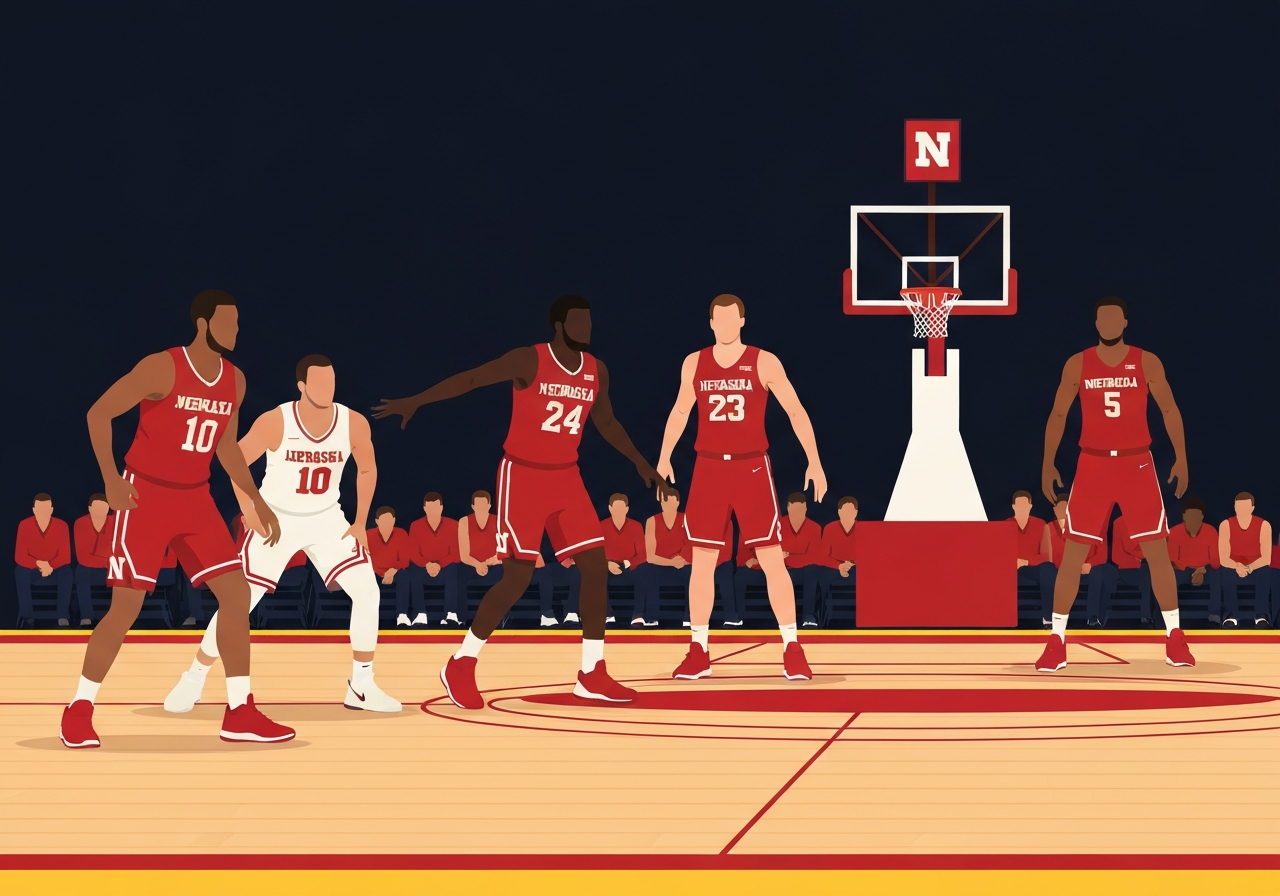
With the Cornhuskers’ season on the line Thursday in the Sweet 16, Nebraska committed a late, decisive error: the team took the court with only four defenders on an inbounds play and Iowa turned that window into an and‑one that effectively ended the game. With 58.8 seconds remaining and Iowa leading 71‑68, junior guard Kael Combs found Alvaro Folgueiras alone past halfcourt on a long inbounds pass. Folgueiras raced to the rim, was fouled by a trailing defender, made the layup and the free throw to convert a three‑point play that pushed Iowa into a 74‑68 margin on its way to a 77‑71 victory. The win sends No. 9 Iowa to the South regional final while Nebraska’s historic run — its first two NCAA tournament victories in program history — concluded in bitter fashion.
Key takeaways
- Nebraska finished with a 71‑77 loss to Iowa in the Sweet 16 on Thursday; the game‑clinching sequence occurred with 58.8 seconds remaining.
- Iowa converted a breakaway layup and free throw—Alvaro Folgueiras completed the three‑point play—to turn a 71‑68 lead into a 74‑68 advantage inside the final minute.
- The decisive possession began on an inbounds play under Iowa’s basket after a timeout; Kael Combs delivered a long pass to an uncovered Folgueiras over halfcourt.
- Nebraska had only four defenders on the floor during the play, a miscommunication head coach Fred Hoiberg publicly accepted responsibility for after the game.
- No. 9 Iowa advances to the South regional final to face No. 3 Illinois for a Final Four berth; Nebraska’s season ends after its first two NCAA tournament wins in program history.
Background
The game came in the NCAA Tournament’s South regional Sweet 16, where single‑elimination stakes magnify every late possession. Nebraska entered the matchup having recorded the first two NCAA tournament victories in program history earlier in the week, a breakthrough for a program that had never advanced past the opening rounds before this season. Iowa, seeded No. 9, built a late lead and was protecting a three‑point margin when Nebraska’s rotation breakdown occurred. Fred Hoiberg, Nebraska’s head coach, has overseen a turnaround that put the Cornhuskers on the national stage; the sudden exit leaves the team with a mix of accomplishment and disappointment.
Tactical and personnel decisions in March have outsized consequences, and end‑of‑game sets are coached and practiced with that in mind. Inbounds plays under the defending team’s basket — when the offense can quickly reverse the ball — are drilled for both execution and awareness of opponents’ spacing. The miscue here was not an athletic failure so much as a communication and substitution lapse: one fewer defender on the floor left a skilled scorer unguarded in transition, and Iowa capitalized immediately. Officials, coaches and teams often scrutinize such sequences after the fact because they combine procedural clarity (who should be on the court?) with split‑second execution.
Main event
The decisive sequence began after an Iowa timeout with the Hawkeyes leading 71‑68. Kael Combs, stationed on the baseline, observed Alvaro Folgueiras standing wide open beyond halfcourt; Nebraska had only four players defending the backcourt at that moment. Combs delivered a pinpoint long pass that hit Folgueiras in stride, initiating a breakaway attack with very little resistance. A trailing Nebraska defender, Berke Büyüktuncel, managed to reach Folgueiras only as he was releasing the shot and was ruled to have fouled.
Folgueiras completed the layup and then converted the free throw, producing the three‑point play that extended Iowa’s lead to 74‑68. That sequence removed Nebraska’s immediate chance to force a stop and get a late possession to tie or win; instead, Iowa carried a two‑possession margin into the closing seconds. Iowa added free throws and managed the clock thereafter to secure the final 77‑71 score.
On the sideline afterward, Nebraska coach Fred Hoiberg assigned responsibility to his staff and himself, calling the miscue a communication breakdown. He noted that he had not encountered that precise scenario before and questioned whether officials have discretion or a formal obligation in similar situations—remarks that highlighted the gray area around on‑court personnel checks when teams are changing assignments or making substitutions late in the game.
Analysis & implications
The play is a reminder that late‑game outcomes in tournament basketball often hinge on routine fundamentals—counting personnel, clear substitution communication and situational awareness—rather than purely on talent. Having one fewer defender on the floor created a mathematically simple path to an uncontested scoring chance; the probability of an easy conversion is high in transition when a player is unguarded near the rim. For Nebraska, the error erased an opportunity to force a defensive stop and possibly rally from a three‑point deficit.
From a coaching perspective, the sequence raises two linked issues: internal process and officiating protocol. Internally, staff and players share responsibility for confirming lineups after timeouts; a formalized, redundant check can reduce the chance of a lapse. Externally, the incident spotlights how officials manage on‑court counts and whether there is a clear, standard procedure when fewer than five defenders are present. The coach’s public uncertainty about the rule suggests room for greater clarity from governing bodies.
For Iowa, the play reinforced a recurring March Tournament dynamic—opponents’ mistakes can be as decisive as any single highlight. The Hawkeyes’ ability to convert in that moment preserves momentum and energy that will matter against a No. 3 Illinois team with a Final Four berth at stake. For Nebraska, the program leaves with tangible progress: two first‑ever NCAA tournament wins. Yet the final impression will be tempered by how the season concluded, and the staff will likely emphasize communication protocols in the offseason to prevent a repeat.
Comparison & data
| Metric | Value |
|---|---|
| Final score | Iowa 77, Nebraska 71 |
| Critical time on play | 58.8 seconds remaining |
| Play result | Broken inbounds → Folgueiras layup + free throw (and‑one) |
| Nebraska tournament milestone | First two NCAA tournament wins in program history |
Context matters: although the and‑one created a six‑point swing in the final minute, Nebraska’s run to the Sweet 16 represents program progress that cannot be erased by a single late miscue. Statistically, transition baskets and uncontested rim opportunities have very high expected values; a long inbounds pass to an unguarded player near the rim is among the highest‑probability scoring chances in basketball. The sequence therefore combines a rare personnel error with an outcome that standard analytics predict — a quick score and an increased chance to close out the game.
Reactions & quotes
Nebraska’s coach acknowledged responsibility immediately after the game, framing the lapse as an internal breakdown rather than a singular officiating mistake.
“Put that one on me. It was a miscommunication. I’m the head coach, and that one’s on me.”
Fred Hoiberg, Nebraska head coach
Hoiberg expanded on the uncertainty about the officials’ role, saying he had not previously been in that precise situation and was unsure whether officials are required to intervene when fewer than five players appear to be set defensively.
“I’ve never been in a situation like that. I know they always count to make sure there’s not six. I don’t know the rule on that with four.”
Fred Hoiberg, Nebraska head coach
Those remarks underscore that even experienced coaches can encounter rare procedural scenarios in high‑pressure moments, and they have prompted discussion about how teams and officials can avoid similar endings going forward.
Unconfirmed
- Whether game officials are required by a specific NCAA rule to pause play or otherwise intervene when a team has fewer than five players on the floor remains unclear based on public statements at the time of reporting.
- There is no publicly released official determination that the on‑court situation constituted an officiating error; Nebraska’s coach described the issue as a miscommunication but did not assert a formal rules violation by the officials.
Bottom line
The game ended on a preventable, communication‑driven play: Nebraska’s four‑on‑court alignment allowed Iowa an uncontested path to a three‑point play with 58.8 seconds remaining, which materially changed the scoreboard from a one‑possession game to a two‑possession margin. That single sequence, not overall season performance, will likely shape immediate headlines, but the broader view must account for Nebraska’s program milestone of winning its first two NCAA tournament games.
Looking ahead, Iowa advances to face No. 3 Illinois in the South regional final with momentum from the late sequence, while Nebraska will evaluate staff procedures, substitution protocols and timeout management to prevent a recurrence. The episode is a clear case study in how process and attention to basic details can determine outcomes on the sport’s biggest stage.
Sources
- Yahoo Sports — news report