
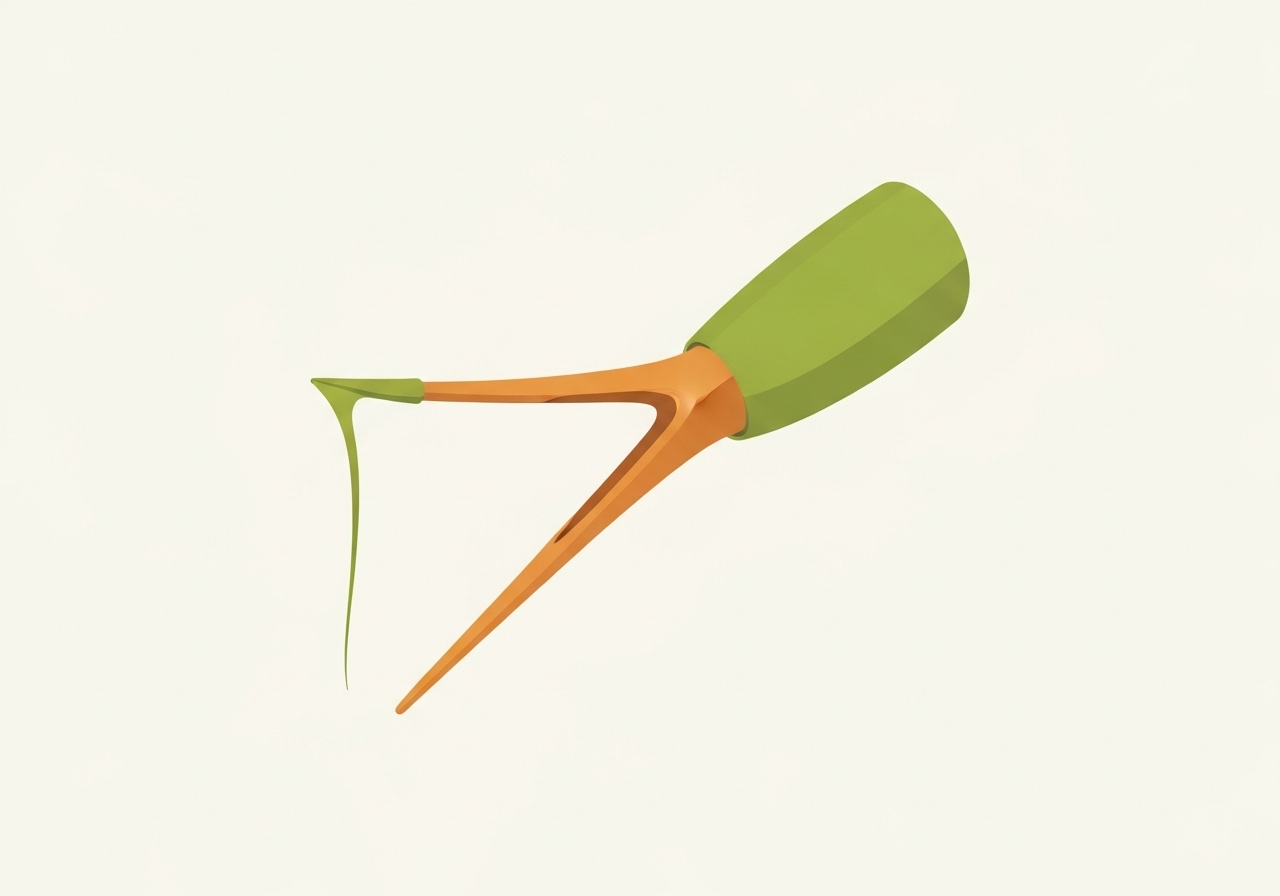
Lead: A research team published in Science Advances (2025) that they fashioned working 3D-printing nozzles from mosquito proboscises, removed from euthanized insects under a microscope and bonded into plastic tips with UV-curable resin. Tests in the lab produced prints with line resolution between 18 and 22 microns and included 600-micron honeycomb lattices, a microscale maple leaf and cell-growth scaffolds. The organic nozzles matched or exceeded the precision of the smallest commercial metal dispensing tips but could not yet match glass tips in submicron resolution or in resistance to high internal pressure. The researchers estimate a raw material cost near $0.80 per nozzle and propose coating or hybrid approaches to raise strength and broaden ink compatibility.
Key Takeaways
- The necroprinter reached a resolution of 18–22 microns, about two times finer than printers using the smallest commercially available metal dispensing tips (implying metal tips are roughly 36–44 microns under comparable conditions).
- Initial prints included 600-micron honeycomb structures, a microscale maple leaf and scaffolds intended for cell seeding, demonstrating geometric fidelity at the tested scale.
- Mosquito-based nozzles struggled with high-viscosity, paste-like inks because the proboscis exhibits limited resistance to internal pressure, per lead researcher Cao.
- Glass dispensing tips still outperform the organic nozzles on two fronts: submicron line printing (below 1 micron) and substantially higher pressure tolerance.
- Cost projections from the team place an organic mosquito-proboscis nozzle at about $0.80 each; researchers say glass and metal alternatives cost 32–100 times more, implying a comparative range of roughly $25.6–$80 per tip.
- The team proposes strengthening strategies such as applying ceramic layers to the proboscis core to increase pressure tolerance while retaining fine resolution.
- Authors envision applications in printing cell scaffolds and microscopic electronic components if durability and pressure constraints are addressed.
Background
The study builds on two long-running threads in microfabrication: pushing nozzle aperture size to achieve finer feature resolution, and exploring unconventional materials or structures to lower cost and expand capabilities. Commercial micro-dispensing tips are commonly made from metal, plastic or glass; glass tips can produce submicron lines but are relatively expensive and sometimes brittle. Researchers turned to mosquito proboscises because these biological structures are evolved to pierce tissue and channel fluids at micrometer scales, and they are abundant and inexpensive to rear.
In the experiment, the team harvested proboscises from euthanized mosquitoes under controlled microscopy and integrated each into the outlet of a plastic tip, bonding the junction with UV-curable resin. That hybrid assembly allowed the proboscis to serve as the final orifice for extruding inks. The work sits at the intersection of biologically informed engineering and low-cost manufacturing, raising questions about scalability, biosafety, lifecycle and engineering trade-offs between organic and synthetic components.
Main Event
Procedure details reported by the team indicate that each proboscis was handled microscopically before integration: the researchers aligned the biological shaft with a prefabricated plastic tip opening and then cured UV resin to secure the joint. After assembly, the devices were loaded with commonly used micro-extrusion inks and evaluated for print fidelity. Across trials, the biological nozzles consistently produced line widths in the 18–22 micron range and successfully extruded small structural tests including 600-micron honeycombs and a tiny decorative maple leaf geometry.
Despite the high-resolution output, the proboscis-based nozzle had a measurable weakness: limited tolerance to internal pressure. In practice, that meant paste-like, high-viscosity inks that hold shape well after deposition caused slumping or inconsistent extrusion with the organic nozzles. The research team reported that while the proboscis delivered superior precision versus some plastic or metal tips, it could not handle the higher pressures and abrasive loads sometimes required for viscous bioinks or composite pastes.
The authors contrasted performance with glass dispensing tips, which remain the standard for ultrafine work: glass can print below one micron in many setups and withstand much higher pressures. To address the gap the researchers proposed composite solutions such as using the proboscis as a core element and depositing ceramic coatings to increase strength. If pressure resistance can be raised without degrading aperture precision, the team argued the approach would be suitable for biomedical scaffolds and microscale electronics.
Analysis & Implications
Technically, the study demonstrates that naturally evolved microfluidic structures can rival engineered parts in key metrics such as aperture diameter and initial resolution. An 18–22 micron nozzle is sufficient for many microfabrication tasks, including certain classes of tissue scaffold printing, micro-lattice structures and components in printed microelectronic prototyping. The low material cost and ubiquity of mosquitoes present an appealing economic case if harvesting and processing can be standardized and scaled safely.
However, the gap in pressure tolerance points to a larger limitation: many practical inks used in precision additive manufacturing rely on higher viscosity to preserve geometry after deposition. Unless reinforced, organic nozzles will remain niche tools for low-pressure inks or very fine, low-viscosity materials. The proposed ceramic coating could materially change that trade-off, but coating processes must avoid clogging, preserve the internal geometry at micron scales and remain manufacturable at low cost.
Beyond the engineering trade-offs, ethical and regulatory issues will shape adoption. Using animal-derived components—even from euthanized insects—raises questions about biosafety, sterility for biomedical uses, and public perception. For tissue-engineering or clinical applications, regulatory pathways will require reproducible, sterile supply chains and validation that any biological remnants pose no contamination risk. The research team acknowledges these constraints and frames the approach initially for nonclinical, laboratory-scale uses.
Economically, the low per-unit cost could democratize access to fine nozzles in resource-limited labs and makerspaces. But total cost of ownership must consider labor for harvesting, assembly, and quality control as well as potential waste-stream and ethical compliance expenses. The most likely early adopters are researchers and educators where cost and availability trump long-term durability.
Comparison & Data
| Nozzle type | Typical resolution | Pressure tolerance | Approx. cost |
|---|---|---|---|
| Mosquito proboscis (hybrid) | 18–22 µm | Low | ~$0.80 each (team estimate) |
| Commercial metal dispensing tips | ~36–44 µm (comparable tests) | Medium–High | ~$25.6–$80 equivalent (32–100× more) |
| Glass dispensing tips | <1 µm | High | Varies; high relative cost |
The table places the mosquito-based nozzle as a low-cost, high-precision option for low-pressure needs while highlighting the superior pressure and submicron capability of glass tips. Any move toward commercialization will hinge on closing the pressure gap without sacrificing the aperture geometry responsible for fine resolution.
Reactions & Quotes
Researcher statements framed the work as exploratory engineering leveraging biological architecture while acknowledging clear limits.
“It was impressive but still too low to accommodate some high viscosity inks,”
Cao, lead researcher (as quoted in team communication)
“One possible solution is to use mosquito proboscis as the core and coat it with ceramic layers to provide much higher strength,”
Cao, lead researcher (as quoted in team communication)
Public discussion and independent expert commentary remain limited in the immediate aftermath of the paper’s publication; initial reader responses emphasize both fascination at the idea and concern about biosafety and scalability. The research team said they have begun follow-on work aimed at both engineering improvements and better understanding mosquitoes themselves.
Unconfirmed
- The long-term durability of ceramic-coated proboscises under repetitive, high-pressure printing cycles remains unproven and was not demonstrated in the published tests.
- The projected cost advantage assumes scalable, standardized harvesting and assembly; the true cost after labor, sterilization and quality control is not yet verified.
- The safety and regulatory pathway for use of insect-derived nozzles in biomedical or clinical-grade printing has not been established and requires separate validation.
Bottom Line
The Science Advances paper presents a provocative proof of concept: naturally evolved microfluidic structures can be repurposed as functional components for precision additive manufacturing, delivering 18–22 micron resolution at an estimated per-unit material cost near $0.80. That combination of precision and low raw cost could be attractive for laboratory-scale prototyping, educational settings and niche microfabrication tasks where high pressure and abrasive inks are not required.
Significant obstacles remain before this approach could displace commercial metal or glass nozzles more broadly: chiefly, the proboscis’s limited pressure tolerance and questions about sterile, reproducible production at scale. Proposed mitigation strategies such as ceramic coatings are plausible but themselves must be engineered to preserve internal geometry and avoid clogging. Readers should watch for follow-up work validating reinforced assemblies, lifecycle analyses and independent replication before treating this as a ready-made alternative to existing micro-dispensing technology.
Sources
- Ars Technica — news report summarizing the study and interviewing the research team (journalism).
- Science Advances, 2025 (DOI: 10.1126/sciadv.adw9953) — peer-reviewed research article presenting the necroprinting experiments (academic journal).