
Lead
On 8 September 2025, violent clashes in Kathmandu and other Nepali cities left at least 19 people dead and dozens wounded amid mass protests against a government decision to block major social media platforms and longstanding complaints about corruption. Young demonstrators—many described as Gen Z students—rallied outside the Parliament complex before some broke through a barricade and confronted security forces. Authorities and local hospitals reported that police used water cannon, tear gas, rubber bullets and, according to multiple reports and medical testimony, live rounds; seven people were declared dead at the National Trauma Centre. The government imposed curfews in central Kathmandu and deployed the army while calling an emergency cabinet meeting.
Key takeaways
- At least 19 people were reported killed on 8 September 2025 during nationwide protests; seven of those deaths were recorded at the National Trauma Centre in Kathmandu.
- More than 100 people received medical treatment for injuries, including 28 police personnel, according to police statements and hospital sources.
- Protests were sparked by a government move to block platforms including Facebook, YouTube and X after platforms allegedly failed to register with authorities.
- Security forces used water cannon, batons, rubber bullets and tear gas; multiple outlets and medical staff reported victims with gunshot wounds to the head and chest.
- Two people were killed in Itahari when demonstrations there turned violent, authorities said.
- The UN human rights office urged a “prompt and transparent investigation,” stressing the need for accountability for killings and injuries.
- Organisers described the demonstrations as led by Gen Z and framed as civil disobedience against perceived authoritarianism and corruption.
Background
The immediate trigger for the demonstrations was the government’s decision last week to block access to major social media platforms, including Facebook, YouTube and X, citing failures to register and alleged misuse such as fake accounts, hate speech and fraud. Digital platforms have become a central space for political debate and mobilisation in Nepal, particularly among younger cohorts who rely on them for information and social connection.
Beyond the ban, protesters and analysts point to deeper grievances: political instability, limited domestic economic opportunities and persistent corruption. Since the 2008 abolition of the monarchy and the 2015 constitution, Nepali politics have seen frequent government turnover, contributing to public frustration—especially among a generation that expected a more inclusive post-monarchy polity.
Main event
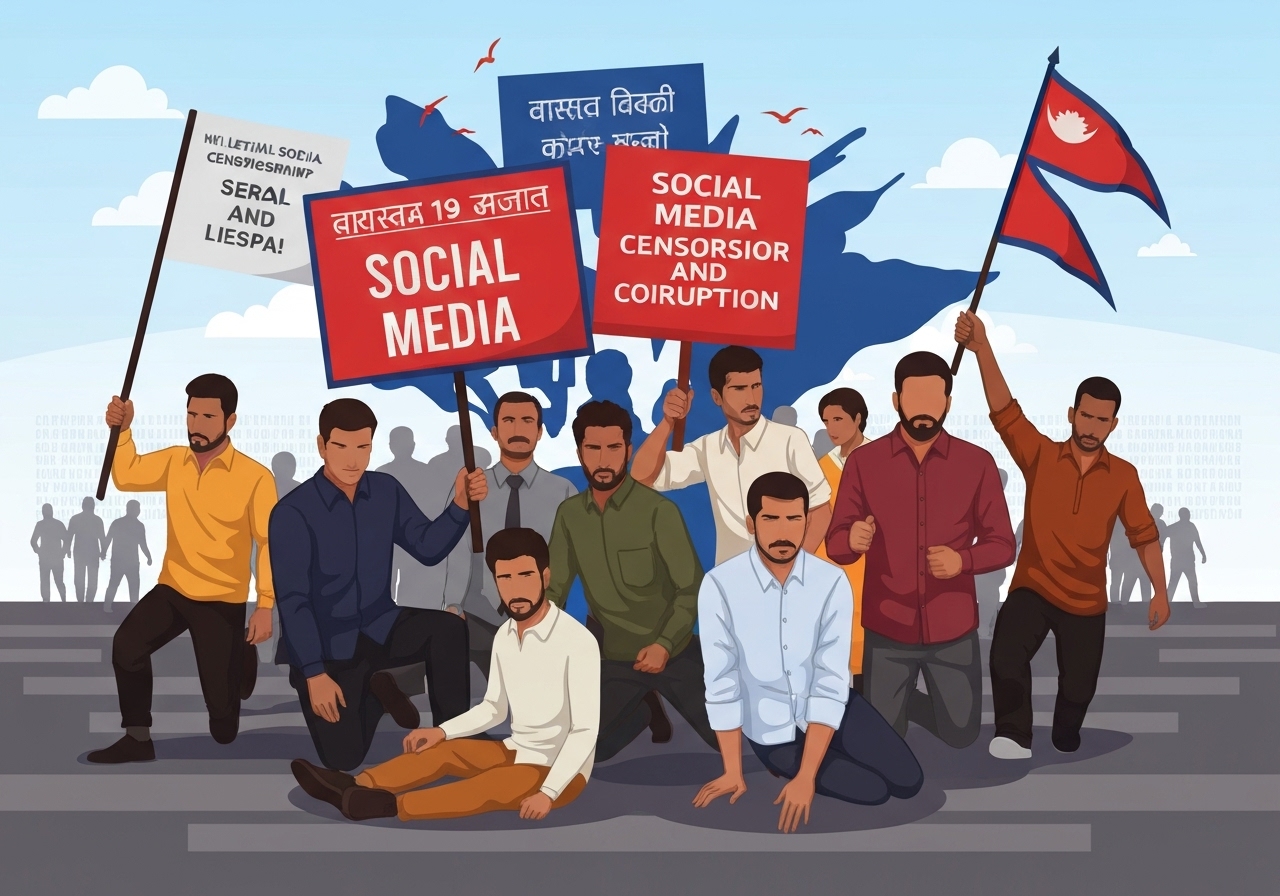
On the morning and afternoon of 8 September, thousands of mainly young demonstrators gathered in central Kathmandu, many wearing school or college uniforms and carrying placards reading “Unban social media” and “Youths against corruption.” Organisers and eyewitnesses say much of the crowd was peaceful until a segment pushed past a barricade and entered parts of the Parliament complex.
Police and district officials say security forces were ordered to disperse the crowd; a Kathmandu District Administration Office spokesperson said police used water cannon, batons and rubber bullets, and that the army was deployed to support operations. Multiple witnesses and at least one protester speaking to the ANI news agency described security forces firing live rounds.
Hospitals in Kathmandu received numerous casualties. Chief medical superintendent Dr Badri Rijal told the Associated Press that seven people died at the National Trauma Centre and many of the wounded appeared to have been shot in the head and chest. Families gathered at hospital entrances and citizens organised blood donations as emergency services struggled with the influx.
Police officer Shekhar Khanal told Reuters that over 100 people were receiving treatment, including 28 police personnel injured in clashes. Authorities also reported two fatalities in Itahari after protests there escalated into violence. The administration imposed curfews—extended through 10pm local time (16:15 GMT) in the Singha Durbar area that houses the prime minister’s office—and Prime Minister KP Sharma Oli convened an emergency cabinet meeting.
Analysis & implications
The immediate political fallout will focus on government handling of civil dissent and the decision to restrict major communication platforms. The social media ban, framed by officials as a regulatory move to force platform registration, collided with deep public sensitivities about freedom of expression and democratic openness, amplifying outrage among digitally connected youth.
Security-sector choices matter politically and legally: the use of potentially lethal force against predominantly young, reportedly unarmed protesters raises questions about rules of engagement, command responsibility and whether non-lethal alternatives were sufficiently prioritised. The UN’s call for a transparent probe increases diplomatic pressure and could prompt independent investigations or international scrutiny of human-rights practices in Nepal.
Economically and socially, a widening trust gap between young Nepalis and state institutions could accelerate migration and brain drain, reinforcing the grievances named by analysts: limited livelihood prospects at home and a sense of exclusion from the country’s promised post-conflict transition. For the government, managing both immediate security needs and a longer-term credibility deficit will be politically costly ahead of any electoral cycle.
Comparison & data
| Location | Reported deaths | Reported injured |
|---|---|---|
| Kathmandu (National Trauma Centre) | 7 | dozens (hospital admissions) |
| Other Kathmandu-area sites / Parliament complex | multiple (included in total) | dozens |
| Itahari | 2 | unspecified |
| Total reported | 19 | 100+ (incl. 28 police) |
The table aggregates figures reported by hospitals and police on 8 September 2025; some numbers remain provisional as investigations and hospital tallies continue. Compared with prior large-scale protests in Nepal, the death toll is unusually high for demonstrations that organisers described as largely youth-led and non-military in character. That gap underlines why independent verification of cause of death and the types of munitions used will be central to any inquiry.
Reactions & quotes
Officials, international bodies and activists issued immediate statements that framed the incident in differing terms—public-order enforcement, human-rights concern and civic outrage.
“We are shocked by the killings and injury of protesters in Nepal today and urge a prompt and transparent investigation.”
Ravina Shamdasani, UN Human Rights Office (official statement)
The UN call signalled an early international demand for accountability and transparency; UN remarks focused on procedural rigor for any probe and the protection of fundamental rights while Nepali authorities balance security and order.
“[They] fired bullets which missed me but hit a friend who was standing behind me. He was hit in the hand.”
Anonymous protester speaking to ANI (eyewitness account)
Eyewitness testimony collected by local and international agencies described direct fire and chaotic scenes outside Parliament. Such testimony will be weighed against official accounts of force used and internal after-action reports from police and military units.
“Police had orders to use water cannon, batons and rubber bullets to control the crowd; the army has been deployed.”
Muktiram Rijal, Kathmandu District Administration Office (official briefing to Reuters)
Administration spokespeople emphasised the official rationale for force and deployment while also confirming curfew measures in central government districts; that position frames the government’s legal defence and shapes immediate domestic messaging.
Unconfirmed
- Attribution of specific fatalities to live ammunition is pending forensic confirmation; medical staff reported gunshot wounds, but full ballistics and autopsy results have not been published publicly.
- Claims that all fatalities were caused by security forces have not been independently corroborated; investigations are needed to establish precise causes and responsible actors.
- The scale and chain of command for any orders to use lethal force remain unclear until internal government and police records are released or an independent investigation is completed.
Bottom line
The 8 September protests mark a critical escalation in Nepal’s recent political turbulence: what began as opposition to a social media registration policy has morphed into a broader confrontation over governance, accountability and young people’s faith in state institutions. The immediate priorities are medical care for the wounded, transparent investigations into the killings, and measures to prevent further lethal clashes.
Longer term, the episode may reshape political alignments and accelerate demands for institutional reform, digital-rights safeguards and clearer rules of engagement for crowd control. International attention and domestic mobilisation mean the government’s next steps—transparent inquiries, accountability and dialogue with youth leaders—will determine whether the crisis deepens or a path to de-escalation emerges.
Sources
- Al Jazeera (international broadcaster, news report)
- Reuters (international news agency, reporting)
- Associated Press (international news agency, reporting)
- AFP (international news agency, reporting)
- UN Human Rights Office (official statement)
- ANI (regional news agency, eyewitness accounts)