
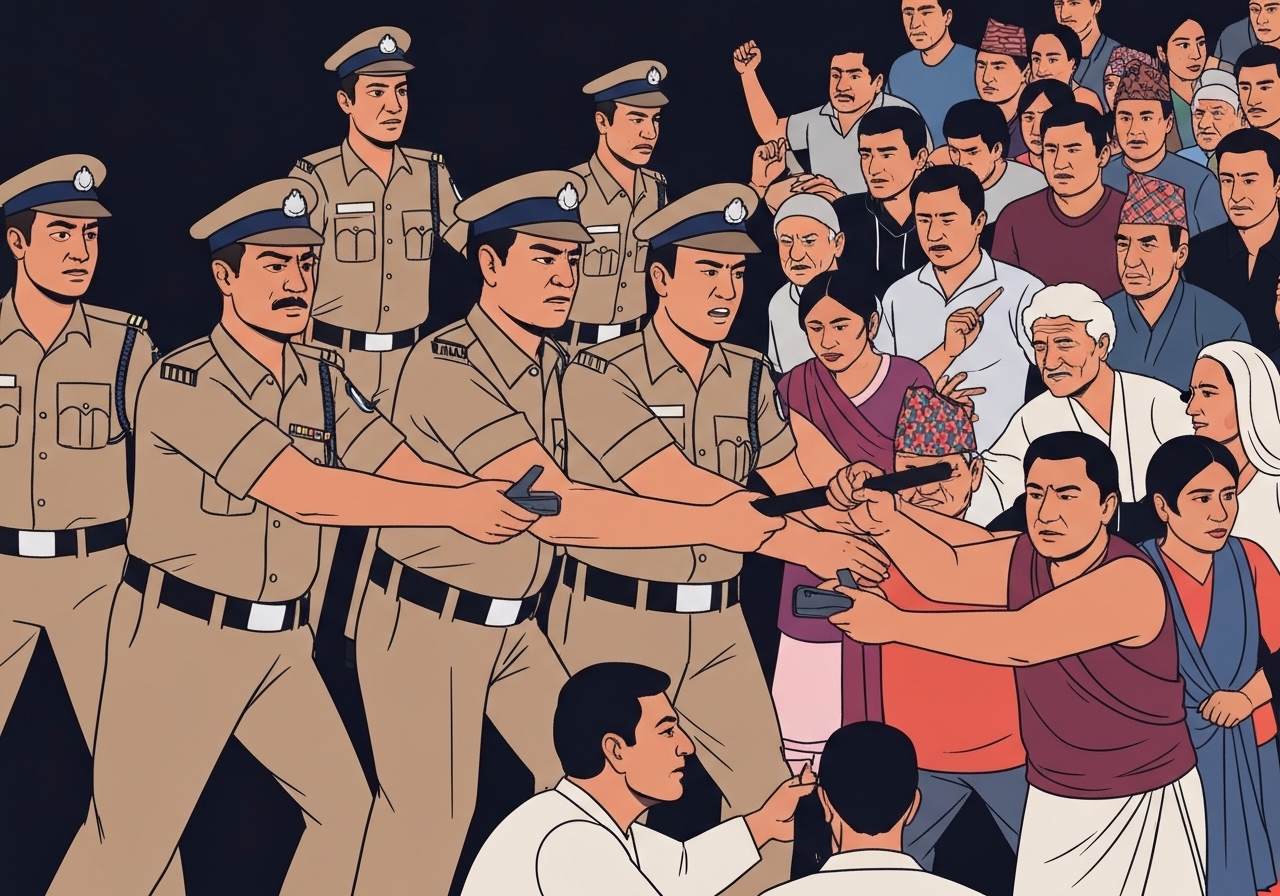
Lead: Police in Kathmandu opened fire on large street demonstrations on Monday, Sept. 8, 2025, after tens of thousands rallied against a government move to block and regulate major social media platforms. Officials say at least 17 people were killed and 145 wounded, including 28 police officers; a curfew was imposed around Parliament and other key sites. The unrest followed enforcement of a new registration requirement for tech platforms that critics call a bid to curb dissent online.
Key takeaways
- At least 17 people were killed and 145 injured in clashes in Kathmandu on Sept. 8, 2025, according to police announcements.
- The Nepal Police said 28 officers were among the wounded; seven of the dead and many of the injured were treated at the National Trauma Center.
- Tens of thousands gathered around the Parliament complex after authorities blocked major platforms such as Facebook, X and YouTube for failing to register locally.
- Protesters forced through barbed wire and pushed riot police back into the Parliament compound before gunfire erupted.
- The government has ordered a curfew covering Parliament, the government secretariat, the presidential residence and other parts of Kathmandu.
- The regulation requires foreign platforms to register a local presence or liaison; TikTok, Viber and three other apps reportedly complied and continued operating.
- Human rights groups and opposition figures have described the law as a potential tool for censorship and silencing critics online.
Background
Nepal’s government has pursued a new social media oversight law that demands international platforms register locally, designate points of contact and comply with content directives. Officials argue the rules are needed to hold companies accountable, reduce harmful content and enforce local law. The measure comes after repeated notices to roughly two dozen platforms that the government says failed to register; those firms have been blocked since the previous week.
Rights groups, opposition politicians and many users have warned the proposal could be used to stifle dissent, restrict free expression and grant authorities sweeping takedown powers. The controversy follows a 2023 temporary ban on TikTok for what the government called threats to “social harmony,” a ban later lifted after platform assurances. Digital rights advocates say the new approach mirrors a global trend of states seeking greater control over online speech.
Main event
On the morning of Sept. 8, demonstrators — many of them young people described by organizers as the “Gen Z” protest — converged on the area surrounding Nepal’s Parliament in central Kathmandu. Witnesses and video circulated online showed crowds pushing past multiple police cordons and tearing through barbed wire lines erected around the legislative compound.
Riot police responded with water cannon and what observers described as increasingly aggressive crowd-control measures. According to police statements, at some point officers fired shots; the sequence and authorization for use of live ammunition remain disputed. Medical staff at the National Trauma Center reported that several victims arrived with gunshot wounds to the chest and head.
Police official Shekhar Khanal announced the death toll and the broader casualty figures late Monday as tensions continued into the evening. Authorities moved to impose a broad curfew around Parliament, the government secretariat, the presidential house and other central neighborhoods and deployed additional forces to secure official buildings.
Platform companies contacted for comment did not immediately reply to media requests. Government spokespeople defended enforcement of the registration notice as compliance with domestic law; critics countered that blocking widely used services inflamed public outrage and disrupted information flows during the unrest.
Analysis & implications
The deadly confrontation marks one of the most serious recent clashes over digital policy in South Asia and signals escalating stakes when states seek to bring global platforms under local control. If governments perceive persistent noncompliance, they may resort to blocking services — a tactic that can provoke mass mobilization in digitally connected populations.
Domestically, the toll of bloodshed could deepen political polarization and weaken the government’s legitimacy, particularly among younger voters who rely on social networks for news and organization. Internationally, the episode may draw scrutiny from rights organizations and heighten concerns among foreign investors about political stability and regulatory unpredictability in Nepal.
For platforms, the incident poses a dilemma: comply with demanding local rules that may erode content standards and user trust, or risk being blocked and cut off from markets. The long-term effect could be a patchwork internet where global platforms operate under highly variant national rules, complicating content moderation, data flows and business models.
Comparison & data
| Metric | Reported figure |
|---|---|
| Fatalities (Sept. 8, 2025) | 17 |
| Injured | 145 |
| Police officers wounded | 28 |
| Dead received at National Trauma Center | 7 |
| Platforms reportedly blocked | Facebook, X, YouTube (+ others) |
The numbers above summarize official tallies released by police and hospital sources on Sept. 8, 2025. Emergency units reported that many injured required urgent surgery and blood donations were solicited at city hospitals. Historical comparisons show that while Nepal has seen street unrest tied to politics and labor disputes, mass protests directly triggered by tech regulation have been uncommon until recently.
Reactions & quotes
Officials and medical staff provided brief public remarks as the situation evolved; independent groups and protesters voiced strong criticism of the regulation and the force used.
The casualty figures announced are a grave matter; multiple patients arrived with wounds to the head and chest and many remain critical.
Dr. Badri Risa, National Trauma Center (medical official)
Police framed their actions as crowd control in the face of escalating disorder, while emphasizing the need to enforce the law on foreign platforms.
We regret the loss of life, but the police acted to restore order after demonstrators breached secured perimeters around the Parliament complex.
Shekhar Khanal, Nepal Police (police official)
Protest organizers and civil society groups described the regulation and the blocking of services as a disproportionate response that provoked the rallies.
The government’s moves to block services and force registration are an attack on free expression that led directly to today’s unrest.
Opposition organizer / digital rights group representative
Unconfirmed
- Whether live ammunition was authorized by senior command remains unverified; official rules of engagement have not been publicly posted.
- Exact identities and ages of all fatalities have not been released, and full victim tallies may change as hospitals report.
- Claims circulating on social media that foreign actors instigated the protests have not been substantiated.
Bottom line
The deaths in Kathmandu illustrate how contentious technology policy can rapidly become a flashpoint in political life, especially where trust in institutions is fragile and youth mobilization is high. The government’s enforcement strategy has moved the conflict from regulatory debate to public security crisis, raising urgent questions about proportionality, accountability and oversight of force.
In the near term, expect heightened tensions, possible legal challenges, and international attention from rights monitors. Longer term, the episode could accelerate a regional trend toward fragmented internet governance, complicating how platforms, users and states interact across borders.