
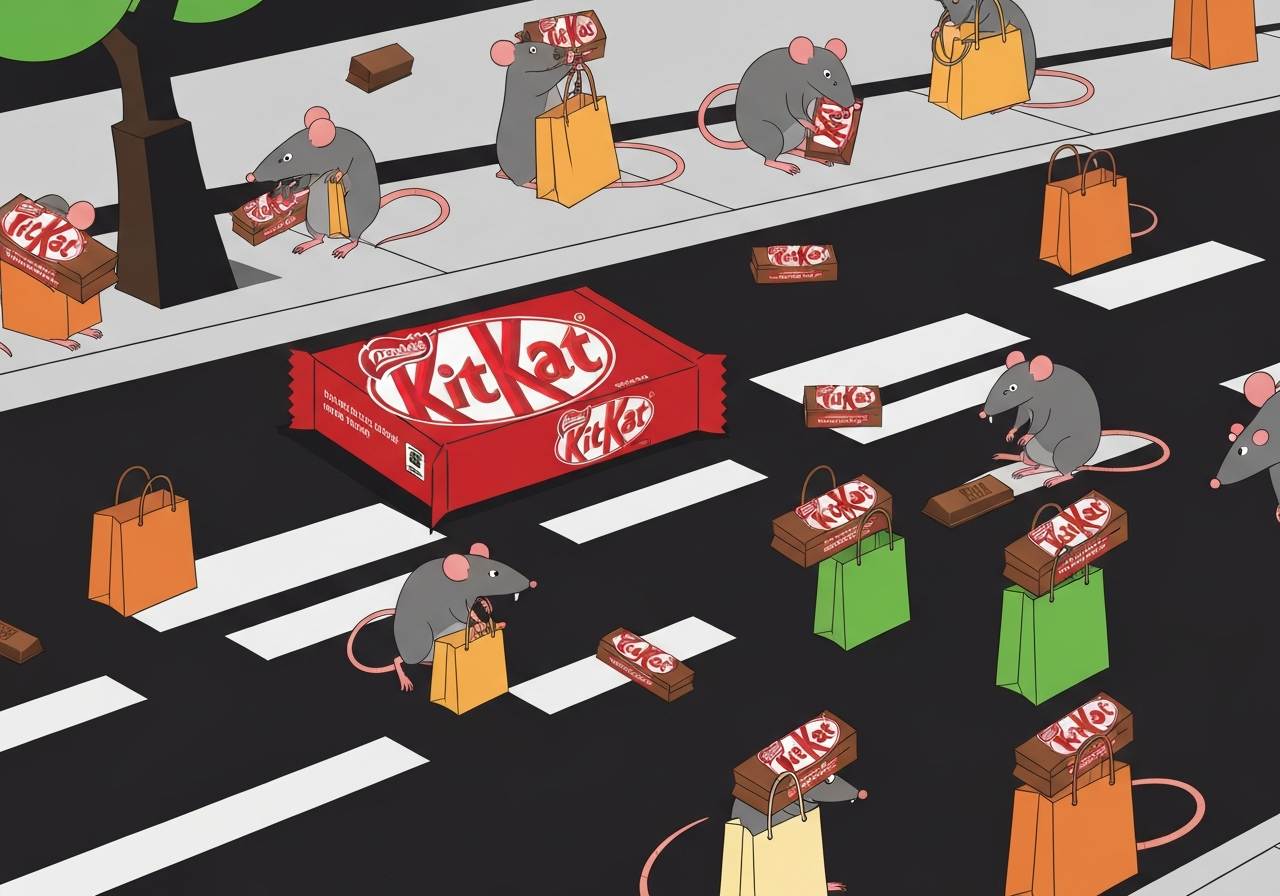
Lead: Nestle announced on Saturday that approximately 12 tonnes of KitKat chocolate — about 413,793 bars from a new product range — were taken last week from a truck that departed a production site in central Italy en route to Poland. The vehicle and cargo were reported missing as of Saturday afternoon, and the company warned the loss could cause localized shortages and the risk of the bars appearing in unofficial sales channels. Nestle said each bar carries a batch code that could be used to trace any illicit resale.
Key Takeaways
- About 12 tonnes (roughly 12,000 kg) of KitKat chocolate were stolen; Nestle reports 413,793 bars were in the shipment.
- The truck left a production facility in central Italy and was bound for Poland when it disappeared last week; exact location was not disclosed.
- As of Saturday afternoon the vehicle and products remained unlocated, according to Nestle’s statement on Saturday.
- Nestle warned the theft may create temporary shortages of the affected KitKat range on some European supermarket shelves.
- Each bar carries a unique batch code; Nestle says matching codes would allow the company to identify and report illicit sales.
- Company highlights cargo theft as an increasing problem, urging greater awareness and security across supply chains.
Background
Cargo theft has been a mounting concern for food and consumer-goods companies operating across Europe, where multi-country distribution routes and large-volume shipments create recurring opportunities for organized theft. Manufacturers and carriers have been investing in tracking hardware, route planning and tighter loading protocols, but thieves have adopted increasingly sophisticated tactics that can defeat basic safeguards.
KitKat — a wafer-based chocolate bar produced by Nestle — frequently ships in high-volume pallets destined for retail networks across the continent. Large shipments of snack products are lucrative to criminals because individual items are easy to repackage and resell through informal markets or online channels. Nestle’s public disclosure aims to draw attention to the broader security issue while alerting partners and consumers to the possibility of illicitly traded stock.
Main Event
According to Nestle, the shipment left its central-Italy production facility last week and was headed to distribution points in Poland when the truck vanished. The company reported the loss on Saturday, providing the tally of roughly 413,793 bars in the missing consignment and estimating the total weight at about 12 tonnes. Nestle did not disclose the precise location where the vehicle was last seen or the carrier involved.
The company warned that the missing bars could surface through “unofficial sales channels,” and said it would use batch-code scanning to detect any recovered or resold units tied to the stolen shipment. Nestle described the decision to go public as a way to raise awareness about an escalation in cargo theft incidents affecting firms of varying sizes.
Local authorities and logistics partners were notified, the company said, and retailers were urged to report any suspicious offers of the affected product. As of the company’s Saturday statement, the truck and the merchandise remained unlocated and there was no public information on suspects or arrests.
Analysis & Implications
Financially, the direct value of 12 tonnes of KitKat is only part of the impact. Retailers might face short-term stock gaps for the specific range affected, which could lead to substitution purchases, temporary price fluctuations in some stores, or accelerated orders from alternate production runs. For a major brand like KitKat, brand-protection and consumer safety concerns are also central: illicitly handled food raises quality-control risks.
Traceability via batch codes offers a practical mitigation route: if stolen bars enter resale networks and are scanned or inspected, a match could provide evidence to alert retailers and law enforcement. However, the effectiveness of batch-code tracing depends on cooperation from distributors, point-of-sale systems, and secondary-market platforms where stolen goods may be offered.
At the supply-chain level, the theft underscores persistent vulnerabilities in over-the-road freight: predictable routes, unsecured parking, and inconsistent carrier vetting create windows of opportunity for theft. Companies may respond by tightening route variability, adding real-time GPS monitoring, increasing secure parking use, and elevating verification steps at transfer points.
Comparison & Data
| Metric | Value |
|---|---|
| Reported total weight | ~12 tonnes (≈12,000 kg) |
| Number of bars | 413,793 bars |
| Average weight per bar | ≈29 g (12,000,000 g ÷ 413,793) |
| Origin | Production facility in central Italy |
| Destination | Poland |
The per-bar calculation (≈29 grams) aligns with typical single-portion KitKat weights, which helps validate the arithmetic between total tonnage and number of bars reported. Compared with a standard full trailer load, 12 tonnes is a partial load — sufficient for hundreds of retail pallets — meaning the theft could affect availability across numerous outlets depending on how the stock was distributed.
Reactions & Quotes
“We’ve always encouraged people to take a break with KitKat—unfortunately, some individuals appear to have taken that message literally at significant cost,”
KitKat brand spokesperson (Nestle)
Nestle used light wording to underscore the seriousness of the loss while signaling intent to trace and report illicit sales. The company framed the disclosure as partly preventive, urging vigilance among retailers and consumers.
“Cargo theft is rising across Europe, driven by opportunistic and organised groups that target predictable, high-volume shipments,”
Logistics security expert
Security practitioners note that criminals often follow patterns in logistics operations; experts recommend layered defences including route randomization and enhanced in-transit monitoring to reduce exposure.
“Retailers should be alert to unusually low-priced offers or non-standard packaging for known items and verify batch codes where possible,”
Retail trade association spokesperson
Trade bodies advising stores said rapid reporting and refusal of suspicious consignments help limit the market for stolen goods.
Unconfirmed
- The exact location and route point where the truck went missing has not been disclosed publicly.
- No suspects or arrests have been announced in connection with the theft as of the company statement on Saturday.
- Whether any of the stolen KitKat bars have entered informal resale channels is not yet confirmed.
Bottom Line
The reported theft of roughly 12 tonnes of KitKat bars underscores both the financial allure of food cargo and the practical vulnerabilities that persist in European logistics. While the direct loss may be confined to a single shipment, the incident highlights systemic risks that can produce localized product shortages and reputational challenges for brands.
Traceability via batch codes gives Nestle a tangible tool to identify stolen items if they resurface, but authorities, retailers and online marketplaces must cooperate to be effective. Companies and regulators are likely to press for stronger in-transit safeguards and swifter information-sharing to reduce the chance of similar incidents recurring.