
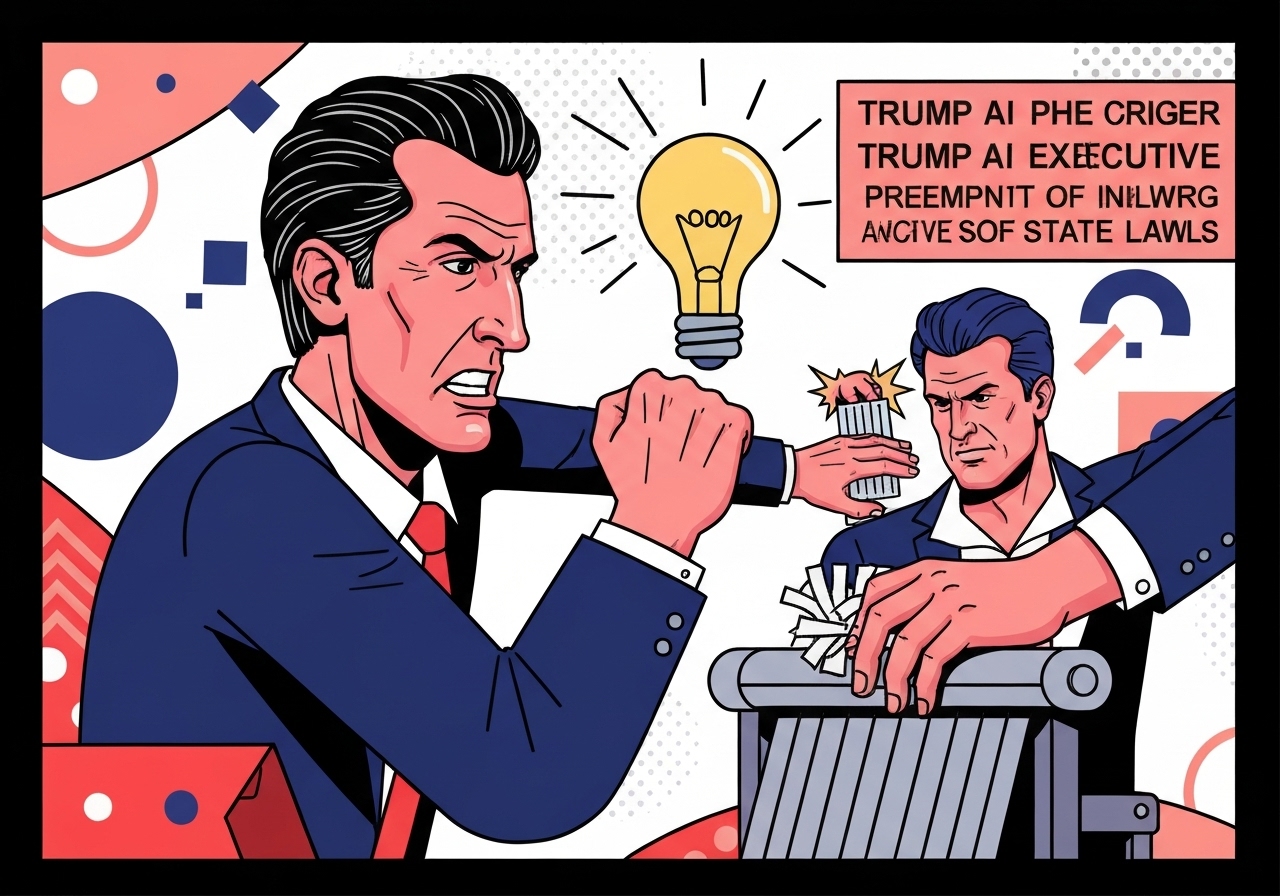
California governor Gavin Newsom immediately denounced President Donald Trump’s new artificial intelligence executive order hours after it was released on Thursday evening, saying the federal directive — which seeks to block state-level AI rules — advances “grift and corruption” rather than public safety or innovation. Newsom framed the measure as an attempt by the federal administration and private advisers to override states that are already writing their own AI safeguards. The order has been hailed by major technology firms as a way to remove a patchwork of state rules, but it has also triggered rapid protests from state officials, child-safety groups, unions and other advocates. The clash sets the stage for litigation and political conflict between California and the White House over the future of AI governance.
Key takeaways
- President Trump signed an executive order that seeks to preempt state AI laws and establish a federal taskforce to review and challenge state statutes; the order was released Thursday evening.
- Governor Gavin Newsom publicly called the order corrupt and vowed to resist preemption, positioning California for a legal and political response.
- California’s September law — the Transparency in Frontier Artificial Intelligence Act — requires frontier model makers to file transparency reports and report safety incidents, with fines up to $1 million for violations.
- The executive order directs an AI litigation taskforce to target state laws deemed not to “enhance the United States’ global AI dominance,” and it contemplates withholding federal broadband funds as leverage.
- Immediate backlash came from child-safety organizations, unions (including the AFL-CIO), members of Congress such as Rep. Sara Jacobs and Senators Alex Padilla and Adam Schiff, and some bereaved families advocating for stricter protections.
- California Attorney General Rob Bonta indicated his office will examine the order’s legality, foreshadowing potential court challenges that could set federalism precedents.
- Supporters in industry view the order as clearing regulatory obstacles; critics call it a tech-friendly shortcut that undermines state experiments in consumer protection and safety.
Background
The debate over AI regulation has accelerated as powerful models have expanded into consumer and critical infrastructure use. States such as California have moved to legislate protections where no comprehensive federal framework yet exists; the Transparency in Frontier Artificial Intelligence Act signed by Governor Newsom in September is one prominent example. That law targets developers of the most powerful models — so-called “frontier models” — requiring disclosure of model provenance and prompt reporting of safety incidents, with penalties up to $1 million for noncompliance. Across the country, lawmakers and advocates have proposed a range of state-level responses addressing harms from AI, from consumer safety and labor impacts to child protection.
At the federal level, policymakers have debated a national approach but so far stopped short of a single, binding regulatory code that would preempt state measures. Earlier in the year, attempts to insert moratorium-like language into federal bills failed amid bipartisan opposition. The executive order that Trump signed replaces those legislative efforts with executive action that aims to harmonize rules by constraining state autonomy. Tech companies that lobbied against state-by-state regulation have welcomed the move as removing compliance burdens, while advocacy groups warn it may leave significant safety gaps.
Main event
The executive order directs executive-branch officials to create an AI litigation taskforce to review state laws and identify statutes that, in the administration’s view, do not “enhance the United States’ global AI dominance.” The taskforce will consult with the administration’s AI and crypto adviser and may pursue litigation or other federal levers — including the potential withholding of federal broadband funds — to challenge states. The order frames preemption as a path to streamline regulation and accelerate U.S. competitiveness in AI deployment.
Within hours, Governor Newsom issued a sharply worded statement accusing the president and his adviser David Sacks of running a “con” and of placing industry interests above public safeguards. California leaders, including Senator Alex Padilla and Representative Sara Jacobs, described the order as an attack on state leadership and a threat to protections that their constituencies have pushed for over the last year. Attorney General Rob Bonta had previously signaled in November that his office would scrutinize any federal effort to undercut state AI legislation, preparing a possible legal challenge.
Other elected officials and union leaders echoed those concerns. Senator Adam Schiff criticized the effort as an attempt to replace emerging state-level safeguards with an absence of meaningful federal protections, while AFL-CIO president Liz Shuler said the order amounts to handing unchecked power to major tech companies. Even some figures aligned with the administration publicly questioned aspects of the plan; Steve Bannon reportedly criticized adviser David Sacks’ guidance on preemption.
Child-safety organizations and a coalition of bereaved parents were among the earliest civil-society voices to object. Groups such as Common Sense Media and Heat Initiative called the order unacceptable, arguing it would undercut efforts to protect children from harmful social-media and chatbot interactions. Those groups cited recent lawsuits and tragic cases involving children and AI-driven platforms as evidence that stronger rules — not blanket preemption — are necessary.
Analysis & implications
Legally, the order raises classic federalism questions: whether and how an executive order can preempt state statutes in areas where Congress has not enacted a comprehensive national regime. Courts typically examine preemption claims by reference to congressional intent; an executive order substituting for legislative action faces an uphill, novel path that legal scholars expect will attract expedited challenges. California’s prior legislative moves and its attorney general’s stated intent to litigate suggest the state will be a lead plaintiff in any constitutional contest.
Politically, the move aligns the administration with major technology firms that have lobbied for uniform, industry-friendly rules. That alignment may reduce compliance costs and speed product rollouts, but it also concentrates regulatory authority in the executive branch and — critics argue — risks prioritizing commercial scale over consumer and worker protections. Union objections highlight concerns about job displacement and labor rights in AI-driven workplaces; business arguments emphasize predictability and a single regulatory locus.
On public safety and child-protection fronts, preemption could blunt state-level experiments aimed at reducing pathologies such as exploitative recommendation systems or unsafe chatbot interactions. Advocates for tighter rules say the absence of demonstrably strong federal standards means preemption would remove safeguards without delivering any replacement safety net. This debate implicates not only policy trade-offs but also the short-term public trust that regulators and technology companies need to maintain broad adoption of AI capabilities.
Internationally, a U.S. move toward centralizing AI policy could influence other countries’ approaches and multinational firms’ compliance strategies. If the federal posture favors rapid deployment and permissive standards, other governments might adopt either harmonized permissive rules or, conversely, stricter national barriers to protect citizens—raising fragmentation risks in global AI governance.
Comparison & data
| Feature | California (Sept law) | Trump executive order |
|---|---|---|
| Scope | “Frontier models” developers; transparency and safety reporting | Broad federal review of state AI laws for preemption |
| Enforcement | State enforcement with fines up to $1,000,000 | Federal litigation taskforce; potential funding penalties |
| Penalties | Fines, compliance mandates | Legal challenges and possible withholding of federal funds |
| Primary aim | Transparency and incident reporting to protect safety | Streamline regulation, boost U.S. AI competitiveness |
The table contrasts California’s statutory approach — focused on transparency, incident reporting and enforceable fines up to $1 million — with the executive order’s mechanism of federal review and potential preemption. California relies on statutory authority and direct penalties against developers; the order relies on executive-led litigation and funding levers to induce uniformity. These are distinct policy tools with different legal foundations and immediate practical effects for companies operating in multiple states.
Reactions & quotes
Governors, members of Congress and advocacy groups responded quickly; the quotes below capture the tenor of the pushback and the rationale behind it.
“President Trump and David Sacks aren’t making policy — they’re running a con. Every day, they push the limits to see how far they can take it.”
Governor Gavin Newsom (statement)
Newsom’s statement framed the order as an industry-driven gambit that threatens state-led safety work. He positioned California as prepared to defend its laws in court and as intent on maintaining its role as a model for balanced AI policy.
“This executive order is deeply misguided, wildly corrupt, and will actually hinder innovation and weaken public trust in the long run. We will explore all avenues — from the courts to Congress — to reverse this decision.”
Representative Sara Jacobs (statement)
Rep. Jacobs emphasized both legal and legislative remedies, indicating a dual-track response that could include court filings and congressional pressure. Her language underscores how some lawmakers view preemption as a threat to consumer and civic protections.
“The AI industry’s relentless race for engagement already has a body count, and, in issuing this order, the administration has made clear it is content to let it grow.”
James Steyer, CEO, Common Sense Media (advocacy group)
Child-safety advocates used strong rhetoric to stress the human costs they associate with unregulated or insufficiently regulated AI systems. Their statements signal sustained advocacy campaigns aimed at preserving or strengthening state authority to regulate platforms that affect minors.
Unconfirmed
- Claims that the taskforce will definitively withhold federal broadband funds from specific states are not yet documented; the order contemplates the option but operational details and legal feasibility remain unclear.
- Allegations that particular tech executives bribed or directly paid the president to secure the order are political assertions reported by some critics; there is no publicly verified evidence provided in the sources reviewed here.
- Reports that the order will immediately halt all state enforcement actions are premature; the order signals intent to challenge state laws but does not automatically suspend existing state statutes.
Bottom line
The executive order crystallizes a high-stakes contest over who sets AI rules in the United States: state legislatures aiming to protect consumers, children and workers, or a federal administration seeking uniformity and industrial advantage. California — with its September transparency law and vocal officials — is likely to be at the center of this dispute, both politically and in the courts. Legal experts expect a rapid series of challenges that will test the limits of executive authority to shape domestic regulation in the absence of comprehensive congressional action.
For businesses, the immediate effect may be uncertainty about compliance obligations across states while litigation unfolds. For advocates and the public, the episode highlights the trade-offs between harmonized national rules and the ability of states to act as laboratories for stricter safety and accountability measures. Watch for fast-moving court filings, continued legislative responses at the state level, and public campaigns from both industry and civic groups in the coming weeks.
Sources
- The Guardian (news)