
Lead
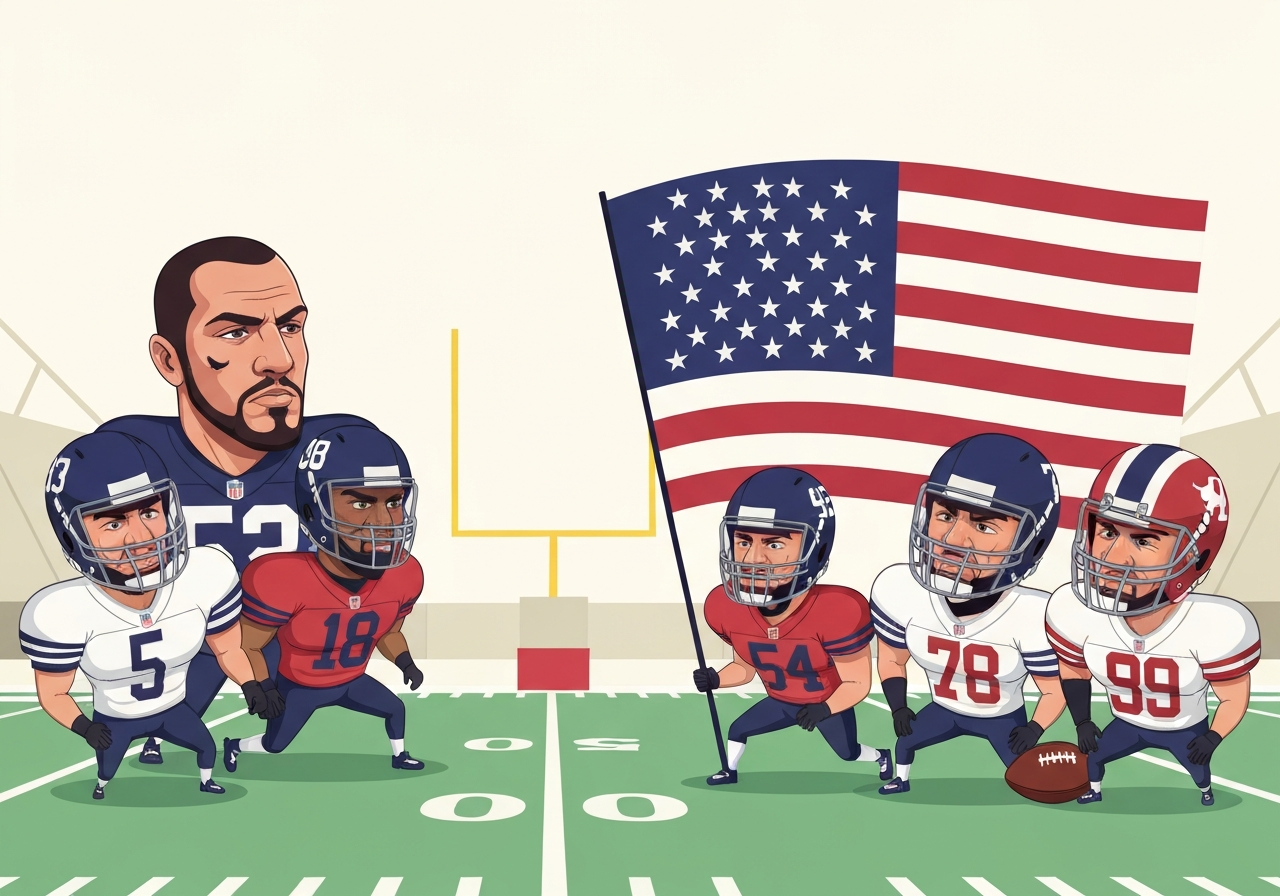
In a recent exhibition matchup, current and former NFL players faced the U.S. men’s national flag football team and trailed 19-6 at halftime. The Wildcats—captained by Joe Burrow and Jayden Daniels—struggled early as the U.S. unit executed clean flag-game fundamentals and drew multiple penalties. Darrell “Housh” Doucette III accounted for a touchdown for the U.S. side and stirred a confrontation with non-football celebrity Logan Paul during the first half. Two plays after the sunglasses incident, a Burrow pass was intercepted and returned for a score, underscoring the NFL players’ adjustment problems.
Key Takeaways
- The U.S. men’s flag team led 19-6 at halftime in the exhibition match against a Wildcats roster captained by Joe Burrow and Jayden Daniels.
- Wildcats’ initial possession failed to produce a first down; the U.S. team marched downfield on its opening series.
- Officials called multiple excessive-contact penalties on the Wildcats, and an illegal-contact penalty accompanied Doucette’s rushing touchdown.
- Darrell “Housh” Doucette III scored a rushing touchdown and was involved in a sideline altercation when Logan Paul removed and threw his sunglasses, drawing a foul.
- An interception on a Burrow pass was returned for a touchdown two plays after the sunglasses incident.
- Joe Burrow later connected on a long touchdown to DeAndre Hopkins, who made a contested one-handed catch to spark the Wildcats.
- Observers noted NFL skill sets—size, speed, power—do not automatically translate to flag football fundamentals like clean flag pulls, lateral spacing, and contact discipline.
- Any NFL-led effort to field a U.S. Olympic flag team for 2028 will require substantial, focused training on rules and tactics.
Background
Flag football differs from tackle football in several core ways: it penalizes physical tackling, emphasizes flag removal, and enforces stricter limits on contact. Those rule differences produce distinct positional priorities—route precision, quick hands, consistent flag-pulling technique and officiating sensitivity to contact. The exhibition was staged in a context where flag football’s profile is rising and nontraditional athletes and entertainers have increasingly participated in high-profile showcase events. That mix of professional football veterans, crossover athletes and public figures raises questions about how quickly players can adapt to a sport with a separate rulebook and different officiating thresholds.
NFL players, by training and habit, are conditioned for collision football: pad technique, block engagement, and tackling fundamentals. Flag football rewards different instincts—avoidance of contact, quicker lateral footwork, and refined hand techniques to both pull flags and protect them. For teams evaluating talent for potential international competition, selectors must weigh raw athletic traits versus sport-specific skill acquisition. The exhibition therefore functioned as both entertainment and a practical audit of how transferable tackle-football skills are to a flag format.
Main Event
The Wildcats opened the game and failed to secure a first down; the U.S. side answered by driving efficiently, exploiting spacing and disciplined flag pulls. Officials flagged the Wildcats repeatedly for excessive contact during the U.S. opening drive, slowing their momentum and pushing them into disadvantaged field position. Darrell “Housh” Doucette III finished a U.S. drive with a running touchdown that was accompanied by another illegal-contact penalty, then engaged in verbal back-and-forth with Logan Paul on the sideline.
Paul escalated the sideline exchange by removing Doucette’s sunglasses and throwing them back toward the field, an act that drew an additional foul against the Wildcats contingent. Two plays later, a pass intended for a Wildcats receiver off Joe Burrow was intercepted and returned for a touchdown, cutting through the visitors’ attempts to regain control. The pick-six highlighted communication breakdowns and a learning curve on how to defend within flag rules without converting routine contact into penalties.
The Wildcats eventually answered: Joe Burrow connected on a deep passing play to DeAndre Hopkins, who used superior body positioning to box out a defender and secured the catch with one hand. That drive demonstrated that traditional pass-catch skill still matters in flag football, but the game remains unforgiving when players revert to tackle-era contact habits. By halftime the scoreboard read 19-6 for the U.S. men’s flag team, reflecting a mixture of decisive U.S. execution and the Wildcats’ unfamiliarity with rule enforcement.
Analysis & Implications
The contest underlined that athleticism alone does not guarantee success in flag football; technique and rule fluency are central. NFL players typically operate within a contact framework and often default to blocking and tackling instincts that are penalized in flag play, especially around the line of scrimmage and in contested catches. Converting NFL talent into elite flag performers requires targeted practice on flag-pulling drills, spacing offense, and contact discipline—tasks that cannot be completed in a brief training camp.
From a selection and development viewpoint, organizations aiming to field a competitive U.S. flag team will need to establish specialized coaching pipelines. That includes rule-focused officiating sessions, film study that highlights legal versus illegal contact in flag contexts, and positional retuning—quarterbacks and receivers must refine timing to smaller windows, while defenders must prioritize clean flag removals and positioning. For players considering a switch, coaches should evaluate not only physical traits but adaptability to quick, non-contact play and decision-making under different officiating standards.
Commercially and culturally, high-profile exhibitions that pair NFL names and celebrities with elite flag units accelerate public interest but also expose gaps in preparation. If the sport broadens its international profile—potentially including Olympic-level showcases—governing bodies and professional leagues must define pathways that balance publicity with credible competition standards. Without structured development, marquee exhibitions risk producing misleading impressions about cross-sport readiness and could slow long-term competitive growth.
Comparison & Data
| Metric | First Half |
|---|---|
| Score | U.S. team 19 — Wildcats 6 |
| Interception returned for TD | 1 (off a Burrow pass) |
| Penalties (Wildcats) | Multiple excessive/illegal-contact calls (game report) |
The table above summarizes confirmed first-half items: the halftime score (19-6), the interception returned for a touchdown, and the presence of multiple contact penalties against the Wildcats. Those events were decisive in the opening 30 minutes: penalties repeatedly stalled the Wildcats’ drives and directly affected field position and scoring opportunities. While exact penalty counts and full statistical boxscore were not published in the original report, the qualitative pattern—U.S. discipline versus Wildcats’ contact infractions—was clear.
Reactions & Quotes
“Flag football asks for different instincts — clean hands and disciplined spacing,”
U.S. men’s flag team coach (postgame summary)
The U.S. team coach framed the victory as a confirmation of fundamentals rather than physical mismatch; the team emphasized execution of non-contact techniques. That perspective explains why the U.S. side repeatedly drew penalties on the Wildcats, turning infractions into field-position advantages.
“We’ve got to rework some habits and study the rulebook; this was a wake-up call,”
Wildcats coaching staff (postgame assessment)
The Wildcats’ staff acknowledged the adjustment gap and placed responsibility on preparation—pointing to the need for targeted drills to eliminate illegal contact and refine flag-specific defense.
“Fans are surprised watching so many big names adapt slowly to a very different game,”
Sports analyst (social media commentary)
Public reaction ranged from surprise to curiosity; many viewers praised the athleticism on display while noting the educational value of such exhibitions for both players and audiences.
Unconfirmed
- Whether any of the NFL players in the exhibition will be selected to represent the United States in future Olympic-level flag football competition remains undecided and unannounced.
- The full, official boxscore (total penalty counts, snap-by-snap charting) was not published with the initial report; some penalty totals are described only as “multiple” in media coverage.
- Longer-term plans for a formal training program linking NFL athletes to the U.S. flag program have not been publicly detailed or confirmed by governing bodies.
Bottom Line
This exhibition made a clear point: elite tackle-football experience provides athletic upside, but flag football demands a distinct set of technical skills and rule awareness. The U.S. men’s flag team converted fundamental advantages—clean flag pulls, spacing discipline, and fewer penalties—into a 19-6 halftime lead over a Wildcats roster featuring high-profile NFL names.
For teams or players aiming at international competition or Olympic ambitions, investing in sport-specific coaching, extended training camps, and officiating education will be essential. The crossover appeal of marquee exhibitions is valuable for exposure, but converting that attention into competitive readiness requires serious, sustained commitment.
Sources
- NBC Sports — media report summarizing the exhibition (original coverage and play-by-play highlights)