
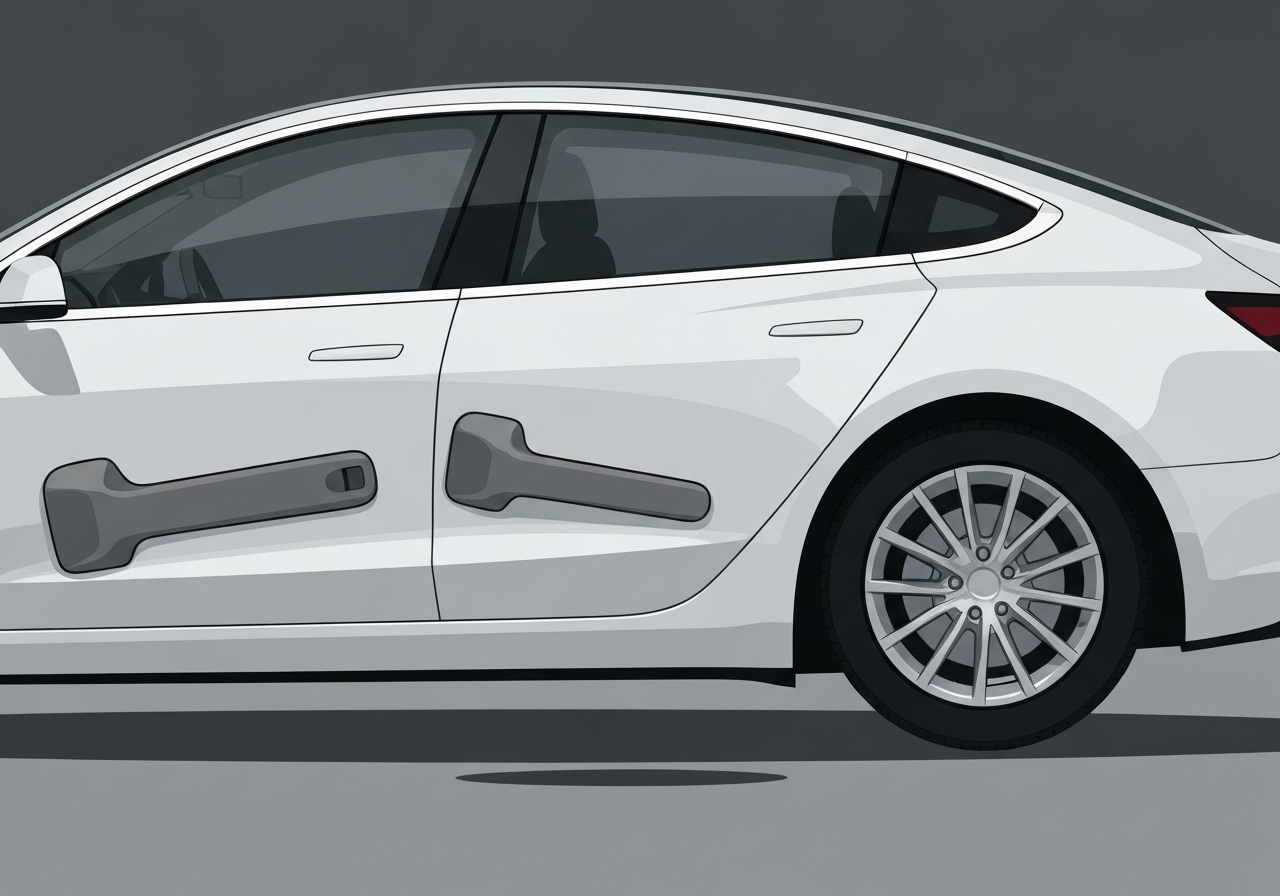
U.S. safety regulators have opened an investigation into the emergency door-release mechanism on certain Tesla Model 3 vehicles after a consumer complaint. The National Highway Traffic Safety Administration (NHTSA) said on Dec. 23 that it received a report alleging the mechanical release is “hidden, unlabeled and not intuitive” during an emergency. The owner said he escaped a 2022 Model 3 fire through the rear window, prompting the agency to review the design and accessibility of the release. The probe targets roughly 179,000 Model 3 cars from the 2022 model year as listed in the NHTSA filing.
Key Takeaways
- The NHTSA filed the investigation on Dec. 23, 2025, following a complaint about Model 3 emergency door handles.
- About 179,000 Tesla Model 3 vehicles from the 2022 model year are included in the review.
- The complainant said the mechanical release was “hidden, unlabeled and not intuitive,” and reported escaping via the rear window after a fire.
- Tesla had not provided an immediate comment to the agency or reporters at the time of the filing.
- The Model 3 has been scrutinized previously: a 2023 Tacoma crash and related court filings cited door-handle access issues during rescue attempts.
- News reports have linked multiple fatal incidents over roughly a decade where rescuers or occupants could not open Tesla doors after collisions and fires.
Background
Regulatory scrutiny of vehicle occupant egress mechanisms has grown as new automotive designs shift away from traditional, manual controls. Electric and flush-mounted components—common in many modern cars for aerodynamic and aesthetic reasons—can complicate rescue procedures if they fail or lack clear manual overrides. For vehicles with power-assisted or motorized door systems, first responders rely on clearly labeled mechanical releases that are easy to find under stress.
The Tesla Model 3, introduced in 2017 as the company’s mass-market sedan, has drawn attention in several high-profile incidents. In 2023, a crash in Tacoma, Washington, involved allegations of unintended acceleration and asserted difficulties with door access that hampered rescue efforts; court filings from that case were cited in later reporting. Safety officials and consumer advocates say repeat reports of occupants or rescuers unable to locate manual releases merit formal review to determine whether a design or labeling deficiency exists.
Main Event
On Dec. 23, 2025, the NHTSA posted an online filing documenting receipt of a complaint from a Tesla owner about the Model 3’s emergency mechanical door release. The filing quoted the owner’s description that the release was “hidden, unlabeled and not intuitive to locate during an emergency.” That complaint says the owner had to exit the vehicle through the rear window after a 2022 Model 3 caught fire.
The agency’s entry does not, at this stage, assert a safety defect; it opens a formal inquiry to gather information, evaluate the complaint against broader complaint data, and determine if further action—such as a recall—would be warranted. The scope listed in the filing covers approximately 179,000 vehicles from the 2022 model year, which aligns with production and registration figures for that model run.
Tesla had not provided an immediate response to requests for comment included in media reports tied to the filing. The company has previously contested some outside allegations in court and regulatory settings, while also updating software and hardware on various models in response to safety reviews and recalls.
Analysis & Implications
The investigation highlights a recurring regulatory challenge: balancing modern design priorities with the need for straightforward, fail-safe occupant egress. If investigators find that the mechanical release is difficult to locate or use under emergency conditions, regulators could press Tesla to revise labeling, user instructions, or the hardware itself. Any mandated fix on tens of thousands of vehicles would carry logistical and financial implications for the manufacturer.
From a public-safety perspective, unclear or poorly marked manual overrides increase risk when electronic systems are damaged in a crash or fire. First responders rely on predictable locations and standard mechanisms; deviations from expected designs slow rescue and can increase casualty risk. A formal NHTSA probe can lead to standardized guidance for automakers on the visibility and accessibility of manual releases in vehicles with power-assisted doors.
For Tesla owners and prospective buyers, the inquiry may raise concerns about usability and emergency preparedness. Even if the probe results in limited regulatory action, the company may opt for voluntary updates to owner manuals, in-vehicle prompts, or retrofit kits to reduce perceived risk. Conversely, a broad finding of no defect would underscore the importance of distinguishing single-incident complaints from systemic design failures.
Comparison & Data
| Item | Count / Year |
|---|---|
| Model 3 vehicles under review | ~179,000 (2022) |
| Noted prior fatal incidents linked in media | Reports cite multiple cases over ~10 years |
The table summarizes the primary numeric elements mentioned in the filing and subsequent reporting. The 179,000 figure is drawn from the NHTSA filing that opened the inquiry; media coverage has referred to multiple crash-and-fire incidents involving Teslas over the past decade, which underpin broader safety concerns but vary in cause and specific vehicle model.
Reactions & Quotes
“The mechanical door release is hidden, unlabeled and not intuitive to locate during an emergency.”
NHTSA filing (complainant summary)
This language appears in the NHTSA document that led to the agency’s review and frames the central usability allegation prompting the probe.
“I had to get out through the back window after the car caught fire.”
Owner interviewed on local Atlanta broadcast (summarized)
The owner’s account, reported to local media, is the event-level claim that initiated the complaint to NHTSA and highlights the personal safety concern at the center of the investigation.
“Reported instances where rescuers could not open doors after crashes and fires raise important questions about emergency egress design.”
Safety analyst (summary)
Independent safety experts emphasize that recurring access problems, if confirmed, have implications for first-responder protocols and design standards across the industry.
Unconfirmed
- Allegations that a specific design flaw caused unintended acceleration in the 2023 Tacoma crash are currently drawn from court filings and media summaries; causal responsibility has not been settled in all public records.
- The exact number of deaths linked to door-access failures in Tesla vehicles reported in media outlets varies by source and has not been independently verified here.
Bottom Line
The NHTSA’s Dec. 23 filing opens a formal review of about 179,000 2022 Tesla Model 3s following a complaint that the emergency mechanical door release is hard to find and use. That complaint—backed by an owner’s account of exiting via a rear window after a fire—has prompted the agency to collect information and assess whether a broader safety defect exists.
Outcomes could range from no further action to requirements for clearer labeling, owner-notification, or hardware changes. The inquiry also reinforces a broader policy discussion about how modern vehicle designs should preserve straightforward, standardized emergency egress to protect occupants and assist first responders.
Sources
- CBS News — media report summarizing the NHTSA filing and related incidents (news)
- National Highway Traffic Safety Administration (NHTSA) — official agency (regulatory filings and investigations)