
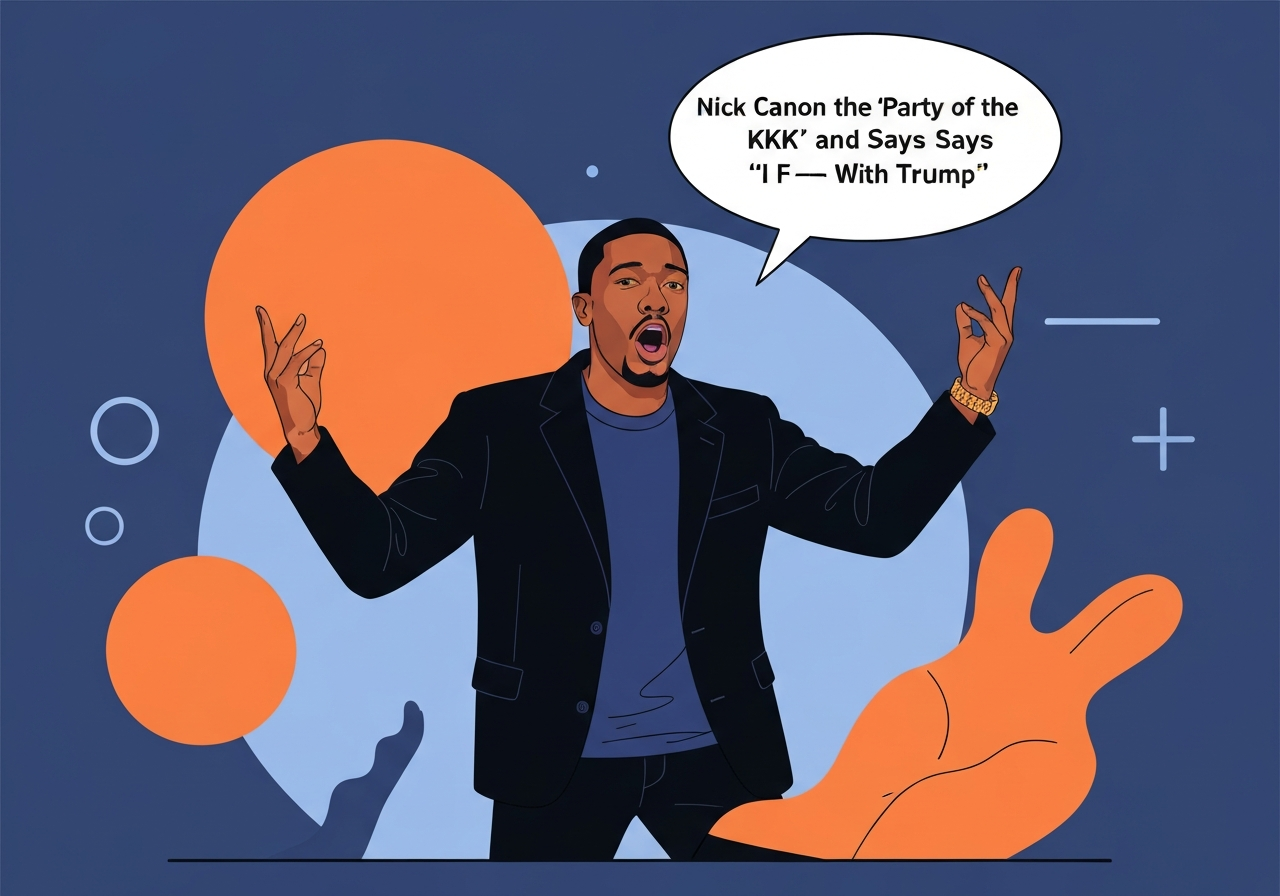
On a recent episode of his web talk show Big Drive, entertainer Nick Cannon told guest Amber Rose that he believes the Democratic Party is “the party of the KKK” and declared, “I f— with Trump,” while praising aspects of former President Donald Trump’s agenda. The exchange, first reported via TMZ and summarized in coverage by Yahoo News New Zealand, drew swift attention for its sharp historical claims and partisan endorsement. Cannon also argued that Republicans were the party that helped end slavery, a point he linked to 19th-century political history. The segment has prompted both fact-checking and debate about how historical facts are used in contemporary political commentary.
Key Takeaways
- Nick Cannon made his comments on his web show Big Drive; the episode was reported by TMZ and picked up by national outlets.
- Cannon said “the Democrats are the party of the KKK” and praised Donald Trump’s actions in a second term hypothetical.
- Historically, the Republican Party was founded in the early 1850s as an anti-slavery political movement; Abraham Lincoln issued the Emancipation Proclamation in 1863 and the 13th Amendment was passed by the House on January 31, 1865, later ratified December 6, 1865.
- The Ku Klux Klan emerged in the aftermath of the Civil War in 1865–1866 and was founded by former Confederate veterans and other local actors in parts of the postwar South.
- Cannon said he does not fully subscribe to either major U.S. party and cited thinker W. E. B. Du Bois to argue both parties are effectively one “evil party with two different names.”
- Public and expert responses have focused on the historical nuance missing from Cannon’s binary assertions about party responsibility for Reconstruction-era violence.
- Media coverage of the episode highlights the intersection of celebrity commentary and contested interpretations of 19th-century American political history.
Background
The post–Civil War era in the United States was a period of political realignment and intense social conflict. The Republican Party coalesced in the early 1850s around opposition to the expansion of slavery; by 1860 it had elected Abraham Lincoln, an event that intensified sectional tensions leading to the Civil War. After the war, Reconstruction (roughly 1865–1877) saw federal and state contests over voting rights, governance, and the integration of formerly enslaved people into political life.
During Reconstruction, groups of white supremacists formed paramilitary organizations that used terror to resist changes in Southern society. The Ku Klux Klan arose in this turbulent environment; historians note its founders were local actors in the defeated Confederacy who sought to restore white dominance through intimidation and violence. Over the following decades, party alignments and regional loyalties evolved: by the 20th century, both major parties’ coalitions and positions had shifted substantially compared with the 19th century.
Main Event
On the episode in question, model and activist Amber Rose discussed party allegiance and treatment of people of color. Cannon responded that he “agree[d] with you 100%” and asserted that “People don’t know that the Democrats are the party of the KKK,” while also saying “the Republicans are the party that freed the slaves.” He added that he does not formally subscribe to either major party and invoked W. E. B. Du Bois’s critique of American party politics to characterize both as variations of the same problem.
Cannon also spoke enthusiastically about a hypothetical second Trump term, saying the ex-president was “cleaning house” and “doing what he said he was gonna do,” and used a metaphor about charging an expensive entrance fee to describe immigration enforcement. The episode’s tone blended political commentary with celebrity banter, and the remarks were circulated widely on social platforms after TMZ reported the segment.
Media summaries have juxtaposed Cannon’s short, emphatic statements with historians’ more detailed accounts of Reconstruction and party history. While Cannon’s phrasing is provocative and aimed at a broad audience, historians caution that such shorthand risks conflating factions or eras and obscuring how party identities changed across more than a century.
Analysis & Implications
Cannon’s remarks are notable in two ways: they show how historical claims are deployed in popular political speech, and they test public understanding of complicated 19th-century realignments. Saying the Democratic Party is “the party of the KKK” simplifies a multifaceted historical record. Factions within the Democratic Party in the immediate postwar South did play roles in resisting Reconstruction, but the Klan’s origin and activity were local and clandestine rather than a formal, universally endorsed party program.
Similarly, crediting the Republican Party alone with “freeing the slaves” compresses a complex sequence of legal and political actions. The Emancipation Proclamation (issued by President Lincoln on January 1, 1863) declared freedom for slaves in rebelling states but did not end slavery nationwide; that required constitutional abolition via the 13th Amendment, which the House passed on January 31, 1865, and which was ratified by the states later that year (December 6, 1865).
For contemporary politics, simplified historical narratives can reinforce partisan identities and motivate audiences, but they can also polarize by framing debates in binary moral terms. Celebrity statements like Cannon’s circulate widely and may shape perceptions without the context historians provide, affecting discourse around voting, party loyalty, and civic memory.
For institutions and educators, the episode underscores the continuing need for accessible public history: short-form media commentary rewards bold, memorable lines, so historians and journalists face the challenge of supplying accurate context in formats that compete with viral soundbites.
Comparison & Data
| Event | Date | Relevant Fact |
|---|---|---|
| Republican Party founded | Early 1850s (1854 commonly cited) | Formed as an anti-slavery coalition |
| Emancipation Proclamation issued | January 1, 1863 | Declared freedom for slaves in rebelling states |
| 13th Amendment passed (House) | January 31, 1865; ratified December 6, 1865 | Abolished slavery nationwide once ratified |
| Ku Klux Klan origin | 1865–1866 | Formed by local actors in the postwar South; used terror tactics |
The table distills key dates and clarifies the sequence often compressed in modern political claims. The Republican Party’s founding in the 1850s, Lincoln’s 1863 proclamation, the legal abolition in 1865 via the 13th Amendment, and the Klan’s emergence after the war are distinct events that have been interconnected in public memory but should not be used interchangeably when attributing institutional responsibility.
Reactions & Quotes
“They don’t care about people of color and the Republicans do.”
Amber Rose, guest on Big Drive (as reported by TMZ)
Amber Rose’s comment sparked Cannon’s follow-up claim about the Democratic Party’s historical link to the KKK. That exchange framed the episode’s central controversy.
“People don’t know that the Democrats are the party of the KKK… I don’t subscribe to either party.”
Nick Cannon, host of Big Drive (as reported by TMZ)
Cannon paired historical assertions with a personal distancing from formal party membership, using W. E. B. Du Bois’s critique to justify skepticism of the two-party system.
“The Ku Klux Klan originated in the post–Civil War South as a violent vigilante group.”
Encyclopaedia/Britannica summary on the KKK
Scholarly sources emphasize the Klan’s roots in local postwar dynamics rather than as a single party organ; historians note the group operated through clandestine violence rather than through formal party channels.
Unconfirmed
- The blanket claim that “the Democrats are the party of the KKK” is an oversimplification; while some Southern Democrats and local actors supported or tolerated Klan violence during Reconstruction, the claim that the entire party institution formally created or uniformly endorsed the Klan is not supported by historical consensus.
- The implication that the Republican Party alone “freed the slaves” omits the staged legal process: Lincoln’s 1863 Emancipation Proclamation, military developments, and the 13th Amendment (passed and ratified in 1865) collectively ended slavery.
- Any contemporary assertion that a single party today bears direct institutional continuity of responsibility for 19th-century organizations requires careful historical and archival demonstration and is not established here.
Bottom Line
Nick Cannon’s remarks on Big Drive demonstrate how provocative historical shorthand can drive headlines and social-media attention. His statements combine personal political preference, contested historical claims, and broad critiques of the U.S. two‑party system. While elements of his historical references are rooted in true events, the simplification obscures the complexity of how parties and movements evolved over time.
For readers, the episode is a reminder to examine bold historical assertions with primary-source dates and reputable scholarship. Observers should watch for further commentary from historians and political figures and for any responses that clarify the historical record or address how public figures use history in political argument.
Sources
- Yahoo News New Zealand — (news article summarizing TMZ/Variety coverage)
- TMZ — (entertainment news outlet reporting the Big Drive episode)
- Encyclopaedia Britannica: Ku Klux Klan — (reference, historical context)
- National Archives: Emancipation Proclamation — (official document and dates)
- National Archives: 13th Amendment — (official record of passage and ratification)