
Lead
Researchers at the University of New South Wales (UNSW) in Sydney are developing a semiconductor, called a thermoradiative diode, that converts night-time infrared emissions into electricity. Building on earlier work at Harvard and Stanford, UNSW’s team first produced a measurable electrical output from such a device in 2022. The prototype currently produces only a tiny fraction of the output of conventional solar panels, but the researchers argue its strongest practical use may be in space. They are preparing a balloon test flight this year to trial the technology beyond the dense lower atmosphere.
Key Takeaways
- UNSW researchers demonstrated electrical power from a thermoradiative diode in 2022, following foundational research from Harvard and Stanford.
- The current device produces roughly 100,000 times less power than a typical solar panel; on Earth the diode’s practical upper power density is about 1 watt per square meter under optimal conditions.
- The diode converts infrared radiation that the Earth emits at night — heat radiating into the cold of space — into electrical energy by emitting light rather than absorbing it.
- Atmospheric gases (water vapor, CO2) limit the temperature differential on Earth, reducing diode efficiency; in space the absence of atmosphere offers a much larger thermal contrast.
- UNSW has received funding from the United States Air Force to improve diode efficiency for low-Earth-orbit applications, and the team plans a balloon test this year.
- NASA researchers see potential for deep-space missions and lunar shadowed regions, where thermoradiative systems could complement or replace heavy radioisotope generators, if materials withstand high temperatures.
- Cost and durability remain open questions: batteries are inexpensive for low-orbit outages, while radioisotope thermoelectric generators (RTGs) are heavy and costly but reliable for long missions.
Background
Sunlight absorbed by the Earth during daytime is re-emitted at night as infrared radiation — electromagnetic energy invisible to the eye but detectable as heat. That nocturnal emission creates a modest temperature difference between surfaces warmed by the sun and the cold sky above; thermoradiative devices aim to exploit that gradient by acting as light emitters that produce a net electrical current. The basic idea draws on semiconductor physics akin to materials used in night-vision sensors, and conceptually reverses how a conventional photovoltaic cell works.
Interest in converting outgoing thermal radiation to electricity is not new: laboratories at Harvard and Stanford published foundational work showing the principle could produce power in controlled conditions. UNSW’s team, led by Professor Ned Ekins-Daukes and including postgraduate researcher Jamie Hanson, took the next step by directly demonstrating a working thermoradiative diode in 2022. That milestone established feasibility but also highlighted steep efficiency gaps versus conventional photovoltaics on Earth.
Main Event
The UNSW device currently yields a tiny electrical output — modest enough that Ekins-Daukes compares it to powering a digital wristwatch from body heat. On Earth, even under ideal thermal contrasts, the diode would generate power densities on the order of 1 watt per square meter, far below the tens or hundreds of watts per square meter typical of modern solar panels. The team attributes this shortfall largely to atmospheric absorption: water vapor and carbon dioxide intercept outgoing infrared and reduce the effective radiative cooling the diode can exploit.
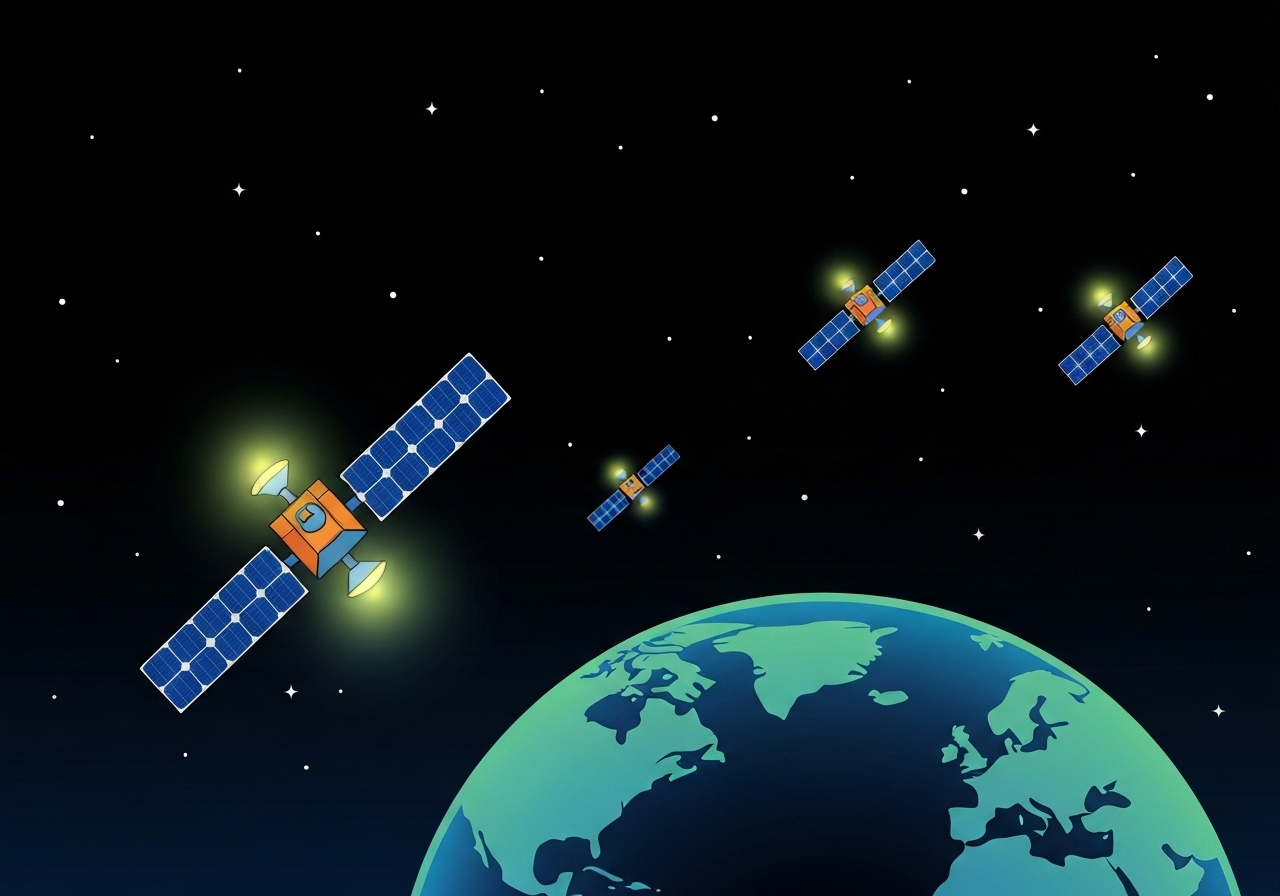
Because space lacks an intervening atmosphere, the researchers argue thermoradiative diodes could fare much better on satellites. In low Earth orbit many small satellites experience roughly 45 minutes of sunlight followed by 45 minutes of darkness; traditional solar panels only produce power when illuminated, and batteries must supply energy during eclipses. The diode concept would let spacecraft harness heat absorbed during sunlight and convert it to electricity as that heat radiates into the cold of space during darkness, providing auxiliary power from surfaces that otherwise go unused.
UNSW is moving toward an in-situ demonstration: the team has planned a high-altitude balloon flight this year to expose their device to a near-space environment and measure performance without the filtering effects of the lower atmosphere. The project has attracted external interest and funding, notably from the United States Air Force, to refine materials and scale the diode for potential use on low-orbit platforms.
Separately, NASA scientists including Dr Geoffrey Landis and Dr Stephen Polly are exploring complementary avenues. Landis notes that for low-orbit outages the diode would need to be extremely low-cost to compete with cheap batteries, but he and Polly see stronger promise for deep-space probes and lunar rovers operating in permanently shadowed regions where conventional solar power is unavailable.
Analysis & Implications
On Earth the fundamental limit for thermoradiative diodes is the modest temperature differential between a sun-warmed surface and the night sky after atmospheric absorption. That physics constrains practical power density to very low values, meaning Earth-bound uses are likely niche. The UNSW team’s focus therefore shifts toward orbital and deep-space niches where the sky acts effectively as a near-absolute- zero heat sink and the thermal gradient can be far larger.
For satellites in low Earth orbit the diode’s principal value would be auxiliary power and better use of unused exterior surfaces. Modern space engineering emphasizes smaller, lighter satellites flying lower while retaining capabilities of larger craft; a thin panel of thermoradiative diodes could provide steady trickle power during eclipse, reducing battery draw and possibly allowing smaller energy storage. Yet the diode does not replace solar arrays — it complements them.
Deep-space applications are more transformative but also more technically demanding. Missions beyond the inner solar system and probes into permanently shadowed lunar craters now rely on radioisotope thermoelectric generators (RTGs) that convert heat from decaying isotopes like plutonium into electricity. These RTGs are heavy (on the order of 45 kilograms) and volumetric, and plutonium is costly and scarce. Thermoradiative panels, if coupled to an isotope heat source, could be much lighter and simpler per watt delivered, stretching scarce isotope supplies to power more missions.
However, material resilience is a major open challenge. Current thermoradiative semiconductors derive from night-vision materials and have not been widely tested at the high temperatures associated with radioisotope heat sources. Existing RTG systems operate at roughly 540° or 1,000° Celsius (1,004° and 1,832° Fahrenheit), and long-duration missions demand decades of reliability. NASA researchers are therefore investigating new materials and testing protocols to determine whether thermoradiative cells can survive and remain efficient at elevated temperatures.
Comparison & Data
| System | Representative power density | Primary environment |
|---|---|---|
| Thermoradiative diode (current, Earth) | ≈1 W/m² (optimal) | Earth night-side (atmosphere present) |
| Conventional solar panel (typical) | tens–hundreds W/m² | Direct sunlight |
| Radioisotope Thermoelectric Generator (RTG) | High power per unit (heavy, voluminous) | Deep-space / shadowed regions |
The table highlights the scale gap on Earth between current thermoradiative diodes and standard photovoltaics. In space, the effective radiative sink is far colder, which increases the potential power density of thermoradiative devices, though exact gains depend on device design, emissivity, and operating temperature. For deep-space probes the mass and material trade-offs versus RTGs will determine whether thermoradiative architectures are competitive.
Reactions & Quotes
Project leaders emphasize the novelty and potential while acknowledging current limits and engineering hurdles.
“We’re developing devices that generate electricity by emitting light instead of absorbing it — it’s like a reverse solar panel,”
Jamie Hanson, UNSW postgraduate researcher
UNSW’s team lead frames the space opportunity succinctly, noting the Earth seen through an infrared camera appears to glow because it radiates heat into the cold universe.
“The Earth is radiating heat out into the cold universe,”
Prof. Ned Ekins-Daukes, UNSW
NASA experts welcome the idea for certain missions but stress cost and materials concerns.
“Batteries are cheap — for low-Earth-orbit eclipse periods, a diode would only be attractive at very, very low cost,”
Dr Geoffrey Landis, NASA John Glenn Research Center
Unconfirmed
- The outcome of the planned balloon test flight this year is not yet known; performance measurements and engineering lessons will determine next steps.
- Cost comparisons between deploying diode panels and simply enlarging battery capacity for low-Earth satellites remain preliminary and unproven.
- Long-term semiconductor durability at RTG-level temperatures and under prolonged space radiation exposure is not yet established.
Bottom Line
Thermoradiative diodes offer a conceptually attractive route to harvest the night-side thermal emission of planets or waste heat from spacecraft, reversing the usual photovoltaic approach. On Earth, atmospheric absorption and limited thermal contrast cap practical output to very low power densities, so near-term terrestrial uses are limited. In space, however, the cold of the universe increases the available temperature differential and opens realistic niches: auxiliary power on low-orbit satellites and potential replacement or augmentation of heavy RTGs for certain deep-space or permanently shadowed lunar missions.
Significant engineering work remains. Teams must improve device efficiency, reduce cost, prove long-term material stability at high temperatures, and demonstrate net mission-level benefit versus batteries and established RTG systems. The next 3–10 years of balloon tests, material research, and prototype satellite trials will determine whether thermoradiative diodes move from laboratory curiosity to a practical tool for space exploration.