
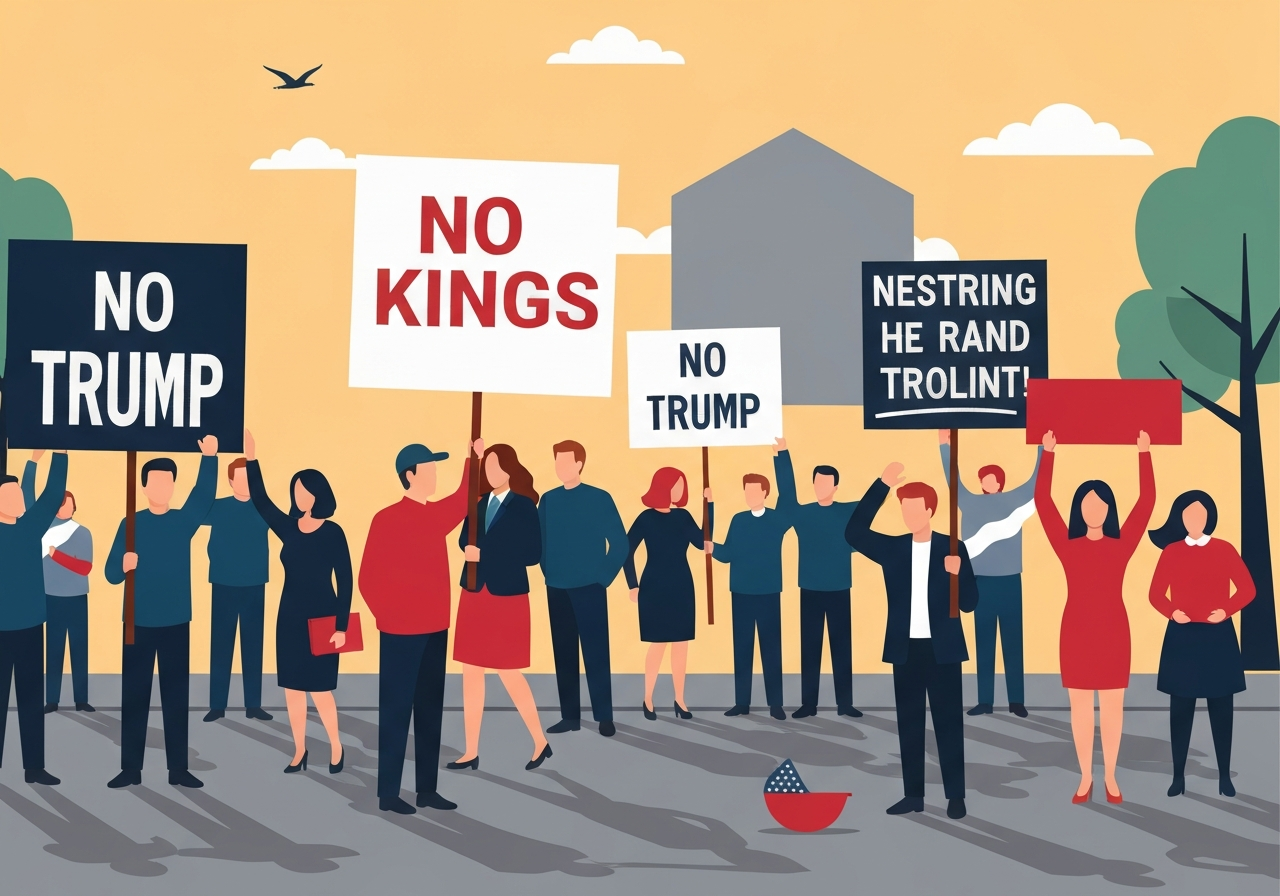
On March 28, 2026, thousands of demonstrators gathered at loosely coordinated “No Kings” rallies across the United States and in several international cities to denounce President Trump and elements of his second-term agenda. The largest concentrations appeared in the Twin Cities, where crowds gathered at the Minnesota State Capitol, and in Little Rock, Ark., where more than 2,000 marchers crossed the Arkansas River. Protesters voiced opposition to mass deportations, voting restrictions, attacks on diversity and — newly prominent — the war in Iran and rising gasoline prices linked to it. Organizers said there were thousands of U.S. events and 39 international rallies; local attendance figures varied by site.
Key Takeaways
- Dates and scope: Demonstrations took place on March 28, 2026, with thousands of U.S. participants and organizers reporting 39 international sister rallies.
- Major locations: Significant gatherings were reported in the Twin Cities (St. Paul/Minneapolis), Little Rock (2,000+ marchers), Portland, and as far north as Kotzebue, Alaska.
- Main issues: Protesters highlighted immigration crackdowns and policies they view as anti-democratic, while the war in Iran and higher gas prices emerged as prominent new grievances.
- Demographics: Rallies drew a mix of long-time activists, unaffiliated voters, and local residents; some demonstrations featured theatrical elements and partisan signage.
- Public posture: Most events were peaceful and civic in tone; there were localized traffic disruptions as marchers occupied intersections and public squares.
- Media access: Coverage included national and local press; some reporting was behind paywalls, and organizer-provided tallies of turnout have not been independently verified at every site.
Background
The “No Kings” demonstrations are part of a series of loosely coordinated protests that have recurred since the start of President Trump’s second term, drawing citizens concerned about perceived threats to democratic norms. Organizers have emphasized decentralized planning, asking local groups to stage marches and teach-ins focused on issues ranging from immigration policy to voting access. Recent moves by federal immigration authorities and high-profile enforcement actions in Minnesota intensified local anger, making the Twin Cities a focal point for the March 28 events.
Nationally, economic pressure from international tensions — notably the war in Iran — has translated into consumer concerns as gasoline prices rose, pushing energy costs onto the list of protest grievances. Past demonstrations in this series have varied widely in size and tone, reflecting the broad coalition of labor groups, civil-rights organizations, and unaffiliated citizens who comprise the movement. Authorities in many cities coordinated temporarily with organizers to manage street closures and public safety while allowing protesters to assemble.
Main Event
In St. Paul and Minneapolis, demonstrators filled the State Capitol grounds and surrounding streets, invoking local names and incidents that have driven recent mobilization. Participants carried signs and effigies, and some used theatrical props to draw attention to perceived excesses in immigration enforcement. Organizers said events began with speeches and devolved into coordinated marches that moved through key intersections, creating traffic disruptions but no large-scale clashes with law enforcement.
Portland saw demonstrators gather at multiple intersections, where speakers warned of what one participant called a “national crisis” of democratic erosion. In Little Rock, a march of more than 2,000 people crossed the Arkansas River and attracted media attention for its size and the presence of both partisan and theatrical signage. In Kotzebue, Alaska — a town above the Arctic Circle with roughly 3,000 residents — a local demonstration underscored how widely the protests had spread geographically.
Across many sites, speakers and signs linked the domestic agenda to foreign policy: the war in Iran was repeatedly named as a proximate cause of economic strain reflected in higher gas prices. Local participants described the rallies as a way to make visible their grievances and to pressure elected officials to alter course on deportation policies, voting rules, and diplomatic strategy.
Analysis & Implications
The immediate political effect of these demonstrations will depend on whether they sustain turnout and translate into organized pressure on lawmakers. Mass street protests can reshape political conversation by elevating issues — in this case immigration enforcement and energy prices tied to the Iran conflict — but converting public energy into policy change typically requires sustained organizing and targeted campaigns. For now, the rallies signal broad public frustration rather than a direct legislative lever.
Economically, linking the war in Iran to rising gasoline prices is consistent with market responses to geopolitical risk; however, attributing specific price movements to one factor oversimplifies a complex supply-and-demand picture that includes global oil production, refining capacity, and market speculation. Political actors may nonetheless find it easier to point to an external event like the Iran war when framing domestic economic pain for voters.
On the legal and administrative front, the protests put local and state officials under pressure to explain recent immigration enforcement actions and to clarify whether those practices reflect federal directives or local implementation choices. In Minnesota, where enforcement actions were cited as a catalyst for the rallies, lawmakers and agencies may face heightened scrutiny and calls for hearings or policy reviews.
Comparison & Data
| Location | Notable detail | Reported attendance |
|---|---|---|
| Twin Cities (St. Paul/Minneapolis) | State Capitol convergence; local names invoked | Thousands (site totals varied) |
| Little Rock, Ark. | March across Arkansas River; mixed signage | 2,000+ |
| Kotzebue, Alaska | Town above Arctic Circle; local turnout | Not specified (town population ~3,000) |
| Puerto Rico | Demonstrations reach U.S. territory | Not specified |
The table highlights reported scale and notable features where data were available. National organizers’ claim of thousands of U.S. participants and 39 international rallies provides a headline figure, but granular verification at each site remains incomplete. Where attendance figures are precise (for example, Little Rock’s 2,000+ marchers), local reporting or organizer counts were cited.
Reactions & Quotes
“Prices are going up, and it feels like we can’t even afford to live anymore.”
John Moes, Minneapolis resident
Mr. Moes, who described himself as an independent leaning Democratic, was one of many participants who tied personal economic strain to broader complaints about administration policy. His use of a 15-foot puppetlike costume referencing a local cultural icon drew attention from other marchers and media covering the event.
“Morons Are Governing America.”
Protester carrying a MAGA-style sign, Little Rock
The blunt sign slogan in Little Rock underscored the sharply partisan tone of some participants even as many rallies were framed as collective civic protest. Organizers emphasized decentralization and local control of marches, while some city officials focused messaging on ensuring peaceful assembly and minimizing disruptions.
Unconfirmed
- Comprehensive turnout: A complete, independently verified national headcount for March 28 is not available; organizer tallies and media estimates differ by site.
- Direct policy impact: Whether these rallies will directly change specific federal policies on immigration or energy is not established and would require sustained follow-up organizing.
Bottom Line
The March 28 “No Kings” demonstrations made clear that concerns about immigration enforcement, voting access, and the domestic costs of foreign conflict — particularly the war in Iran and its effect on fuel prices — have become mobilizing grievances for a wide range of Americans. While the protests were broadly peaceful and varied in size, their geographic spread from Kotzebue, Alaska, to Puerto Rico shows the depth of engagement on these topics.
For the political future, the key question is whether organizers convert episodic demonstrations into sustained pressure that can influence lawmakers or electoral outcomes. In the near term, expect continued public scrutiny of immigration enforcement in Minnesota and heightened political debate over how international events are affecting household budgets at home.
Sources
- The New York Times (media — paywalled)